
Plastic Waste EPR Registration: Who Needs It & How to Apply Online in India
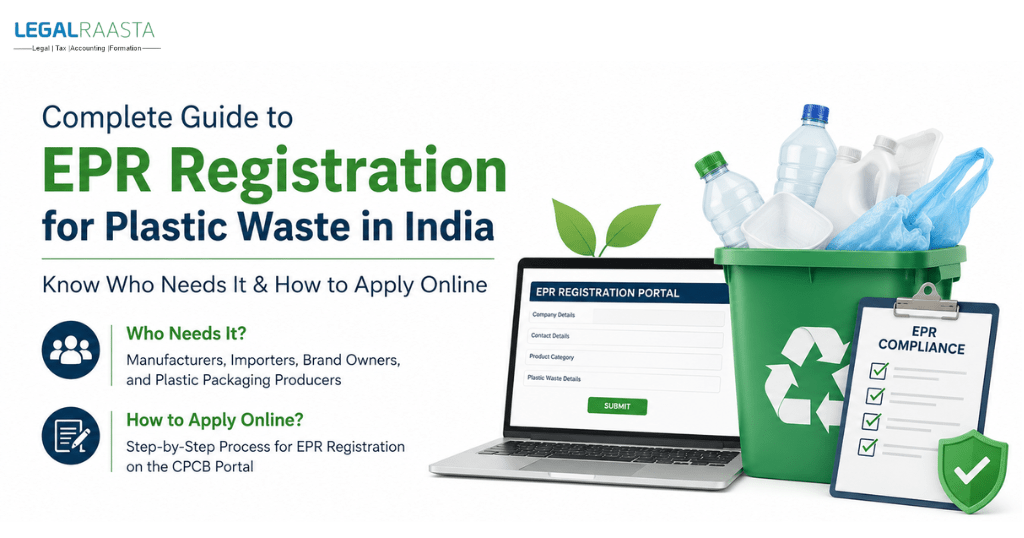
Most businesses selling packaged goods in India are unknowingly violating the law — and the penalty isn’t just a fine, it’s a complete ban on production. That’s the reality since the Plastic Waste Management Rules in India were tightened in 2022. The government isn’t sending reminders. They’re sending notices. And if you’re a brand, importer, or manufacturer using any form of plastic packaging, Plastic Waste EPR Registration is no longer optional — it’s the law.
This article breaks down exactly who needs to register, why it matters, and how the process works — without the legal jargon that makes everyone’s eyes glaze over.
What Is Plastic Waste EPR Registration and Why Does It Exist?
EPR stands for Extended Producer Responsibility. In plain English, the government is saying: if you put plastic into the market, you’re responsible for taking it back.
Plastic Waste EPR Registration is the mandatory compliance process through which producers, importers, and brand owners (PIBOs) formally register on the Central Pollution Control Board (CPCB) EPR portal and commit to collecting and processing plastic waste equal to what they introduce into the market.
The framework was first introduced under the Plastic Waste Management Rules, 2016, but the real enforcement teeth came in 2022 when CPCB made online registration mandatory and started actively auditing compliance. Since then, thousands of businesses have scrambled to get their EPR plastic certificate in order — many of them far too late.
The philosophy behind it is sound: India generates over 3.5 million metric tonnes of plastic waste annually, and a large chunk of it ends up in rivers, landfills, and oceans. EPR puts the financial and operational burden of managing that waste on the businesses that profit from plastic — not on the public.
The Four Categories of Plastic Waste EPR Registration
The CPCB has divided plastic packaging into four categories for compliance purposes:
1st Category — Rigid plastic packaging (bottles, containers, jars)
2nd Category — Flexible plastic packaging (pouches, covers, wraps)
3rd Category — Multi-layered plastic, including laminates
4th Category — Plastic sheets and carry bags
Each category carries different targets for collection and recycling, and your EPR obligations are calculated based on the tonnage of plastic packaging and plastic you introduce into the market annually.
Who Exactly Needs Plastic Waste EPR Registration? (Be Honest With Yourself Here)
This is where most businesses get confused — or conveniently tell themselves the rules don’t apply to them. Let’s be clear.
Under the Plastic Waste Management Rules of India, three types of entities are legally required to register:
- Producers — Any person or company that manufactures plastic packaging material or products.
- Importers — Any entity that imports plastic-packaged goods into India, including e-commerce sellers importing products.
- Brand Owners — Any business selling products under their brand name in plastic packaging — this is the big one that catches most companies off guard.
So, if you run a D2C brand selling skincare products in plastic bottles? You need it. If you import electronics packaged in plastic bubble wrap? You need it. Do you manufacture FMCG goods in flexible pouches? Absolutely, you need it.
The threshold isn’t about your company size or revenue — it’s about whether plastic packaging touches your business in any commercial way.
There is no minimum turnover exemption. Small businesses and startups are equally liable.
Step-by-Step: How to Apply for Plastic Waste EPR Registration Online
The good news is that the government has centralised the entire process on the CPCB EPR portal. The not-so-good news is that the portal has its quirks, and a single documentation error can delay your EPR plastic certificate by weeks.
Here’s how the process flows from start to finish:
1st Step: Account Creation on the EPR Portal — Register as a Producer, Importer, or Brand Owner on the CPCB platform. Keep your GST and PAN handy.
2nd Step: Business Profile Setup — Enter your company details, registered address, CIN/LLPIN, and nature of plastic packaging activity.
3rd Step: Plastic Packaging Data Declaration — Declare the quantity (in metric tonnes) of each category of plastic packaging and plastic you’ve introduced into the market in the last financial year, or your projected quantity.
4th Step: EPR Action Plan Submission — Submit your plan for how you intend to meet your recycling targets — through tie-ups with recyclers, PROs (Producer Responsibility Organisations), or your own collection infrastructure.
5th Step: Document Upload — Upload GST certificate, certificate of incorporation, PAN card, authorised signatory ID, and your plastic packaging details.
6th Step: CPCB Review & Certificate Issuance — Once CPCB reviews and approves your application, you receive your EPR certificate, which serves as your proof of compliance.
The entire process, if done correctly with complete documentation, typically takes 15–30 working days. Errors, missing documents, or a mismatch in plastic data can significantly extend this.
Documents You’ll Need for Plastic Waste EPR Registration (Don’t Miss These)
One of the most common reasons applications get stuck is incomplete or mismatched documentation. Here’s what you need to keep ready before you even log into the EPR portal:
- GST Registration Certificate
- Certificate of Incorporation / Partnership Deed / LLPIN
- PAN Card of the Company
- Aadhaar / PAN of Authorised Signatory
- Board Resolution / Authorisation Letter
- Details of plastic packaging used — category-wise and quantity-wise
- Agreement with a registered PRO or recycler (if applicable)
- Previous year’s plastic data / projected data for new businesses
Pro tip: Many businesses make the mistake of entering plastic quantity in kilograms instead of metric tonnes on the portal, which causes a mismatch and rejection. Always verify units before submitting.
EPR Annual Compliance: Registration Is Just the Beginning
Here’s the part most businesses overlook: getting your EPR plastic certificate is not a one-time checkbox. The real responsibility starts after registration.
Under EPR annual compliance, every registered entity must:
File Annual Returns — Submit your annual EPR return on the CPCB EPR portal by the due date, disclosing the actual quantities of plastic introduced and those collected and recycled.
Meet Recycling Targets — CPCB sets year-wise recycling targets (currently scaling up to 100% by 2025–26). If you miss targets, you must purchase EPR credits to offset the shortfall.
Maintain Records — Keep documentation of all plastic transactions — purchase invoices, recycler agreements, and tonnage certificates — for auditing.
Renew and Update Profile — If your plastic usage changes significantly (new product lines, new packaging formats), you must update your profile on the EPR portal accordingly.
Non-compliance with EPR annual compliance attracts penalties under the Environment Protection Act, and repeated violations can result in production shutdowns. CPCB has already issued show-cause notices to hundreds of companies in the last two years.
Think of it this way: the EPR certificate gets you in the door. Annual compliance keeps you from getting thrown out.
Penalties for Non-Compliance & Why Plastic Waste EPR Registration Can’t Wait
Let’s talk about what actually happens if you ignore Plastic Waste EPR Registration. Because ‘I didn’t know’ is not a defence that holds up before CPCB.
Under the Environment Protection Act, 1986, and the Plastic Waste Management Rules of India, penalties include:
Financial Penalties — CPCB can impose an Environmental Compensation (EC) charge proportional to the quantity of plastic for which you failed to meet EPR targets.
Production Stoppage — Persistent non-compliance can lead to orders to halt manufacturing or import activities.
Criminal Liability — Willful non-compliance can attract imprisonment of up to 5 years under Section 15 of the Environment Protection Act.
Reputational Risk — CPCB publishes lists of non-compliant companies. For D2C and FMCG brands, this kind of public exposure can seriously damage consumer trust.
The enforcement has been escalating year over year. In FY 2023–24, CPCB significantly ramped up audits on e-commerce sellers and FMCG brands specifically. FY 2025–26 targets are the most aggressive yet, with recycling obligations approaching 100% for most plastic categories.
Beyond penalties, there’s a business case here. Retailers, e-commerce platforms, and institutional buyers are increasingly demanding EPR compliance documentation before onboarding new suppliers. Not having an EPR plastic certificate is starting to cost businesses contracts, not just penalties.
Bottom Line: Where Do You Stand?
Plastic Waste EPR Registration isn’t a bureaucratic formality. It’s a fundamental shift in how India holds businesses accountable for environmental impact — and it’s not going away.
If your business uses plastic packaging in any form, here’s what you need to do right now: assess your plastic usage category-wise, determine your EPR targets, get registered on the CPCB EPR portal, and set up a system to meet your EPR annual compliance every year.
The registration process is manageable. The documentation is achievable. And the long-term cost of compliance is far lower than the cost of being caught without it.
If you’re unsure where your business stands or need expert help navigating the EPR portal and documentation process, LegalRaasta’s compliance team handles end-to-end Plastic Waste EPR Registration across all business types — from D2C startups to large-scale importers.

Related Posts
Our Clients







Featured In