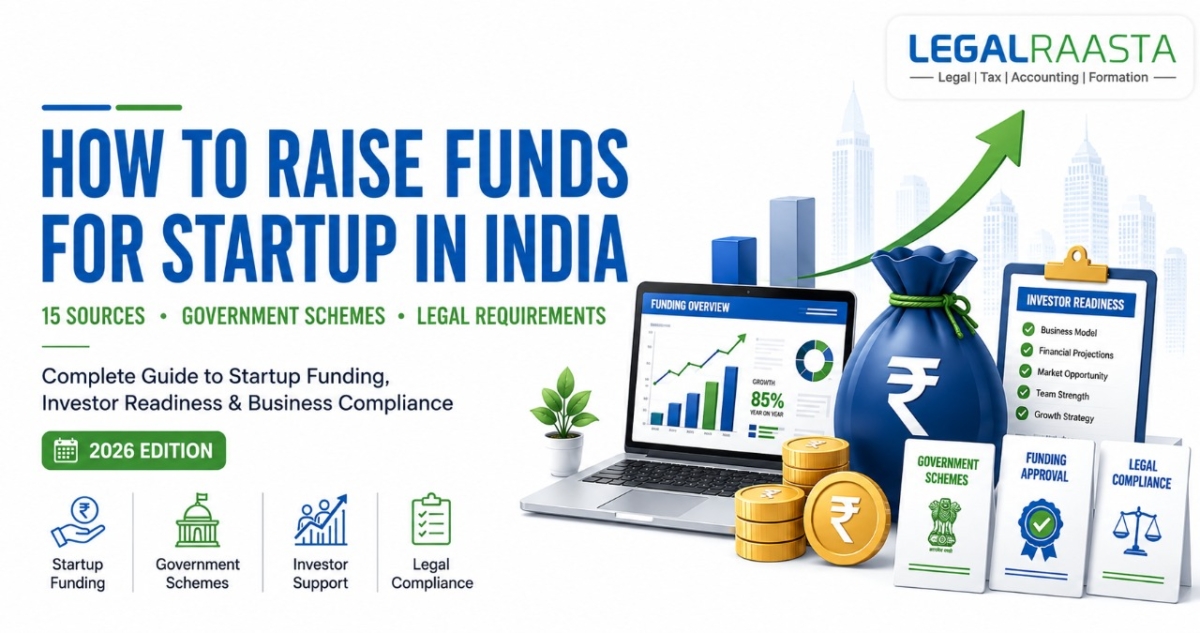
How to Raise Startup Funding in India: 15 Sources, Schemes & Legal Needs (2026)
Most Indian founders do not fail because their idea was bad. They fail because they ran out of money before they could prove it was good.
Knowing how to raise funds for a startup in India is not just useful; it is probably the most important practical skill you will build as a founder. India now has over 100 unicorns, more than Rs 2 lakh crore in startup funding deployed over the last five years, and a government that is genuinely trying to make early-stage capital easier to access. But none of that automatically flows to you. You have to go get it, and you have to show up prepared.
This guide covers all 15 startup funding sources available in India in 2026, the government schemes most founders never apply for, the legal groundwork investors will check before writing a cheque, and the mistakes that quietly kill fundraising rounds before they even begin.
LegalRaasta helps startups get investor-ready, from company registration and DPIIT recognition to shareholder agreements and compliance, so nothing blocks your funding round.
Startup Funding Stages in India: Know Where You Stand
Before you approach anyone for money, understand which stage your startup is at. Every funding stage has a different investor type, different cheque size, and different things they expect to see.
|
Stage |
Typical Amount |
Who Invests |
What They Want to See |
|
Pre-Seed |
Rs 5 lakh to Rs 50 lakh |
Founders, family, friends |
Idea validation, basic MVP |
|
Seed |
Rs 50 lakh to Rs 5 crore |
Angel investors, angel networks |
Product, early customers, traction |
|
Series A |
Rs 5 crore to Rs 50 crore |
VC funds |
Proven unit economics, growing revenue |
|
Series B |
Rs 50 crore to Rs 250 crore |
VC and PE funds |
Expansion, strong team, market position |
|
Series C and beyond |
Rs 250 crore+ |
Late-stage VC, PE, sovereign funds |
Market leadership, pre-IPO readiness |
15 Startup Funding Sources in India (2026)
The 15 funding options for Indian startups, ranging from government grants to venture capital, structured by growth stage and equity requirements.
1. Bootstrapping
Funding your startup from personal savings or early revenue. No dilution, full control. Zoho and Zerodha both scaled significantly before taking external money. Best for founders with savings or a revenue-generating product from the start.
2. Friends and Family
The first external capital most founders raise, usually Rs 2 lakh to Rs 25 lakh from people who believe in you personally. Even this needs proper legal documentation. Undocumented equity promises create cap table problems that block future rounds.
3. Angel Investors
High-net-worth individuals investing their own money at the seed stage. Networks like Indian Angel Network, Mumbai Angels, Lead Angels, and LetsVenture connect startups with angel investors across sectors. Typical cheque size is Rs 10 lakh to Rs 1 crore per angel, and Rs 50 lakh to Rs 5 crore for syndicates.
4. Venture Capital
Institutional funds that invest from seed to growth stage. Sequoia India, Accel, Nexus, Elevation Capital, and Kalaari are among the most active. VC funding comes with mentorship and network access alongside higher dilution and governance requirements. You need a private limited company, audited financials, and strong unit economics before most VCs will engage seriously.
5. Startup India Seed Fund Scheme (SISFS)
A government grant providing up to Rs 50 lakh for proof of concept and prototype, and up to Rs 1.5 crore for market entry through convertible debentures. Available only to DPIIT-recognised startups through approved incubators. Applications go through startupindia.gov.in. Massively underutilised by founders who do not know it exists.
6. Bank Loans
Traditional bank loans work best for asset-heavy businesses with predictable revenues. Not ideal for tech startups without collateral, but useful for manufacturing, logistics, and food businesses that can service debt from early cash flows.
7. MUDRA Loans
Pradhan Mantri MUDRA Yojana offers loans from Rs 50,000 to Rs 20 lakh under three categories: Shishu, Kishor, and Tarun. No collateral required for smaller amounts. Available through any scheduled commercial bank. Good for micro and small businesses at the earliest stage.
8. SIDBI Funding
Small Industries Development Bank of India provides direct loans, guarantees, and refinancing to MSMEs and startups. SIDBI also manages the Rs 10,000 crore Fund of Funds for Startups, which invests in SEBI-registered AIFs that then invest in Indian startups.
9. Equity Crowdfunding
SEBI-regulated platforms like Tyke allow startups to raise Rs 50 lakh to Rs 5 crore from a large number of small investors. Works best for B2C startups with strong communities where customers can also become shareholders.
10. Startup Incubators
Incubators provide funding of Rs 5 lakh to Rs 5 crore alongside office space, mentors, and structured support, typically in exchange for 2 to 8% equity. IIM Ahmedabad’s CIIE, IIM Bangalore’s NSRCEL, and T-Hub are among the most respected in India.
11. Startup Accelerators
Programs like Y Combinator, 100X.VC, and Venture Catalysts run 3 to 6-month intensive programs with funding and investor access. Great for founders at the idea or early MVP stage who need structured support and introductions more than just capital.
12. Corporate Venture Capital (CVC)
Investment arms of large corporations like Tata, Mahindra, Reliance, and Infosys that invest in startups with strategic fit. Cheques range from Rs 2 crore to Rs 100 crore. You get credibility, distribution access, and sometimes a pilot contract alongside the investment. Watch for exclusivity clauses.
13. Government Grants and Subsidies
Beyond SISFS, the Atal Innovation Mission (AIM), Biotechnology Ignition Grant (BIG), and Stand-Up India scheme provide non-dilutive capital for specific sectors and founder profiles. Stand-Up India gives Rs 10 lakh to Rs 1 crore to SC/ST and women entrepreneurs for greenfield businesses.
14. Revenue-Based Financing
Platforms like Velocity, GetVantage, and Recur Club provide Rs 10 lakh to Rs 10 crore in exchange for a fixed percentage of monthly revenues until a repayment multiple is reached. No equity dilution. Best for D2C brands and SaaS companies with monthly revenues above Rs 10 lakh.
15. Strategic Partnerships and Joint Ventures
Large corporations sometimes provide capital, distribution, or resources through partnerships rather than straight equity investment. A joint venture with an established player can fund your growth while giving the partner strategic access to your technology or market.
Top Government Startup Funding Schemes in India (2026)
This table outlines India’s top government startup schemes, detailing funding amounts, eligibility rules, and application portals.
|
Scheme |
Maximum Amount |
Key Eligibility |
How to Apply |
|
Startup India Seed Fund (SISFS) |
Rs 1.5 crore |
DPIIT-recognised, under 2 years |
Via approved incubators at startupindia.gov.in |
|
Fund of Funds for Startups (FFS) |
Through AIFs |
SEBI-registered AIFs investing in startups |
VCs apply; benefits flow through VC investment |
|
MUDRA Yojana |
Rs 20 lakh |
Any micro or small business |
Any scheduled bank or MUDRA portal |
|
Stand-Up India |
Rs 1 crore |
SC/ST or women, greenfield enterprise |
standupmitra.in or banking network |
|
Atal Innovation Mission |
Grant and incubation |
Deep-tech and innovation startups |
aim.gov.in |
|
SIDBI Startup Mitra |
Rs 10 crore (debt) |
Revenue-generating DPIIT startups |
sidbi.in or SIDBI branch offices |
|
PMEGP Scheme |
Rs 50 lakh |
Manufacturing and service businesses |
kvic.gov.in |
Legal Requirements Before Raising Startup Funds in India
This is the part most founders skip until an investor asks for it and then panic. Get this right before you start outreach.
Private Limited Company Registration
Every equity investor in India- angel, VC, PE, or crowdfunding platform- requires you to be a private limited company. LLPs cannot issue shares. Partnerships have no share capital structure. Sole proprietorships have no separate legal existence. If you are not a Pvt Ltd, you cannot raise equity, full stop.
DPIIT Startup Recognition
Apply at startupindia.gov.in. It is free, takes 2 to 4 weeks, and unlocks the Section 80-IAC income tax holiday (3 years of zero income tax), angel tax exemption, SISFS access, and faster IP processing. No serious founder should skip this.
Clean Cap Table
Undocumented equity promises to co-founders, advisors, or early contributors will surface during due diligence and kill deals. Every share allotment must be backed by proper documentation and an MCA Form PAS-3 filing within 30 days.
Founders’ IP Assignment
All intellectual property created by founders must be formally assigned to the company. Investors will not fund a startup where core IP sits with individuals rather than the company entity.
Shareholder Agreement (SHA) and Share Subscription Agreement (SSA)
Once a term sheet is agreed, these binding documents govern the entire investment relationship. Key terms include anti-dilution protection, Right of First Refusal, drag-along and tag-along rights, board representation, and exit mechanics. Never negotiate these without a corporate lawyer reviewing every clause.
FEMA Compliance for Foreign Investment
If your investor is an NRI or a foreign entity, the investment requires FCGPR filing with the RBI. Missing this attracts serious FEMA penalties.
What Investors Actually Check Before Investing
Founders spend months perfecting pitch decks and almost no time preparing the things investors check first.
- Cap table: Who owns what, is it clean, are there undocumented shareholders
- Corporate documents: Incorporation certificate, MoA, AoA, board resolutions
- Audited financials: At least one year of clean audited accounts
- MIS reports: Monthly management information showing revenue, burn rate, and key metrics
- Customer contracts: Proof that revenue is real and contracted
- IP ownership: All IP formally assigned to the company
- Compliance status: GST filed, income tax filed, MCA annual returns filed, no defaults
A great pitch deck with a messy data room loses deals. Investors fund businesses that look like they are being run properly.
Common Mistakes Founders Make While Raising Startup Funds
- Approaching VCs at pre-seed stage: VCs back businesses with proven models. Go to angels and government schemes first.
- No DPIIT recognition before fundraising: You are leaving angel tax exemption and SISFS access on the table.
- Negotiating term sheets without a lawyer: The headline valuation is the least important number on a term sheet. The covenants, liquidation preferences, and anti-dilution mechanics matter far more long-term.
- Undocumented friends and family equity: Creates legal chaos when institutional investors run due diligence.
- Raising too little: Founders raise enough for 6 months and spend 4 of those months raising again. Raise 18 to 24 months of runway every time.
- Sending pitch decks cold: Warm introductions from portfolio founders or mutual connections have a dramatically higher conversion rate than cold LinkedIn messages to investors.
Why Choose LegalRaasta for Startup Fundraising Support
Getting investor-ready is not just about having a good product and a deck. The legal and compliance foundation is what separates fundable startups from ones that get passed on after due diligence.
LegalRaasta helps startups with:
- Private Limited Company registration
- DPIIT Startup Recognition
- Shareholders Agreement and Share Subscription Agreement drafting
- Cap table structuring and MCA Form PAS-3 filings
- FEMA compliance for foreign investment
- Trademark and IP assignment to company
- GST, income tax, and ROC compliance cleanup before fundraising
Conclusion
Raising startup funding in India in 2026 is more accessible than it has ever been. The government schemes are real and funded. The angel ecosystem is active. VCs are writing more cheques than ever across more sectors and cities.
But none of it comes to founders who are not prepared. Incorporate correctly. Get DPIIT recognition. Keep your financials clean. Build your product and show early traction. Then go to the right funding source for your stage with a clear ask and a clean data room.
The founders who raise are not always the ones with the best ideas. They are the ones who show up with the best preparation.
Connect with LegalRaasta today and get your startup legally ready for its first funding round.
Frequently Asked Questions
-
How do I raise startup funding in India as a first-time founder?
Start by incorporating as a private limited company and getting DPIIT recognition. Build an MVP, get early customers, then approach angels through networks like IAN or LetsVenture. For non-dilutive capital, apply for the startup funding scheme SISFS through an approved incubator at startupindia.gov.in.
-
What is the Startup India Seed Fund Scheme for startup funding?
SISFS provides up to Rs 50 lakh for proof of concept and up to Rs 1.5 crore for market entry to DPIIT-recognised startup funding applicants. It is a government grant with zero equity dilution. Applications go through approved incubators registered on startupindia.gov.in.
-
Can I raise startup funding without a private limited company?
No. Every equity investor requires a private limited company for startup funding. LLPs, partnerships, and sole proprietorships cannot issue shares. If you are in any other structure, convert before approaching any angel investor, VC, or crowdfunding platform.
-
What documents are needed to raise startup funding in India?
For startup funding, you need your Certificate of Incorporation, DPIIT recognition certificate, audited financials, clean cap table, IP assignment agreements, pitch deck, and a data room with key contracts. At closing, you need a term sheet, SHA, SSA, and MCA Form PAS-3 filing.
-
What is DPIIT recognition and why does it matter for startup funding?
DPIIT recognition is a free government certification that unlocks angel tax exemption, Section 80-IAC income tax holiday, and SISFS access. No serious startup funding round in India should begin without it. Apply at startupindia.gov.in in 2 to 4 weeks.
-
How much equity should I give angel investors in a startup funding round?
Typical angel startup funding rounds in India dilute founders by 10 to 25%. Try to keep total seed dilution below 25 to 30% so you retain enough equity for Series A. At a Rs 5 crore valuation, a Rs 1 crore investment equals 20% dilution.
-
What government schemes offer startup funding in India?
Key government startup funding schemes include SISFS (up to Rs 1.5 crore), MUDRA loans (up to Rs 20 lakh), Stand-Up India (up to Rs 1 crore for SC/ST and women founders), Atal Innovation Mission grants, and SIDBI Startup Mitra loans up to Rs 10 crore.
-
How long does a startup funding round take to close in India?
A seed startup funding round typically takes 3 to 6 months from first investor meeting to funds received. This includes pitching (4 to 8 weeks), term sheet negotiation (2 to 4 weeks), due diligence (2 to 6 weeks), and legal documentation (2 to 4 weeks). Being prepared shortens this considerably.
-
What is angel tax and how does it affect startup funding in India?
Angel tax under Section 56(2)(viib) taxes investments received above fair market value as income. DPIIT-recognised startups are fully exempt, making DPIIT recognition essential before any startup funding round. Non-recognised startups raising at premium valuations remain exposed to this tax.
-
How does revenue-based financing work as a startup funding option?
Revenue-based financing provides startup funding of Rs 10 lakh to Rs 10 crore with zero equity dilution. Repayment is a fixed percentage of monthly revenues until a 1.3x to 2x multiple is repaid. Platforms like Velocity and GetVantage offer this for startups with monthly revenues above Rs 10 lakh.

Related Posts
 Startup
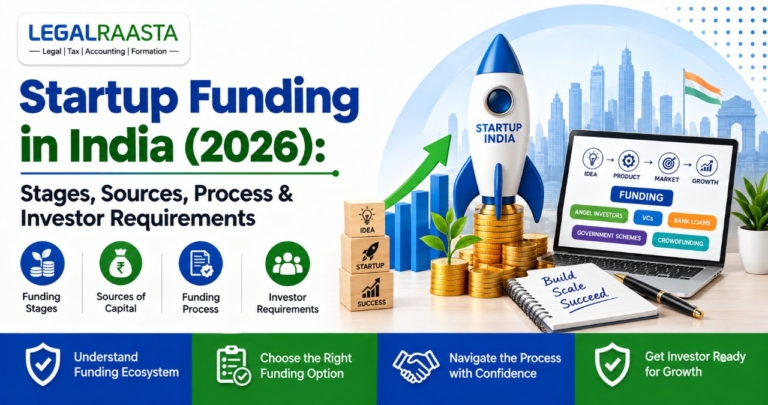
Startup Funding in India (2026): Stages, Sources, Process & Investor Requirements
Read More → Startup
Annual Compliance Checklist for Startups in India 2026: Due Dates, Filings, Penalties & Complete Guide
Read More →


Our Clients




Featured In