
Difference Between Statutory Company and Registered Company: Complete Guide (2026)
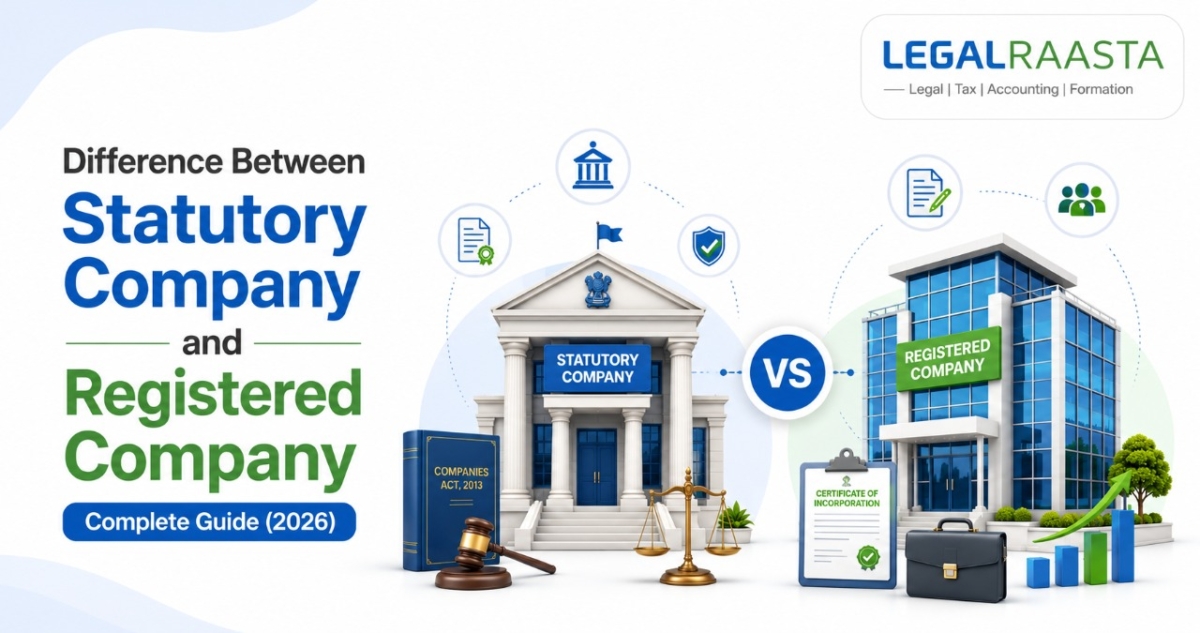
Bad decision-making in a business organization can get you stuck in a financial commitment, you could face huge penalties from the Government, and your growth would stall before even pitching to your first client. Starting a business involves certain complexities related to corporate law and legal jargon, which leaves it perplexed in India. Two terms are sometimes misinterpreted: statutory and registered company. Both are correct business organization forms, but they have entirely different rules, authorizations, and compliance routes.
The difference is clear between these two structures, and is something which is to be understood to make sure that your business or Startup is grounded on a solid, legally compliant basis. Strengthen your compliance process now, with LegalRaasta to make your corporate registration a seamless journey!
What Is a Statutory Company? Understanding the Legislative Blueprint
A statutory company is a company formed with the help of a special act made by the legislature of the state or the Parliament of India. These companies do not only simply register on a website of the Government or sign on some common forms, but are actually “birthed” by a law.
The Structural Pillars of Legislative Corporations
- Special Statute Incorporation: There is a separate statute for each of these entities (in the case of banks, the RBI Act or the LIC Act, etc.). Certain of its powers, objectives, and privileges are set out in this particular law.
- State Ownership and Funding: They are typically state-owned or are fully funded by the state to provide services for public interest sectors, such as finance, transport, and energy.
- Sovereign Immunities: They derive from parliament and can frequently have special legal privileges and financial support that are unavailable to normal private companies.
- Custom Financial Norms: Their audit norms are normally handled by the Comptroller and Auditor General of India (CAG) rather than private chartered accountants.
Key Features of a Statutory Company
- Autonomous Operations: They have a high comfort level of operational autonomy and are managed by a board of directors appointed directly by the government.
- Separate Legal Entity status: They can buy property, enter into contracts, and sue or be sued in their own name.
- Public Accountability: Their annual performance reports and audit sheets are presented directly on the floor of the Parliament or State Assembly for review.
What Is a Registered Company? The Standard Corporate Framework
A registered company is simply a business/company that is incorporated in accordance with the mandatory provisions of Section 176 of the Companies Act 2013 compliance requirements. This category encompasses most of the private limited companies, public limited companies, and one-person companies (OPCs) currently in existence in India.
The Core Mechanics of Registered Businesses
- MCA Portal Route: The companies are incorporated through the electronic filing of forms such as SPICe+ with the Ministry of Corporate Affairs (MCA) website.
- Supervision by the Registrar of Companies (RoC): They are directly supervised by the Registrar of Companies (RoC) of the respective state.
- Constitutional documents: All of its operation, scope, and internal management are controlled through two documents called the Memorandum of Association (MoA) and Articles of Association (AoA).
- Private Capital Sourcing: They can seek funding from private investors, the founding investor, or the general population through shares, where applicable (as they would with POs)
Key Features of a Registered Company
- Limited Liability Protection: If the business is facing heavy debts or liquidation, the personal assets of the shareholders are completely safe.
- Perpetual Succession: The business continues to exist after the change in ownership, retirement, or death of its owners, directors, or shareholders.
- Strict Regulatory Checklist: They should submit continuous financial returns, Balance Sheets, and Audits to RoC annually to keep their status active.
Difference Between Statutory Company and Registered Company
There is a basic distinction between a statutory company and a registered company in respect of the way in which they are established, who governs the rules that are to be adhered to in the course of their operations, and how the annual company compliance is conducted. A company that is established with the purpose of dealing in business or providing a service purpose that can be expanded in its operations and self-managed by private individuals or business entities is called a Registered company, while a company established for the purpose of maintaining the public utility or national infrastructure is called a Statutory company.
Comparative Analysis Matrix
|
Basis of Comparison |
Statutory Company |
Registered Company |
|
Method of Incorporation |
Created by passing a unique Special Act in Parliament or the State Assembly. |
Registered online through the MCA portal under the Companies Act, 2013. |
|
Governing Rules |
Governed strictly by the provisions of its specific legislative Act. |
Governed by the Companies Act, 2013, along with its MoA and AoA. |
|
Primary Objective |
Public welfare, social utility, and national infrastructure development. |
Earning profits, commercial trading, and building brand equity. |
|
Audit & Oversight |
is audited directly by the Comptroller and Auditor General of India (CAG). |
audited by independent, registered Chartered Accountants (CAs). |
|
Flexibility of Rules |
Changing operational rules requires an official legal amendment in Parliament. |
Rules can be modified easily by passing resolutions among shareholders. |
|
Common Examples |
Reserve Bank of India (RBI), Life Insurance Corporation (LIC), SBI. |
Reliance Industries, Infosys, or your local private limited startup. |
Implementation Workflows: How Both Structures Take Shape
For the practical working of these entities in the commercial scenario of India, let’s understand the developmental stages, the timelines, and the risk checklists of the structures.
Resource and Timeline Allocation Guide
|
Operational Phase |
Expected Duration |
Primary Bottleneck |
Mitigation Strategy |
|
Legislative Drafting / MCA Filing |
7 Days (Registered) vs 6+ Months (Statutory) |
Parliamentary debates or documentation errors on the MCA portal. |
Use standardized digital templates and clear business objectives. |
|
Capital Structuring & Allocation |
10 to 15 Days |
Delay in opening corporate bank accounts or verifying PAN/TAN data. |
Submit complete KYC paperwork of all promoting directors together. |
|
Annual Audit and Return Filings |
Ongoing Process (Yearly) |
Tracking input tax credits and reconciling monthly bank statements. |
Deploy automated accounting software and hire compliance experts. |
Risk Mitigation Checklist for Indian Corporate Bodies
- Structural risks: Do not do anything beyond what is stated in the MoA or legislative Act – anything unauthorized is legally null and void.
- Compliance Risks: Severe daily penalties on returns of the RoC filed late in April or when annual statistical reports are not submitted, as well as the government’s non-compliant list for unscheduled directors.
- Financial Risks: Maintain full separation between your personal bank accounts and your business accounts to ensure that your limited liability if subjected to an audit of your business.
Advantages Compared: Which Structure Wins?
Benefits of a Statutory Company
- Sovereign Trust Factor: These entities are heavily trusted by banks, international partners, and the community because they are supported by the Indian parliament.
- Financial Stability: They generally have direct access to government grants, capital investment funds, and public subsidies, so they are not exposed to market failures.
- Monopoly Advantage: Good systems of law give many governments special operating powers over essential industries (such as the economy of money or national transport), for which they do not attempt to compete in the private economy.
Benefits of a Registered Company
- Online Registration: A private limited business can be registered online within a couple of working days without getting any political approval.
- Easy Investor Funding: Angel Investors and Venture Capitalists prefer to invest in registered private companies because they can be easily bought and sold in the company, and shares can be transferred.
- Complete Management Freedom: The promoters can change the course of their business, start fresh product development, and alter internal procedures with little effort by simply approving a passing motion on the board.
How LegalRaasta Can Help You with Company Registration & Compliance
When running a business and continually dealing with sales and customer service, the difficult part is establishing and maintaining compliance. LegalRaasta removes the stress from the entire legal journey by handling your documentation, making portal filings, and acting for you with annual accounting issues. Every application is handled by a specialist staff that keeps you from ruining your application with Googling errors and from getting charged for inevitable penalties, rejected applications, and delayed applications.
Conclusion
Navigating Indian corporate law does not have to be a confusing journey if you understand the basic structures of the market. A statutory company, with its public utility and national infrastructure responsibilities, is a means of government, whereas the registered company, no matter its size, seems the best vehicle for private enterprise and startup growth. When you align your business objectives with the right corporate entity and have good compliance routines, you secure your investments and create a business that’s ready for long-term growth.
Your attention and effort are on full display when you start a business and manage it. Effortlessly pace your growth and safeguard your operational future by joining the race of LegalRaasta for all your company registration and tax-related formalities.
Frequently Asked Questions (FAQs)
-
What is the main difference between statutory company and registered company models?
Statutory company vs registered company structures are basically the two; they differ in their scope and fundamental nature. The statutory body is established by a specific Act of Parliament, and a registered business gets incorporated via the MCA portal through the normal process as provided for under the Companies Act 2013.
-
Can a private entrepreneur set up a new statutory company in India?
No, a person is not the one who can make a company directly, including using the statutory company meaning framework. They are set up by only the central government or state government for managing state assets, national assets, critical public utilities, etc., or for managing any significant financial system, such as the RBI.
-
What are the key registered company features that attract startup investors?
The most sought-after features of a registered company are perpetual succession, ease of designing a share capital, and protection of limited liability. These structural advantages make it substantially easier for the founders to get funding from small-scale investors like private equity funds as well as angel investors.
-
How does Companies Act 2013 compliance apply to legislative corporations?
In general, the compliance rules of the Companies Act 2013 are not applicable against a statutory body if they conflict with any particular Act of Parliament. The special rules contained in its freedom of contract legislation always prevail over the general rules of the corporation.
-
Which business model shows the highest level of structural operational flexibility?
The registered business model offers much higher flexibility than any entity based on the difference between statutory company and registered company attributes. The Art of Association allows registered and existing businesses to modify business decisions rapidly without having to vote in parliament.
-
What are the most common types of corporate bodies in India today?
In India, the most apparent forms of corporate entities are statutory corporations, registered public limited companies, private limited companies, and one-person companies. There are two different types that can cater to the needs of different commercial sectors, which range from small businesses to large public sector undertakings.
-
Who handles the annual financial audits for large public statutory corporations?
A statutory corporation is audited under the strict supervision of the Comptroller and Auditor General of India, as opposed to private companies, which employ private auditors. The excessive auditing system guarantees the transparency of public funds spent.
-
What happens if a registered business fails to file its annual RoC returns?
The consequences of not achieving Companies Act 2013 compliance are significant, including daily fines with financial penalties of up to £15,000. The Registrar of Companies may be at liberty to remove the business name from the register of companies and may disqualify directors for continued non-compliance, if continued for too long.
-
Can a registered firm convert into a statutory corporation down the line?
No, it cannot simply be converted into an ordinary business. It is essential to make it a legislative entity by introducing a special bill in Parliament to assume its work, as was done with major types of corporate bodies in India, such as nationalized banks.
-
Why is the difference between statutory company and registered company vital for business owners?
The distinction between statutory company and registered company frameworks is important to understand, and can help business owners determine the appropriate legal action. It ensures that they are not wasting time by looking at complex options in legislation, if the commercial requirements could be served by a standard private limited registration.

Related Posts
Form INC-20A Filing (2026): What Happens If You Start a Business Without It?
Read More →
 Company Registration
NRI Company Registration in India 2026: Complete FEMA, FDI & RBI Compliance Guide
Read More → Company Registration
How to Start a Pharma Company in India: Registration & Licensing Guide 2026
Read More →

Our Clients







Featured In