CDSCO Registration for Orthopedic and Implantable Medical Devices in India
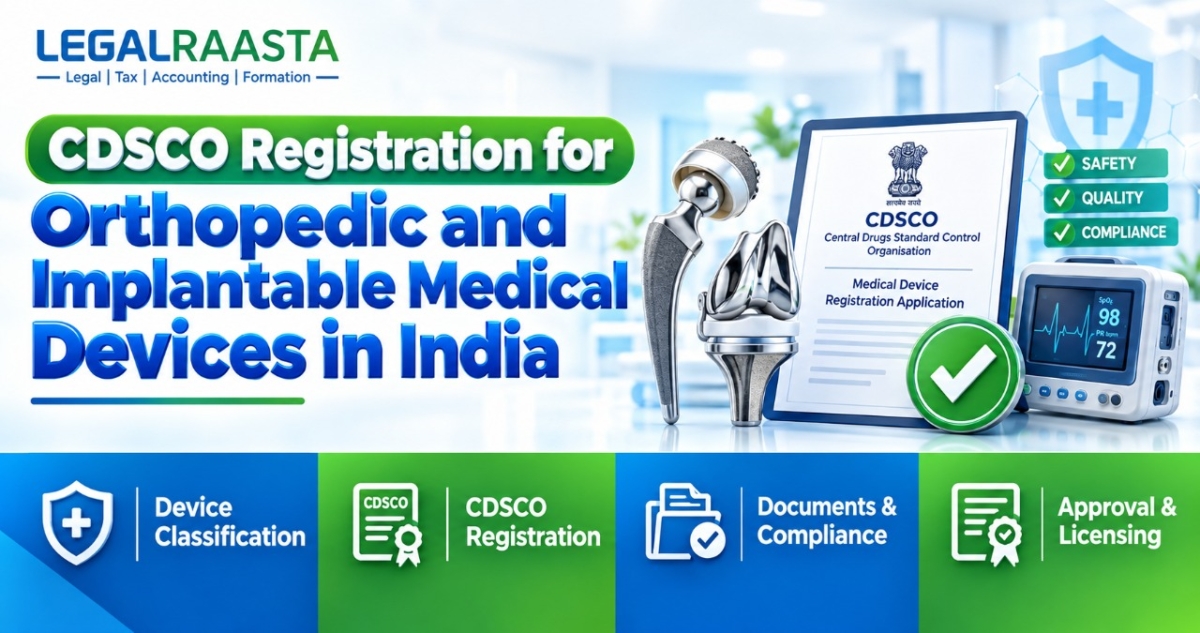
Selling bone plates or joint replacements in India means you must deal with the government first. The rules are strict. You cannot just launch these products in the open market. Getting CDSCO Registration for Orthopedic and Implantable Medical Devices is a mandatory legal step. The government classifies these products as moderate to high risk. A faulty bone screw can cause severe harm. Therefore, the regulatory authorities check everything from your factory setup to your final packaging. The CDSCO strictly monitors every single medical product sold in the country. Let us look at the exact steps to get this compliance sorted without facing rejections. Accelerate your growth and protect your operational future effortlessly with LegalRaasta.
Quick Answer / At a Glance
|
Requirement |
Details |
|
Registration Authority |
|
|
Application Portal |
Official SUGAM portal |
|
Core Documents |
ISO 13485 certificate, Device Master File, Plant Master File |
|
Government Fees |
₹50,000 per site and ₹1,000 per distinct device |
|
Processing Time |
4 to 6 months |
|
Eligibility |
Local manufacturers and official Indian importers |
What Is CDSCO Registration for Orthopedic and Implantable Medical Devices?
This registration is a formal approval given by the Indian government. It allows a business to legally make or import surgical implants. A medical device placed inside the human body requires intense scrutiny. The registration process verifies that your products are safe for patients. It also confirms that your manufacturing unit follows global quality standards. Without this specific license, you cannot sell your products to hospitals or clinics. The registration acts as a shield for public health.
Overview of Orthopedic and Implantable Medical Devices
Orthopedic devices support or replace damaged bones and joints. Surgeons rely heavily on these products during major operations. They stay inside the body for months or even permanently.
Common examples include:
- Knee and hip joint prostheses
- Bone fixation plates
- Spinal implants
- Orthopedic screws and nails
- Intervertebral fusion devices
The materials used must be biocompatible. Any toxic reaction can lead to fatal infections. This is why the government tracks the origin of every single implant.
Which Orthopedic and Implantable Devices Require CDSCO Registration?
Every single implantable device needs government approval. The exemption list for non-notified devices no longer exists. Since October 2023, the government closed that gap completely. If you make it or import it, you must register it.
Here are specific categories that need immediate filing:
- Permanent joint replacements
- Temporary bone support structures
- Trauma fixation devices
- Custom-made implants for specific patients
- Sterilized surgical instruments used during implantation
CDSCO Registration for Orthopedic and Implantable Medical Devices applies universally across these product lines. There are no exceptions for small-scale manufacturers.
Medical Device Classification in India
Proper classification decides your entire regulatory pathway.
The Risk-Based Class System
India follows a four-tier risk system under the Medical Devices Rules 2017. Orthopedic implants rarely fall into the low-risk buckets. They go directly to the top tiers.
|
Class |
Risk Level |
Orthopedic Examples |
Licensing Authority |
|
Class A |
Low risk |
Surgical dressings |
State Authority |
|
Class B |
Low to moderate risk |
Basic surgical drapes |
State Authority |
|
Class C |
Moderate to high risk |
Bone fixation plates |
Central Authority |
|
Class D |
High risk |
Specific hip prostheses |
Central Authority |
Recent 2025-2026 Classification Directives
The government issued a strict circular in late 2025. State authorities can no longer issue licenses blindly. You must get your classification verified centrally first. If your specific bone screw is not on the published list, you must apply for central classification before doing anything else. Getting this sequence wrong creates severe compliance risks.
Regulatory Authorities and Applicable Regulations
The Central Licensing Authority handles all high-risk products. State authorities manage low-risk items. The primary law governing this sector is the Medical Devices Rules 2017. These rules dictate everything from factory hygiene to product labeling. The Drug Controller General of India acts as the final signing authority for these licenses. The latest 2026 draft amendments also play a huge role in how applications get processed today.
Eligibility for CDSCO Registration for Orthopedic and Implantable Medical Devices
Not everyone can just wake up and apply. You need a solid business foundation. First you need a registered business entity. This is where company registration becomes your starting point.
You also need:
- A fully functional manufacturing site or a clear import agreement
- An ISO 13485 quality management certificate
- Competent technical staff to oversee production
- A registered Indian address for foreign manufacturers
Foreign companies cannot apply directly. They must hire an Indian authorized agent. This agent holds the legal responsibility for the product within Indian borders.
Documents Required for CDSCO Registration for Orthopedic and Implantable Medical Devices
The paperwork is massive. The government expects highly detailed technical dossiers. Missing a single page can cause weeks of delay.
Key documents for CDSCO Registration for Orthopedic and Implantable Medical Devices include:
- Device Master File containing product design details
- Plant Master File showing your factory layout
- ISO 13485 certificate copy
- Free Sale Certificate from the country of origin for imports
- Clinical test reports and predicate device comparisons
- Valid PAN card and basic KYC documents
- Details of trademark if you brand your products
Your documents must prove that your implant works exactly as claimed.
CDSCO Registration Process for Orthopedic and Implantable Devices
Filing the application requires extreme attention to technical details.
Step 1: Device Classification and Verification
You first check the official government database. Find out if your device is Class C or Class D. If it is missing, you write to the central authority. You cannot guess the class. The government must confirm it.
Step 2: Quality Management System Implementation
You must set up your factory according to ISO 13485 standards. This means tracking every raw material. Your sterilization processes must be perfect. The government will audit this system later.
Step 3: SUGAM Portal Application
You create an account on the official CDSCO portal, you upload the Device Master File and you fill out the specific forms. Importers use Form MD-14. Local manufacturers use Form MD-7 or MD-8. You pay the government fees online.
Step 4: Audit and Approval
The authority reviews your files. They will likely send query letters. You must answer them quickly. A notified body or government inspector will visit your factory. If everything matches your paperwork, they issue the final license.
Role of the Manufacturer, Importer, and Authorized Agent
The manufacturer controls product quality. They must ensure every batch is safe. The importer handles logistics and customs clearances. They cannot bring in expired or substandard items. The authorized agent acts as the legal bridge. If an implant fails in an Indian hospital, the government will question the authorized agent first. They must maintain distribution records to recall faulty products instantly.
CDSCO Registration Fees and Costs for Orthopedic and Implantable Medical Devices
The government fees depend strictly on your product class. Orthopedic implants usually fall into the highest brackets.
|
Fee Type |
Amount Required |
Applicability |
|
Manufacturing Site Fee |
₹50,000 |
Paid once per factory location |
|
Product Specific Fee |
₹1,000 |
Paid for each distinct device |
|
Import Site Fee |
$3,000 USD |
Paid by foreign manufacturers |
|
Import Product Fee |
$500 USD |
Paid per imported device |
Filing your ITR properly helps maintain clear financial records when paying these hefty government charges. You must also budget for external consultant fees and laboratory testing costs.
CDSCO Registration Timeline for Orthopedic and Implantable Medical Devices
Getting CDSCO Registration for Orthopedic and Implantable Medical Devices requires immense patience. Government officers read hundreds of pages per application.
- Application Preparation: 1 to 2 months
- Government Review: 3 to 4 months
- Factory Audit: 1 month
- Total Estimated Time: 4 to 6 months
However, the 2026 draft rules aim to cut down application scrutiny time. The government wants to reduce the review window for Class C and D products from 45 days down to 30 days. This will help faster market entry for compliant companies.
Validity and Renewal of CDSCO Registration for Orthopedic and Implantable Medical Devices
Your CDSCO license for Orthopedic and Implantable Medical Devices is legally valid for five years. It is not a lifetime approval. You must apply for renewal before the expiry date. The government will check your compliance history during renewal. If you have hidden adverse events or changed your factory setup without permission, they will cancel your license immediately.
Benefits of CDSCO Registration for Orthopedic and Implantable Medical Devices
Legal compliance builds immense market trust. Hospitals refuse to buy unregistered implants. They fear medical negligence lawsuits.
Getting CDSCO Registration for Orthopedic and Implantable Medical Devices in India brings multiple advantages:
- Unrestricted access to major corporate hospital networks
- Protection against sudden government raids and product seizures
- Higher brand value compared to unorganized competitors
- Ability to participate in lucrative government hospital tenders
- Clear legal standing during patient dispute cases
Compliance is a massive business advantage today.
Common Challenges in CDSCO Registration for Orthopedic and Implantable Medical Devices
Many businesses fail on their first attempt. The most common rejection reason is poorly drafted technical files. Companies just copy-paste data from the internet. The government catches this instantly. Another big hurdle is predicate device matching. If you claim your product is similar to an existing approved product, you must prove it with hard data. Finding the right testing labs for biocompatibility also delays the process. Many applicants ignore queries sent on the portal, which leads to automatic application closure.
How to Maintain CDSCO Compliance After Registration
The work does not stop after getting the license. The government can inspect your facility at any time.
- Pharmacovigilance: You must track how patients react to your implants.
- Adverse Event Reporting: If an implant breaks inside a patient, you must report it within strict deadlines.
- Labeling Rules: Your packaging must contain specific details. The 2026 rules mandate that the sterilization site license number must be visible on the label.
- Change Notifications: If you change your raw material supplier, you must inform the authorities first.
What happens if you do not comply? The penalties are brutal. The government will seize your entire inventory. They will cancel your CDSCO license. Directors can face criminal charges under the law.
Latest 2026 Updates in Medical Device Rules
The regulatory landscape shifted significantly in 2026. Outsourcing sterilization no longer requires a separate loan license if your third-party vendor holds a valid manufacturing license. This saves paperwork. A formal definition for the Certificate of Registration finally exists. Central classification is now a strict prerequisite. You cannot bypass the central authority by going to state officers. These updates make CDSCO Registration for Orthopedic and Implantable Medical Devices in India faster but much stricter regarding documentation.
CDSCO Registration for Orthopedic & Implantable Devices with LegalRaasta
Applying for medical licenses is complex and risky. A single mistake costs months of delay.
|
DIY Approach |
LegalRaasta Expert Approach |
|
Guessing product classification |
Accurate central database mapping |
|
Struggling with SUGAM portal errors |
Seamless portal management |
|
Messy technical file compilation |
Audit-ready documentation |
|
High chance of application rejection |
First-time approval strategy |
We handle the entire process, we map your products, prepare the massive technical dossiers, and answer government queries on your behalf, and we provide realistic timelines and clear fee structures without false promises. Consult with us today to secure your CDSCO Registration for Orthopedic and Implantable Medical Devices smoothly.
Conclusion
The medical device industry in India is growing rapidly. The government demands absolute safety for patients receiving bone and joint implants. Securing your CDSCO Registration for Orthopedic and Implantable Medical Devices is non-negotiable. It requires deep technical knowledge and strict adherence to the latest 2026 rules. Do not risk your business continuity by ignoring these mandatory legal requirements. Prepare your quality systems early. Gather your clinical data meticulously. Build a solid compliance framework. Accelerate your market entry and protect your operational future effortlessly with LegalRaasta. Also, if you are looking to expand your brand reach online, we also offer digital marketing, website development, and SEO services to help your business grow digitally. Just visit cloudgeta.com to explore our customized tech solutions.
Frequently Asked Questions (FAQs)
1. Who needs CDSCO Registration for Orthopedic and Implantable Medical Devices?
Any manufacturer or importer selling these products must apply through the SUGAM portal. It is mandatory for market entry.
2. What is the government fee for Form MD-9 applications?
Manufacturers pay fifty thousand rupees for CDSCO Registration for Orthopedic and Implantable Medical Devices per site. They also pay one thousand per device.
3. How long does CDSCO Registration for Orthopedic and Implantable Medical Devices take?
The entire CDSCO approval process usually takes four to six months. Recent rules aim to reduce this waiting period slightly.
4. Are Class C and Class D items exempt from government approval?
No. Every high-risk item legally requires CDSCO Registration for Orthopedic and Implantable Medical Devices before sale. There are no exemptions.
5. Can an overseas company directly apply for CDSCO Registration for Orthopedic and Implantable Medical Devices?
Foreign companies must appoint an Indian authorized agent to file the application. They cannot apply directly on the portal.
6. Who files Form MD-14 for foreign products?
The Indian agent files it to secure the CDSCO Registration for Orthopedic and Implantable Medical Devices legally. This allows customs clearance.
7. Does the technical documentation impact CDSCO Registration for Orthopedic and Implantable Medical Devices?
Yes. The Central Licensing Authority reviews your files deeply to verify product safety. Missing data leads to instant rejection.
8. What happens if you skip CDSCO Registration for Orthopedic and Implantable Medical Devices?
Selling without it violates the Medical Devices Rules 2017 and leads to heavy penalties. The government will seize your goods.
9. Does a local factory need a Device Master File?
Yes. It is mandatory to complete CDSCO Registration for Orthopedic and Implantable Medical Devices successfully. It proves your product works safely.
10. Do 2026 updates change CDSCO Registration for Orthopedic and Implantable Medical Devices?
Yes. New guidelines require checking the official database before submitting applications to the State Licensing Authority. Classification rules are much stricter now.
Related Posts
 CDSCO
CDSCO
How to Protect Your AI Healthcare Product in India: Trademark, Copyright & Patent Guide
Read More → CDSCO
CDSCO
AI-Driven Medical Device Registration in India: CDSCO Process, Fees & Requirements
Read More →
Our Clients




Featured In