CDSCO Registration for Disposable Medical Devices in India: Eligibility, Process, Documents, Fees & Compliance
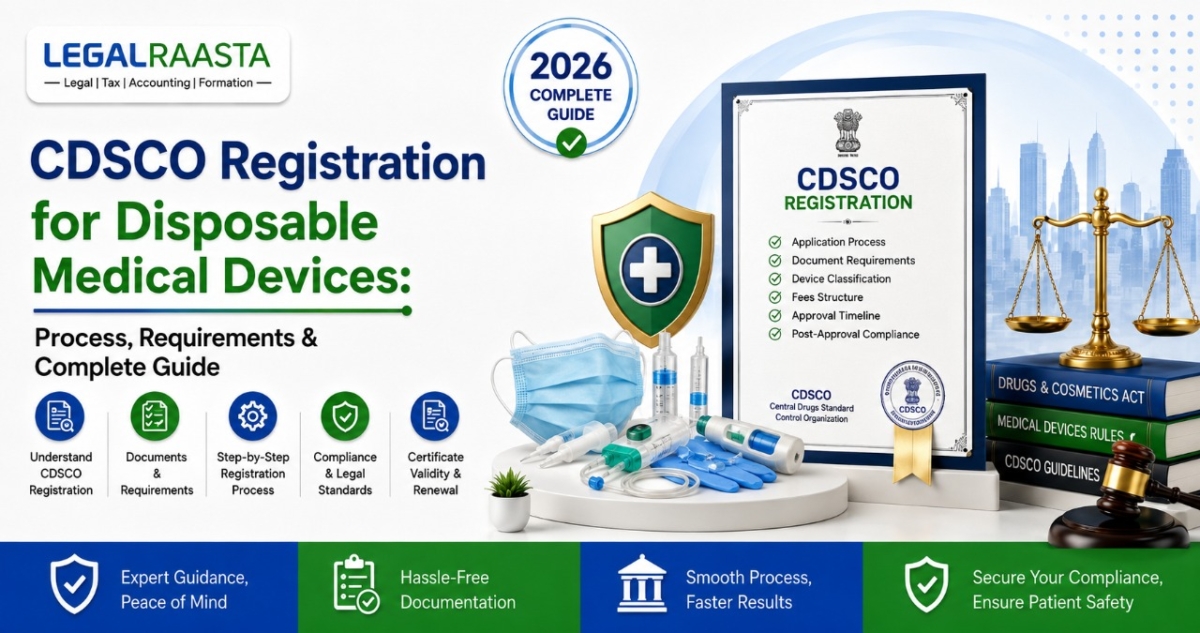
Selling syringes, gloves, or IV sets in India without a licence sounds harmless. It isn’t. CDSCO Registration for Disposable Medical Devices is a legal requirement, not paperwork you can skip and fix later.
Miss it, and customs holds your shipment or a state drug inspector shuts your unit down mid-production. Get it right the first time, and you’re selling to hospitals, government tenders, and export markets without a compliance headache hanging over you.
This guide walks through classification, the actual CDSCO filing steps, fees as they stand in 2026, and the mistakes that get applications rejected. Talk to LegalRaasta’s regulatory team if you’d rather have someone file this correctly the first time.
Quick Answer: CDSCO Registration for Disposable Medical Devices at a Glance
|
Requirement |
Details |
|
Regulator |
CDSCO, under the Ministry of Health and Family Welfare |
|
Governing law |
Medical Devices Rules, 2017 (MDR 2017) |
|
Application portal |
SUGAM (sugam.gov.in / cdscomdonline.gov.in) |
|
Manufacturing forms |
MD-3 → MD-5 (Class A/B), MD-7 → MD-9 (Class C/D) |
|
Import forms |
MD-14 → MD-15, via Indian Authorised Agent |
|
Manufacturing licence fee |
Rs 5,000 + Rs 500/device (A/B), Rs 50,000 + Rs 1,000/device (C/D) |
|
Import licence fee |
Roughly Rs 83,300 per site (A/B), Rs 2,49,900 per site (C/D), plus USD 1,000 per product |
|
Licence validity |
5 years, renewable |
|
Processing time |
3 to 6 months (A/B), 9 to 18 months (C/D) |
What Is CDSCO Registration for Disposable Medical Devices?
CDSCO Registration for Disposable Medical Devices is the licence that lets you legally manufacture, import, sell, or distribute single-use medical products in India.
It applies to items used once and discarded, such as syringes, gloves, catheters, IV sets, dressings, and dozens of similar products. Without the CDSCO licence, you can’t sell the product to a hospital, list it on a government e-procurement portal, or clear it through Indian customs if you import it.
Are Disposable Medical Devices Regulated by CDSCO in India?
Yes, and this wasn’t always the case. Before 2020, only a limited list of notified devices needed CDSCO approval. A government notification, S.O. 648(E), brought every medical device, disposable or otherwise, under regulation from April 2020, rolled out in phases by risk class.
So today, if your product meets the legal definition of a medical device under the Drugs and Cosmetics Act, it needs CDSCO clearance. There’s one exception worth knowing. Class A devices that are non-sterile and non-measuring were exempted from mandatory licensing under a 2026 CDSCO update, though they still need registration on the portal.
CDSCO Medical Device Classification for Disposable Devices
Classification decides everything that follows: which form you file, how much you pay, and how long approval takes. Here’s how disposable products typically fall across the four risk classes.
Class A Disposable Medical Devices
Lowest risk. Examples include examination gloves, gauze, cotton swabs, alcohol swabs, disposable face masks, and tongue depressors. Many now only need registration, not a full licence, under the 2026 NSNM exemption.
Class B Disposable Medical Devices
Low to moderate risk. Disposable syringes, hypodermic needles, IV cannulas, urine bags, Foley catheters and disposable scalp vein sets sit here. A full manufacturing or import licence is mandatory.
Class C Disposable Medical Devices
Moderate to high risk. Disposable dialyser sets, blood tubing sets for haemodialysis, and certain drug-delivery catheters fall in this bracket. Expect stricter documentation and a site inspection.
Class D Disposable Medical Devices
Highest risk. Disposable devices used in critical or cardiac care, angiography catheters being one example, attract the most rigorous CDSCO review, including clinical data in some cases.
Always confirm your specific product against CDSCO’s official classification list before filing. Misclassification is the single biggest cause of rejected applications.
Who Needs CDSCO Registration for Disposable Medical Devices?
Anyone touching the product commercially needs to be on record with CDSCO. That includes Indian manufacturers producing disposables domestically, foreign manufacturers exporting into India through an Indian Authorised Agent, importers and distributors who stock and resell devices, and contract manufacturers who assemble, sterilise or repackage devices in India, even from imported components.
Eligibility for CDSCO Registration of Disposable Medical Devices
You need a valid business entity registered in India, a GST registration, and for manufacturers, premises that meet the Fifth Schedule quality management requirements under MDR 2017. Foreign manufacturers without an Indian office must appoint an Indian Authorised Agent holding a wholesale licence in Form MD-42 before they can even begin the SUGAM application.
CDSCO Registration Process for Disposable Medical Devices in India
The process runs through six broad stages, though the exact paperwork changes depending on whether you manufacture in India or import.
Step 1: Identify and Classify the Medical Device
Check your product against CDSCO’s classification list first. Everything downstream- the form, the fee, the timeline- depends on getting this right.
Step 2: Determine the Applicable Regulatory Route
Decide whether you need MD-3/MD-5 (manufacturing, Class A/B), MD-7/MD-9 (manufacturing, Class C/D), or MD-14/MD-15 (import, any class).
Step 3: Prepare the Required Documents
Compile the Device Master File, Plant Master File, quality management certificates, and labelling artwork. This step usually takes the longest, so start early.
Step 4: Submit the Application
File through the SUGAM portal at sugam.gov.in. Offline or physical submissions are not accepted for any category.
Step 5: CDSCO Review and Query Resolution
A reviewing officer examines the application and raises queries if anything is missing. Class C and D applications may also involve a physical site inspection.
Step 6: Obtain the Applicable Licence or Approval
Once cleared, you receive Form MD-5, MD-9, or MD-15 depending on your category, valid for five years from the date of issue.
Documents Required for CDSCO Registration
|
Document |
Manufacturer |
Importer |
|
Device Master File |
Yes |
Yes |
|
Plant Master File |
Yes |
Yes (foreign site) |
|
ISO 13485 certificate |
Yes |
Yes, from foreign site |
|
Free Sale Certificate |
Not applicable |
Yes, from country of origin |
|
Constitution/incorporation documents |
Yes |
Yes |
|
Power of Attorney for Indian Authorised Agent |
Not applicable |
Yes |
|
Wholesale licence (Form MD-42) of the agent |
Not applicable |
Yes |
|
Labelling and Instructions for Use, in English/Hindi |
Yes |
Yes |
CDSCO Fees for Disposable Medical Device Registration
Fees scale sharply with device class, and manufacturing costs are far less than importing.
|
Category |
Application |
Licence |
Site Fee |
Per-Device Fee |
|
Manufacturing, Class A/B |
MD-3 |
MD-5 |
Rs 5,000 |
Rs 500 |
|
Manufacturing, Class C/D |
MD-7 |
MD-9 |
Rs 50,000 |
Rs 1,000 |
|
Import, Class A/B |
MD-14 |
MD-15 |
Approx. Rs 83,300 |
USD 1,000 |
|
Import, Class C/D |
MD-14 |
MD-15 |
Approx. Rs 2,49,900 |
USD 1,000 |
These figures are indicative. Always verify the exact fee on the SUGAM portal before filing, since the Ministry revises the fee schedule from time to time.
CDSCO Requirements for Disposable Medical Devices
Beyond the licence itself, CDSCO expects a functioning quality management system aligned with the Fifth Schedule of MDR 2017, sterilisation validation for single-use sterile products, biocompatibility data where the device contacts skin or mucous membranes, and a documented risk management file. None of this is optional, even for a simple product like a disposable syringe.
CDSCO Registration for Imported Disposable Medical Devices
Import approvals go through the Central Licensing Authority regardless of class, unlike manufacturing, where State Licensing Authorities handle Class A and B. The foreign manufacturer cannot apply directly. Their Indian Authorised Agent files Form MD-14 on their behalf, and once approved, the agent holds Form MD-15 and is responsible for customs clearance, post-market surveillance reporting, and adverse event tracking in India.
CDSCO Registration for Indian Manufacturers
Domestic manufacturers deal with State Licensing Authorities for Class A and B disposables, which usually means faster turnaround and no mandatory site audit for Class A products. Class C and D manufacturing shifts to the Central Licensing Authority, the DCGI’s office in Delhi, and always involves a plant inspection before the licence is granted.
Labelling and Packaging Requirements for Disposable Medical Devices
Every disposable device sold in India needs its CDSCO licence number, batch number, manufacturing and expiry dates, sterilisation status where applicable, and storage instructions printed clearly on the pack. Labels must carry information in English, and increasingly, Hindi is expected as well for products reaching government hospitals and rural markets. Single-use products additionally need a “Do Not Reuse” symbol or equivalent statement.
Testing and Quality Management Requirements
Sterile disposables need sterilisation validation reports, usually from a NABL-accredited lab. Non-sterile Class A products face lighter testing, but biocompatibility and material safety data are still expected if the device touches the body. Your quality management system, whether it’s an in-house SOP framework or a full ISO 13485 certification, gets reviewed as part of the application, not after.
CDSCO Registration Timeline for Disposable Medical Devices
Class A and B manufacturing licences typically take 3 to 6 months from a complete application. Class C and D manufacturing can stretch to 9 to 18 months, mostly because of the mandatory site inspection and, sometimes, a technical committee review. Import licences follow a similar pattern: 6 to 12 months for Class A/B, 9 to 15 months for Class C/D, counted from the date the Indian Authorised Agent files Form MD-14.
Common Reasons for CDSCO Application Rejection or Delay
- Wrong risk classification claimed at the outset
- Incomplete Device Master File or missing sterilisation validation data
- Labelling that doesn’t match the approved product description
- Foreign manufacturer applying directly instead of through an Indian Authorised Agent
- Expired or mismatched ISO 13485 certification
- Fee challan errors or payment made outside the SUGAM portal
Post-Registration Compliance for Disposable Medical Devices
The licence isn’t the finish line. Manufacturers and importers must track adverse events and report them to CDSCO, maintain batch records for traceability, renew the licence before the five-year validity lapses, and inform CDSCO of any change in manufacturing site, product specification, or Indian Authorised Agent. Skipping renewal is one of the most common ways companies lose their market access overnight.
CDSCO Registration vs CDSCO Import Licence
|
Point |
CDSCO Registration |
CDSCO Import Licence |
|
Applies to |
Class A NSNM devices, domestic products in general |
All imported medical devices |
|
Form |
Registration on SUGAM portal |
MD-14 (application), MD-15 (licence) |
|
Who applies |
Manufacturer or entity directly |
Indian Authorised Agent, on behalf of foreign manufacturer |
|
Site inspection |
Rarely required |
Common for Class C/D |
|
Typical use case |
Low-risk domestic disposables |
Foreign-manufactured devices entering India |
Why Choose LegalRaasta for CDSCO Registration?
Getting classification wrong once means restarting the entire filing, and that costs months, not days. LegalRaasta’s regulatory team classifies your disposable device correctly, builds the Device Master File, handles the SUGAM filing end to end, and follows up on CDSCO queries so your licence doesn’t sit stuck for six extra months over a document you could have fixed upfront.
Conclusion
CDSCO Registration for Disposable Medical Devices isn’t a one-size-fits-all process. A box of examination gloves and a haemodialysis set follow completely different paths, timelines, and fee structures. What stays constant is this: get the classification right, keep the documentation airtight, and file through the correct route the first time. Reach out to LegalRaasta to get your disposable medical device registered without the back and forth.
Frequently Asked Questions (FAQs)
1. Does every disposable product need CDSCO Registration for Disposable Medical Devices?
Almost all do. Even low-risk Class A medical device items like gauze or gloves need registration, though some non-sterile ones are now exempt from full licensing.
2. What is a medical device manufacturing license used for?
It’s the legal permission to produce devices in India. For CDSCO Registration for Disposable Medical Devices, manufacturers file Form MD-3 or MD-7 depending on risk class.
3. How long does CDSCO Registration for Disposable Medical Devices actually take?
Class A and B products usually clear in 3 to 6 months. Class C and D can take 9 to 18 months because of mandatory site inspections under SUGAM portal registration.
4. What is a CDSCO import license needed for?
It authorises bringing foreign-made devices into India. Foreign firms outside the CDSCO Registration for Disposable Medical Devices rules must use an Indian Authorised Agent to import legally.
5. Can foreign manufacturers apply for CDSCO Registration for Disposable Medical Devices directly?
No, they cannot. Only an Indian Authorised Agent, holding a valid wholesale licence, can file the SUGAM portal registration on their behalf.
6. What is Class A medical device classification based on?
It’s based on risk to the patient, the lowest tier. CDSCO Registration for Disposable Medical Devices treats Class A items like masks and swabs with the lightest scrutiny.
7. Is CDSCO Registration for Disposable Medical Devices mandatory for hospitals selling disposables?
Hospitals using devices don’t need the licence themselves, but any manufacturer or importer supplying them under medical device classification in India rules absolutely does.
8. What happens if CDSCO Registration for Disposable Medical Devices is skipped?
Products get seized at customs or during inspection, and penalties follow under the Drugs and Cosmetics Act, alongside the loss of a valid medical device manufacturing license.
9. Does CDSCO Registration for Disposable Medical Devices cover both manufacturing and import?
Yes, it covers both, just through different forms: MD-3/MD-7 for domestic manufacturing and the CDSCO import license route for foreign-made devices.
10. How often does CDSCO Registration for Disposable Medical Devices need renewal?
Every five years. Missing renewal under the SUGAM portal registration means the licence lapses, and the product can no longer be legally sold in India.
Related Posts
Our Clients


Featured In