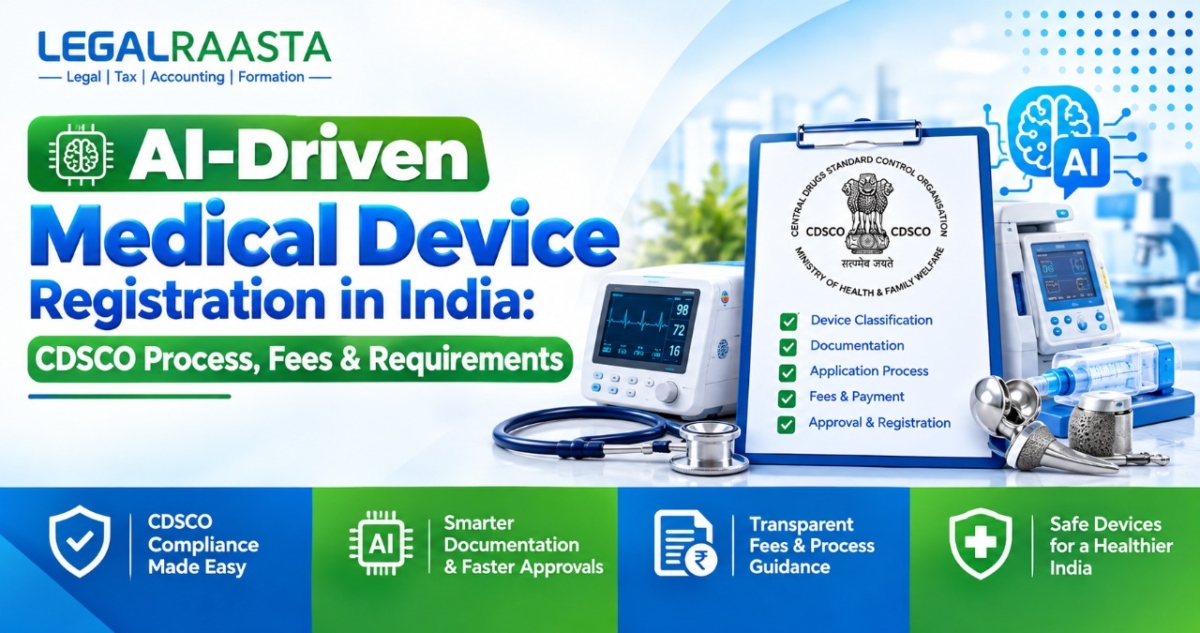
AI-Driven Medical Device Registration in India: CDSCO Process, Fees & Requirements
A Bangalore health-tech team built an AI tool that reads chest X-rays for early tuberculosis signs. Brilliant model, strong accuracy numbers, ready for hospitals. Then someone asked which CDSCO class it fell under, and the room went quiet. AI-Driven Medical Device Registration doesn’t run on a separate rulebook just because the product has a neural network inside it. That’s the first myth worth killing here. CDSCO fits AI and machine learning software into the same risk-based framework every other device uses, though a fresh guidance document from mid-2026 finally spells out how algorithms, datasets, and software updates fit into that picture.
This piece walks through classification, the actual registration steps, and what changed most recently for anyone asking how to register AI-driven medical devices with CDSCO. The regulatory team at LegalRaasta handles exactly this kind of filing, so get your device classified correctly before you submit anything.
AI-Driven Medical Device Registration: Quick Answer
|
Question |
Answer |
|
Separate AI classification system? |
No, same Class A-D system under MDR 2017 |
|
Key 2026 update |
Final MDSW Guidance, CDSCO/MD/GD/MDSW/01/2026, dated 21 July 2026 |
|
Registration forms |
MD-3/MD-5 (Class A/B), MD-7/MD-9 (Class C/D), MD-14/MD-15 (import) |
|
Portal |
|
|
Regulator |
|
|
Extra requirement for AI devices |
Algorithm documentation, dataset validation, change management plan |
What Are AI-Driven Medical Devices?
These are software products, sometimes standalone, sometimes bundled with hardware, that use machine learning or algorithmic logic to support a medical purpose. Think diagnostic imaging tools that flag tumours, triage software that prioritises emergency cases, or predictive models estimating patient deterioration risk. CDSCO’s own guidance groups these under the umbrella of Medical Device Software, MDSW for short, whether or not AI sits inside them.
Does an AI Medical Device Require CDSCO Registration in India?
Yes, if the software serves a medical purpose. Intended use decides this, not the technology behind it. A wellness app tracking steps doesn’t need registration. A tool diagnosing diabetic retinopathy from a retinal scan does, regardless of whether it runs on a simple rule engine or a deep learning model underneath.
CDSCO Classification of AI-Driven Medical Devices
Here’s where a lot of confusion creeps in. There’s no special “AI classification track” at CDSCO, AI-driven devices slot into the exact same four-tier risk system every medical device uses, based on function and potential harm, not the algorithm powering them.
Class A AI Medical Devices
Low risk software, things like general health information tools or basic symptom checkers that don’t drive a clinical decision on their own.
Class B AI Medical Devices
Moderate risk, covering software that supports diagnosis without being the sole basis for treatment, an AI tool flagging abnormal readings for a doctor’s review, for instance.
Class C AI Medical Devices
Moderate to high risk. AI-based cancer detection software analysing X-rays, CT scans, or MRIs has been treated at this level in recent notifications, given the direct impact a missed or false diagnosis carries.
Class D AI Medical Devices
Highest risk, reserved for AI systems making or directly driving critical, life-affecting decisions with little room for human override, closed-loop systems in critical care being the clearest example.
Regulatory Authorities Involved in AI Medical Device Registration
CDSCO, through its Medical Devices Division, issues the actual licence or registration. State Licensing Authorities handle Class A and B manufacturing approvals, while the Central Licensing Authority, the DCGI’s office, handles Class C and D manufacturing plus every import application regardless of class. For AI-specific software, the same Medical Devices Division that regulates hardware devices also owns the MDSW guidance framework.
CDSCO Registration Process for AI-Driven Medical Devices
The process follows the same eight-stage sequence CDSCO uses for any medical device, just with AI-specific documentation woven into a couple of the steps.
Step 1 – Identify the Intended Use
Write a precise intended use statement covering the medical purpose, target condition, and patient population your software addresses.
Step 2 – Determine Device Classification
Match your software’s risk profile against the Class A-D system, based on function, not the presence of AI itself.
Step 3 – Identify the Applicable Licence or Registration Route
Decide between MD-3/MD-5 for Class A/B manufacturing, MD-7/MD-9 for Class C/D, or MD-14/MD-15 if importing a foreign-built AI tool into India.
Step 4 – Prepare Technical & Regulatory Documents
Compile your Device Master File, algorithm documentation, training dataset summary, and validation reports alongside standard technical files.
Step 5 – Submit the CDSCO Application
File through the SUGAM portal, with the test report and technical documentation attached in full.
Step 6 – Regulatory Review & Queries
Expect questions specifically about algorithm performance and validation methodology, these get scrutinised more closely than a typical hardware submission.
Step 7 – Inspection or Testing, If Applicable
Class C and D applications may involve a facility or quality system review, even for a purely software-based product.
Step 8 – Obtain CDSCO Licence or Approval
Once cleared, you receive your licence number, valid for five years and tied to the specific software version submitted.
Documents Required for AI Medical Device Registration
Paperwork here overlaps heavily with standard CDSCO filings, with a few AI-specific additions layered in.
|
Document |
Standard Requirement |
AI-Specific Addition |
|
Device Master File |
Yes |
Includes algorithm architecture summary |
|
Risk Management File |
Yes (ISO 14971) |
Covers algorithmic bias and failure modes |
|
Software Lifecycle Documentation |
Yes (IEC 62304) |
Version control and update history |
|
Clinical/Validation Data |
Yes |
Dataset composition and performance metrics |
|
Quality Management Certificate |
ISO 13485 |
Extended to cover model retraining processes |
Additional Requirements for AI & Machine Learning-Based Medical Devices
Beyond the standard file, CDSCO’s July 2026 guidance expects a few things specific to how algorithms behave differently from fixed hardware. Datasets used to train and validate the model need documented provenance, so reviewers can judge whether the training data actually represents the Indian patient population the device will serve. Bias mitigation gets its own scrutiny too, since a model trained predominantly on one demographic can perform unevenly elsewhere. None of this is unique to India, it mirrors the direction FDA and IMDRF guidance has taken globally, but it’s now explicitly baked into what CDSCO reviewers check.
CDSCO Fees for AI-Driven Medical Device Registration
Fees follow the same structure as any other medical device under MDR 2017, since AI status doesn’t change the fee schedule itself.
|
Category |
Application |
Licence Fee |
Site Fee |
|
Manufacturing, Class A/B |
MD-3 |
MD-5 |
Rs 5,000 |
|
Manufacturing, Class C/D |
MD-7 |
MD-9 |
Rs 50,000 |
|
Import, any class |
MD-14 |
MD-15 |
Approx. Rs 83,300 to Rs 2,49,900 |
Always confirm the exact figure on the SUGAM portal directly, since fee schedules get revised periodically.
How Long Does CDSCO Registration Take for AI Medical Devices?
Class A and B software typically clears in 3 to 6 months from a complete application. Class C and D submissions run longer, often 9 to 15 months, mostly because algorithm validation queries take longer to resolve than a standard hardware query would.
Compliance Requirements After CDSCO Registration
The licence isn’t a one-time achievement, and a handful of obligations kick in the moment the product actually reaches hospitals.
|
Obligation |
What It Actually Involves |
|
Adverse event tracking |
Logging and reporting any incident where the device’s output contributes to patient harm |
|
Performance record maintenance |
Keeping documented evidence of real-world accuracy, not just validation-stage results |
|
Accuracy drop reporting |
Flagging any significant decline in diagnostic performance once deployed |
|
Model drift monitoring |
Watching for the slow decline that happens when real-world data starts looking different from whatever the model originally trained on |
A tool performing beautifully on day one can quietly underperform eighteen months later if nobody’s tracking that shift, and CDSCO’s post-market expectations now assume someone is.
AI Medical Device Software Updates & Change Management
This is where AI-driven devices genuinely diverge from traditional hardware. A pacemaker doesn’t change its behaviour after approval. An AI model can, especially if it’s designed to learn continuously. CDSCO’s guidance requires a documented change management plan covering how software updates get evaluated, whether a change is minor enough to log internally or significant enough to require fresh regulatory review, and how version history gets maintained for audit purposes.
Common Challenges in AI Medical Device Registration
Three recurring problems account for most of the friction in this process, and none of them are really about the technology itself.
|
Challenge |
What’s Actually Happening |
|
Explaining algorithm logic |
A radiologist-turned-regulator can judge clinical relevance easily enough, but asking that same reviewer to evaluate a convolutional neural network’s architecture choices is a different skill entirely. CDSCO’s queries often reflect that gap, asking for plainer explanations than a technical team expects to give. |
|
Dataset diversity |
A model trained largely on chest X-rays from European or American hospital systems doesn’t automatically perform the same way on Indian population data, different imaging equipment, different disease prevalence patterns, sometimes different average body types entirely. Reviewers have started asking pointed questions about this directly. |
|
Change management planning |
Teams design the model, validate it, file for approval, and only then start thinking about what happens when the next version ships. A plan built after the fact tends to be thinner and less convincing than one built alongside the original submission. |
Teams that walk in prepared on all three points spend noticeably less time stuck in the query cycle than those figuring it out live, mid-review.
Global Alignment: How CDSCO’s AI Guidance Compares
CDSCO didn’t invent this approach from scratch, and knowing what it borrowed from explains why the requirements read the way they do.
|
Regulatory Body |
Approach to AI/ML Medical Software |
|
CDSCO (India) |
July 2026 guidance covering algorithm documentation and lifecycle change management |
|
FDA (United States) |
Total Product Lifecycle approach, treating regulatory oversight as continuous through every meaningful update |
|
IMDRF (International) |
Shared framework pushing member countries toward consistent AI/ML software oversight |
That’s a genuinely useful signal for anyone building for multiple markets. Documentation built to satisfy CDSCO’s expectations on algorithm transparency and change management usually translates reasonably well toward FDA or EU MDR submissions too, even though the specific forms and fee structures differ completely.
Common Mistakes to Avoid During CDSCO Registration
Most rejections and delays trace back to the same handful of avoidable slip-ups, not genuinely complex regulatory disputes.
- Assuming AI devices skip classification entirely because “software isn’t really a medical device”
- Submitting validation data from a single demographic without addressing Indian population relevance
- Treating every software update as minor, when a meaningful algorithm change needs fresh regulatory review
- Using outdated SaMD/SiMD terminology from the October 2025 draft guidance instead of the function-based approach the final July 2026 guidance adopted
- Underestimating how long algorithm-specific queries take to resolve compared to standard hardware queries
AI Medical Device Registration for Indian vs Foreign Manufacturers
Indian developers apply directly through SUGAM for manufacturing licences. Foreign AI health-tech companies without an Indian entity must appoint an Authorised Indian Representative to file the import application on their behalf, and that representative carries ongoing responsibility for post-market surveillance and adverse event reporting once the product is live in India.
CDSCO Registration vs Medical Device Manufacturing Licence
These terms get used loosely, but they’re not identical. Registration, in the CRS-style sense used for lower-risk categories, involves lighter scrutiny and no facility inspection. A full manufacturing licence, required for Class C and D products including many higher-risk AI diagnostic tools, involves a more detailed technical review and, in many cases, a facility or quality system check even when the “facility” is really just a software development office.
Why Choose LegalRaasta for AI-Driven Medical Device Registration?
Getting an AI tool’s classification wrong at the outset means redoing months of documentation later, and reviewers are only getting sharper about algorithm-specific questions as this guidance beds in. LegalRaasta’s team classifies your AI-driven device correctly against the current MDSW guidance, builds out the algorithm and dataset documentation CDSCO now expects, and manages the SUGAM filing so a validation query doesn’t stall your launch by another quarter.
Conclusion
AI-Driven Medical Device Registration in India runs through the same CDSCO framework every other device uses, but the July 2026 guidance means reviewers now ask sharper, more specific questions about algorithms, datasets, and software change management than they did even a year ago. Getting classification and documentation right the first time matters more now than it used to. Talk to LegalRaasta before you submit your next AI health-tech filing to CDSCO.
If your regulatory paperwork is airtight but your product’s own website still can’t explain what the device actually does to a non-technical buyer, that’s a gap worth closing too. CloudGeta (cloudgeta.com) builds websites and runs the SEO and digital marketing behind them, so the product you’ve spent months getting cleared actually gets found and understood once it’s ready to sell.
Frequently Asked Questions About AI Medical Device Registration
1. Does AI-Driven Medical Device Registration follow a separate classification system?
No. AI Medical Device Registration uses the same Class A-D risk-based system under MDR 2017 that every medical device follows, based on intended use rather than the underlying technology.
2. What is the latest CDSCO update affecting AI medical device registration?
CDSCO issued a final Medical Device Software guidance on 21 July 2026. This directly shapes AI-Driven Medical Device Registration, covering algorithm documentation and lifecycle change management requirements.
3. How to register AI-driven medical devices with CDSCO if the manufacturer is foreign?
Foreign manufacturers need an Authorised Indian Representative to file through MD-14/MD-15. AI Medical Device Registration for imported software follows this same route regardless of complexity.
4. Which CDSCO form applies to AI-Driven Medical Device Registration for Class C devices?
Class C AI devices use Form MD-7 for application and MD-9 for the licence. AI-Driven Medical Device Registration at this tier also typically involves a facility or quality system review.
5. Does AI-Driven Medical Device Registration require dataset documentation?
Yes, CDSCO’s current guidance expects dataset provenance and validation details. AI Medical Device Registration applications lacking this documentation face queries that delay approval significantly.
6. How long does AI-Driven Medical Device Registration typically take?
Class A and B software usually clears in 3 to 6 months. AI-Driven Medical Device Registration for Class C and D products often stretches to 9 to 15 months given deeper algorithm scrutiny.
7. What happens when an AI model gets updated after CDSCO approval?
A documented change management plan decides whether the update needs fresh regulatory review. AI Medical Device Registration doesn’t end at approval, ongoing version control matters just as much.
8. Is a facility inspection required for AI-Driven Medical Device Registration?
Only for Class C and D categories, even when the “facility” is a software development office rather than a factory. AI-Driven Medical Device Registration for Class A/B typically skips this step entirely.
9. What CDSCO fee applies to AI Medical Device Registration?
Fees mirror standard MDR 2017 rates, Rs 5,000 for Class A/B manufacturing sites up to roughly Rs 2,49,900 for higher-risk imports. AI-Driven Medical Device Registration carries no separate AI-specific fee category.
10. Can LegalRaasta help with AI-Driven Medical Device Registration in India?
Yes, LegalRaasta’s regulatory team classifies AI health-tech products correctly, prepares algorithm and dataset documentation, and manages the full SUGAM filing for AI-Driven Medical Device Registration from start to finish.
Related Posts
Our Clients


Featured In