
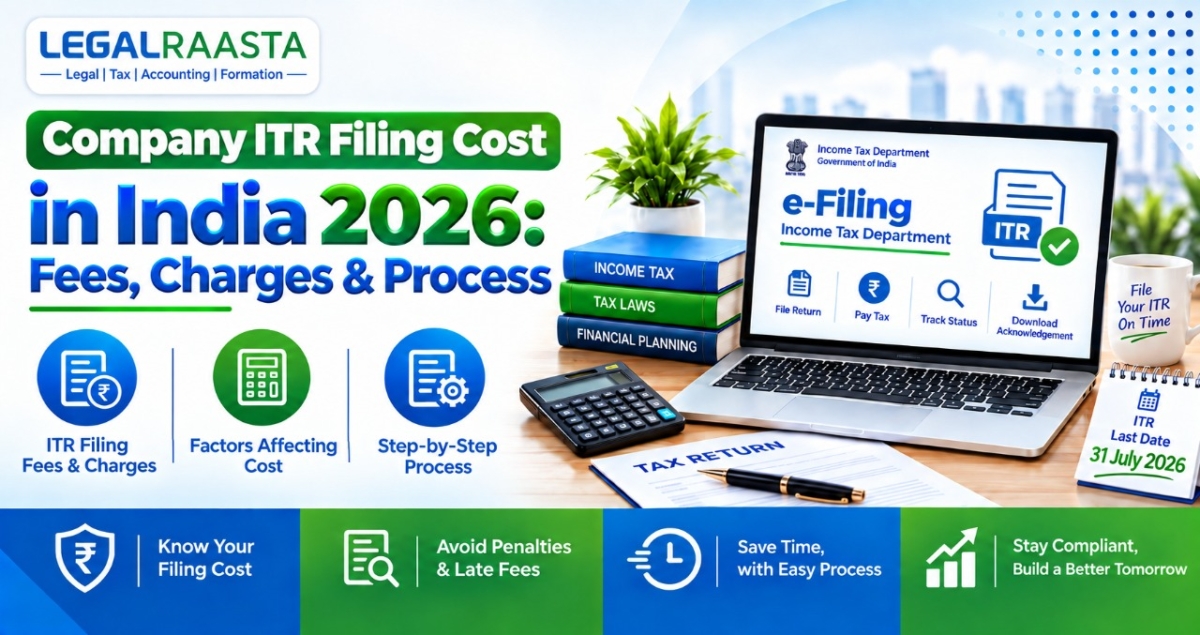
Company ITR Filing Cost in India 2026: Fees, Charges & Process
A Surat-based trading company once paid its CA twelve thousand rupees for what turned out to be a fifteen-minute filing job. No tax audit, no complications, just a company that didn’t know what a fair price actually looked like, and a CA who never volunteered to explain the difference. Company ITR Filing Cost in India isn’t fixed by the government, and that’s exactly why quotes swing so wildly between CAs, online platforms, and the aunty’s-neighbour’s-accountant everyone seems to know. The e-filing portal itself charges nothing.
Every rupee you pay goes to whoever prepares and files the return for you, and what that should actually cost depends on a few specific things this guide walks through: turnover, audit status, and how organised your books already are. Get LegalRaasta’s tax team to quote your company’s actual ITR-6 filing before you commit to a number that might be double what the job needs.
Company ITR Filing Cost in India: Quick Overview
|
Detail |
Current Position (AY 2026-27) |
|
Applicable form |
ITR-6 |
|
Governing Act |
Income-tax Act, 1961 (this is the final AY under it) |
|
E-filing portal fee |
Nil |
|
Typical professional fee range |
Rs 8,000 to Rs 50,000+ |
|
ICAI recommended minimum (active Pvt Ltd) |
Rs 25,000 and above |
|
Due date |
31 October 2026 |
|
Verification method |
Digital Signature Certificate, mandatory |
What Is Company ITR Filing in India?
Company ITR Filing is the yearly return every registered company submits to the Income Tax Department, declaring income, expenses, tax paid, and tax owed for the financial year. Unlike individuals, a company has no option to skip this even in a loss year or a year with zero business activity. The return is filed through ITR-6, and it has to carry a Digital Signature Certificate; no other verification method is accepted for companies.
Company ITR Filing Cost in India in 2026
Three things drive what you actually pay, and none of them are a fixed government charge.
Average Professional ITR Filing Charges for Companies
ICAI’s own recommended minimum for an active private limited company sits at Rs 25,000 and above, rising to Rs 65,000 and above for active public limited companies. In practice, market rates for a straightforward audit-case ITR-6 run Rs 15,000 to Rs 50,000, and dormant or defunct companies pay considerably less, sometimes under Rs 10,000.
Government Fees, Late Fees, Interest & Other Applicable Costs
Filing itself costs nothing on the portal. What costs money is getting it wrong or getting it late, a Section 234F late fee up to Rs 5,000, Section 234A interest at 1% a month on unpaid tax, and a Section 271B penalty of 0.5% of turnover, capped at Rs 1.5 lakh, if a required tax audit doesn’t happen on time.
Factors Affecting Company ITR Filing Cost in India
Turnover size, whether a tax audit applies, the number of transactions to reconcile, TDS mismatches, and whether the company has multiple income streams (business income, capital gains, other sources) all push the fee up or down. A company with clean, organised books almost always pays less than one handing over a shoebox of receipts in the last week of October, since the CA’s time is the real cost driver here, not the filing itself.
ITR-6 Filing Fees for Companies
ITR-6 itself carries no separate government fee; it’s simply the form every company other than one claiming exemption under Section 11 must use. What varies is the professional cost of preparing it correctly, since ITR-6 demands detailed schedules covering balance sheet items, depreciation, and MAT computation that individual ITR forms never touch.
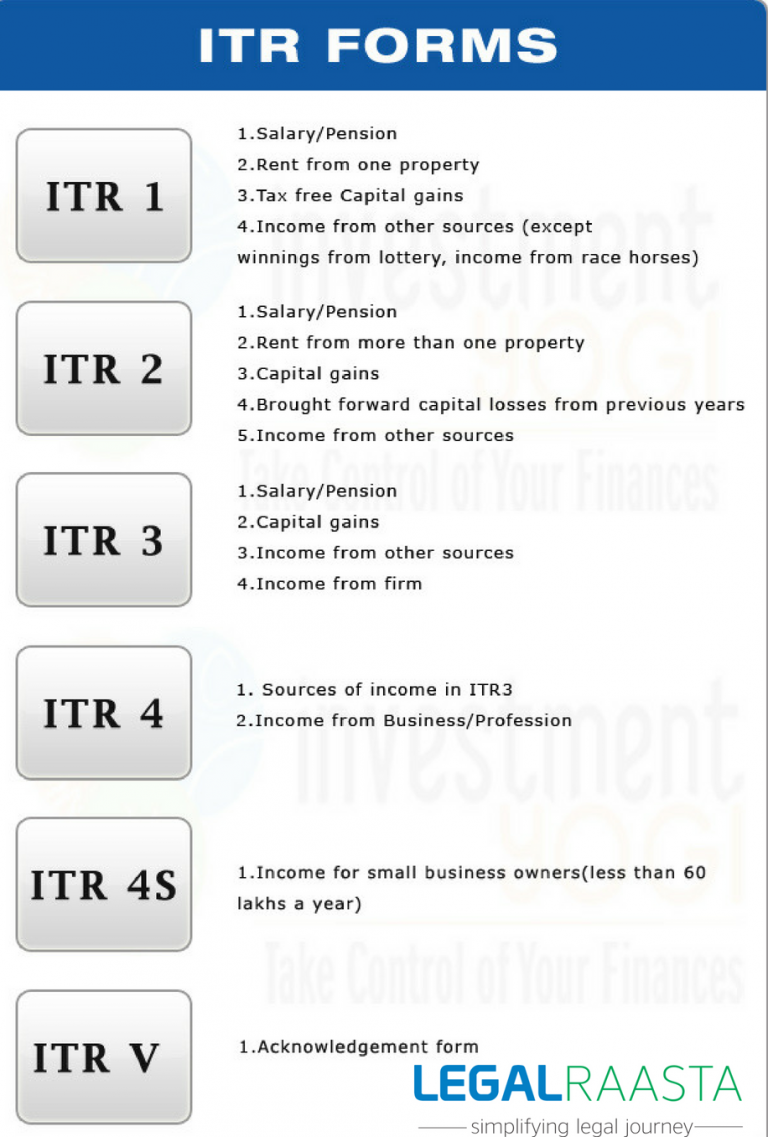
ITR-6 vs Other ITR Forms: Why Companies Cost More to File
Comparing ITR-6 against the forms individuals and firms use explains why company filings never come cheap, even for a small business.
|
Form |
Used By |
Typical Complexity |
|
ITR-1/ITR-2 |
Salaried individuals |
Low, minimal schedules |
|
ITR-3/ITR-4 |
Business individuals, professionals |
Moderate |
|
ITR-5 |
Partnership firms, LLPs |
Moderate to high |
|
ITR-6 |
Companies (non-Section 11) |
High, MAT and balance sheet schedules mandatory |
|
ITR-7 |
Trusts, Section 11-exempt entities |
High, exemption-specific schedules |
The balance sheet and profit-and-loss schedules inside ITR-6 alone run longer than an entire ITR-1 form, which is a big part of why the professional fee gap between individual and company filing is so wide.
Who Needs to File an Income Tax Return for a Company?
Every company incorporated in India, private limited, public limited, OPC, or Section 8, must file ITR-6 regardless of turnover, profit, or business activity. A dormant company with zero transactions still files. A company running at a loss still files, partly because carrying forward that loss to offset future profits requires an on-time return in the first place. There’s no income threshold that exempts a company the way it might exempt an individual earning below the basic exemption limit.
Company ITR Filing Due Date for FY 2025-26 / AY 2026-27
Here’s the part that trips a lot of companies up. Because the Companies Act, 2013 requires every company to get its accounts audited regardless of turnover, companies always fall under the “audited under another law” category for income tax purposes too. That pushes the ITR-6 due date to 31 October 2026 for every company, not just the ones crossing the Section 44AB turnover threshold on their own.
|
Filing |
Due Date |
|
Tax Audit Report (Form 3CA-3CD) |
30 September 2026 |
|
ITR-6 (Company Return) |
31 October 2026 |
|
Belated Return |
31 December 2026 |
|
Revised Return |
31 March 2027 |
|
Updated Return (ITR-U) |
31 March 2031 |
Worth noting too, AY 2026-27 is the last assessment year filed entirely under the old Income-tax Act, 1961. Income earned from 1 April 2026 onward falls under the new Income Tax Act, 2025 instead, first filed only in 2027.
Documents Required for Company ITR Filing
Getting these ready before your CA starts work shortens the whole process considerably, and most delays in October trace back to a document that should have been ready in July.
|
Document |
Purpose |
|
PAN and Certificate of Incorporation |
Confirms entity identity |
|
Audited Financial Statements |
Balance sheet, P&L, cash flow |
|
Tax Audit Report (Form 3CD, if applicable) |
Required for the audit-linked due date |
|
Form 26AS and AIS |
Reconciles TDS and other tax credits |
|
Bank statements |
Cross-checks income and expenses |
|
Digital Signature Certificate |
Mandatory for verification |
|
Details of related party transactions |
Needed for disclosure schedules in ITR-6 |
Company ITR Filing Process in India
Filing runs through seven stages, and skipping the reconciliation step early is where most delays actually start.
Step 1: Collect Financial & Tax Documents
Gather audited financials, bank statements, and Form 26AS before touching the return itself. Missing even one bank statement at this stage usually means restarting the reconciliation step later.
Step 2: Determine the Applicable ITR Form
Confirm ITR-6 applies, unless the company claims Section 11 exemption, in which case ITR-7 is used instead.
Step 3: Reconcile Income, TDS & Tax Information
Match books of accounts against Form 26AS and AIS data; mismatches here cause most notices later. A deductor who filed TDS under the wrong PAN or quarter shows up here first, not after the return is filed.
Step 4: Calculate Taxable Income & Tax Liability
Apply depreciation schedules, MAT provisions, and any brought-forward losses before arriving at final tax payable. Companies under the concessional tax regime skip some of this, but MAT credit tracking still needs checking year on year.
Step 5: Prepare and Validate the ITR
Fill the ITR-6 schedules and run the portal’s built-in validation checks before submission. The validation utility catches most schema errors, but not logical ones, like a balance sheet that doesn’t actually balance.
Step 6: Submit the Return on the Income Tax Portal
File through the e-filing portal, signed using the company’s registered Digital Signature Certificate.
Step 7: Verify the ITR
Confirm the DSC-based verification went through, since an unverified return counts as not filed at all.
Tax Audit and Its Impact on Company ITR Filing Cost in India
A tax audit under Section 44AB applies once turnover crosses Rs 1 crore, or Rs 10 crore where cash receipts and payments each stay within 5% of total transactions. This is separate from the Companies Act audit every company needs anyway, but when it applies, expect professional charges to climb meaningfully, since the CA now certifies Form 3CD alongside the return itself, adding a layer of scrutiny and paperwork.
Companies specifically use Form 3CA, not Form 3CB, for this certification, since Form 3CA is reserved for entities already audited under another law, and every company qualifies through the Companies Act regardless of turnover. That distinction alone tells you why a company’s audit paperwork almost never comes cheap; the CA is essentially reviewing two audits’ worth of ground even when only one report gets filed with the return.
Common Mistakes Companies Make While Filing ITR
A surprising number of notices trace back to the same handful of preventable errors, not genuinely complex tax positions.
- Choosing ITR-7 by mistake for a company that doesn’t actually qualify for Section 11 exemption
- Skipping MAT credit reconciliation, leaving money on the table across future years
- Filing before TDS entries in Form 26AS have fully updated for the quarter
- Assuming a dormant company is exempt from filing simply because there’s no revenue
- Waiting until the last week of October to start gathering documents, which is exactly when CA availability gets tightest, and fees often climb
What Happens If a Company Misses the ITR Filing Due Date?
Interest starts accruing immediately under Section 234A, at 1% a month on any unpaid tax. A late filing fee up to Rs 5,000 applies under Section 234F, and if the tax audit report itself was late, Section 271B adds its own penalty of 0.5% of turnover. Beyond the money, a late return also blocks the company from carrying forward certain business losses to future years, which can cost far more than the penalty itself, sometimes running into lakhs depending on how large the loss was.
How to Reduce Company ITR Filing Costs and Avoid Errors
Keeping records clean through the year does more for your final bill than negotiating hard in October.
- Reconcile TDS monthly: waiting until filing season to match Form 26AS against your books turns a quick check into hours of billable CA time
- Keep bank statements categorised: unsorted transactions are the single biggest driver of extra preparation charges
- File on time, every time: avoiding penalty and interest charges is cheaper than any discount a CA could offer
- Get one fixed quote upfront: compare it against the ICAI recommended minimum before agreeing to a number that seems oddly high or suspiciously low
- Share documents early: a CA working with a complete file in August charges less, on average, than one racing your return through in the last week of October
- Track MAT credit every year: a missed carry-forward compounds into a higher cost down the line than the fee saved by skipping the check now
Why Choose LegalRaasta for Company ITR Filing?
A wrongly picked ITR form or a missed MAT computation doesn’t just cost money; it invites a notice that takes months to resolve, and resolving a notice almost always costs more than the original filing ever would have. LegalRaasta’s tax team prepares and files income tax returns for companies of every size, reconciles TDS mismatches before they become notices, and quotes a fixed fee upfront so there’s no surprise bill in October.
File Your Company ITR with LegalRaasta
Beyond the ITR-6 filing itself, the team handles the pieces that usually get missed:
- Tax Audit Coordination: working with your auditor so Form 3CD and ITR-6 stay consistent with each other
- TDS and Form 26AS Reconciliation: catching mismatches before the Income Tax Department does
- MAT and Depreciation Schedules: getting the technical computations right the first time
- Late Filing and Notice Response: handling belated returns and any resulting departmental queries
Conclusion
Company ITR Filing Cost in India shouldn’t feel like a mystery every October. Know your turnover, know whether a tax audit applies, and get a quote that actually matches the work involved, not a number pulled from thin air. Talk to LegalRaasta for a fixed-fee ITR-6 filing that’s done right and filed on time.
If your company’s finances are sorted but its website still looks like it’s from 2018, that’s a different problem worth fixing too. CloudGeta (cloudgeta.com) handles website development, SEO, and digital marketing for businesses that would rather look as current as their compliance actually is.
Frequently Asked Questions About Company ITR Filing Cost in India
1. How Much Does It Cost to File ITR for a Company in India?
Company ITR Filing Cost in India typically runs Rs 15,000 to Rs 50,000 for an audit-case private limited company, based on ICAI’s recommended minimum and current market rates for ITR-6 preparation.
2. Which ITR Form Is Applicable to a Private Limited Company?
ITR-6 applies to nearly every private limited company. Company ITR Filing Cost in India for this form tends to run higher than individual forms, given its detailed balance sheet and MAT schedules.
3. Is ITR-6 Mandatory for Every Company?
Yes, except companies claiming exemption under Section 11, which use ITR-7 instead. Company ITR Filing Cost calculations should confirm the correct form before estimating fees.
4. What Is the Due Date for Company ITR Filing for AY 2026-27?
The due date is 31 October 2026, since every company falls under the audit-linked timeline. Company ITR Filing Cost discussions often miss that this applies regardless of actual turnover.
5. Is Company ITR Filing Mandatory If There Is No Income?
Yes, dormant and loss-making companies must still file ITR-6. Company ITR Filing Cost in India for such companies is usually lower, since there’s less to reconcile and compute.
6. Does Tax Audit Increase the Cost of Company ITR Filing?
Yes, considerably. Company ITR Filing Cost rises once Section 44AB tax audit applies, since the CA now certifies Form 3CD alongside the standard ITR-6 return itself.
7. What Documents Are Required for Company ITR Filing?
Audited financials, Form 26AS, AIS, PAN, and a valid Digital Signature Certificate are essential. Company ITR Filing Cost in India estimates should account for how organised these documents already are.
8. What Happens If a Company Files Its ITR Late?
Interest under Section 234A and a late fee under Section 234F both apply. Company ITR Filing Cost can climb further if a delayed tax audit triggers a separate Section 271B penalty too.
9. Can LegalRaasta Help With Company ITR Filing?
Yes, LegalRaasta prepares and files ITR-6 for companies of every size. Getting Company ITR Filing Cost quoted upfront, as a fixed fee, avoids the surprise billing many CAs still practise.
10. Can a Company File Its ITR Without a Digital Signature?
No, DSC verification is mandatory for every company filing ITR-6. Company ITR Filing Cost in India estimates should always include a valid, current Digital Signature Certificate as a prerequisite.

Related Posts


Our Clients








Featured In