
FSSAI License for Home-Based Food Business 2026: Documents Checklist & Guide
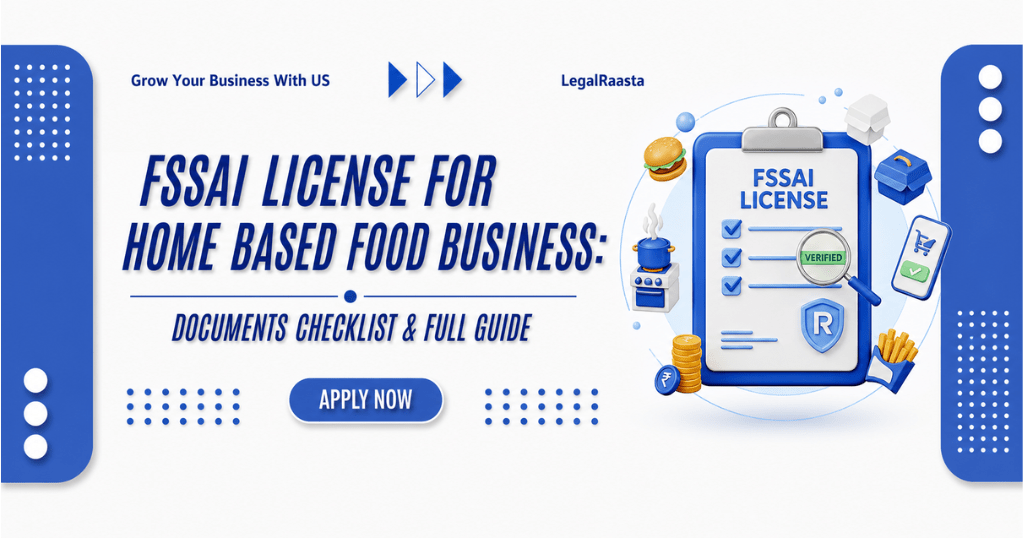
The food culture of India has undergone a tectonic shift. By 2026, Home Chef will have ceased to be an amateur and will have become a vital industry in the food-tech economy. It regards law as an FSSAI registration regardless of whether you are a home baker who cooks the sourdough in an artisanal way or a cloud kitchen operator who delivers meals to your door at the convenience set by Zomato. Just because you are working in your home kitchen does not mean you do not have to abide by food safety laws, and in fact, the FSSAI License for Home-Based Food Business is ultimately the key credential that transforms your kitchen experiment into a reliable professional name.
Increased cases of digital scrutiny mean that a well-validated 14-digit FSSAI number is the digital passport that business personnel require to enter major markets and ensure basic customer safety. Bring your biggest food desire to reality and ensure that you have your FSSAI License for Home-Based Food Business legally and signed with LegalRaasta today.
Do You Need an FSSAI License for a Home-Based Food Business?
Another myth that is popular with home entrepreneurs is the idea that small scale is no license. But as noted in the Food Safety and Standards Act, 2006, any person who is connected with the preparation, processing, or selling of food, irrespective of the place, is considered a Food Business Operator (FBO).
Why is it Mandatory in 2026:
- Market Access: Online platforms such as Swiggy, Zomato, and Amazon Food do not allow onboarding without a proven FSSAI License for Home-Based Food Business.
- Legal Protection: It protects you against heavy fines (up to Rs 5 Lakh) when manual health examinations occur out of the blue.
- Consumer Trust: In the age of conscious consumption, the logo, another certification on your package, is the FSSAI, which is a symbol of hygiene and quality.
- Financial Growth: Banks and NBFCs need an FSSAI registration as a compulsory document when borrowing an amount of money or claiming benefits of an MSME.
Types of FSSAI Registration for Home Kitchens
The form of registration you require depends upon your annual turnover and the kind of operations you are involved with. FSSAI categorizes the small cottage-style arrangements as the “Petty Food Business Operators”.
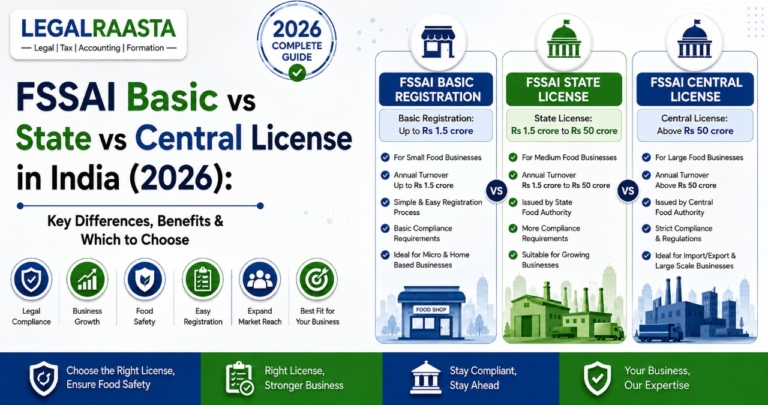
FSSAI Category Selection for Home Food Businesses
|
Business Type |
Annual Turnover |
Mandatory Form |
Issuing Authority |
|
Basic Registration |
Up to Rs 12 Lakhs |
Form A |
Registering Authority (Local Officer) |
|
State License |
Rs 12 Lakh to Rs 20 Cr |
Form B |
State Food Safety Department |
|
Central License |
Above Rs 20 Cr / Multi-State |
Form B |
Central FSSAI Authority |
The Basic Registration is adequate for 90% of the home-based startups. Nonetheless, once your home cook expands to a large-volume cloud restaurant that exceeds the Rs 12 Lakh mark, an upgrade to a State License is mandatory.
Documents Checklist for Home-Based Food Business (2026 Update)
In 2026, documentation requirements have been simplified, although more emphasis on the Digital Verification is topical. Make sure that you have flatbed-scanned documents and not only mobile photos, so that your portal does not reject your documents.
Mandatory Document List:
- Identity Proof: Scanned copy of Aadhaar Card, PAN Card, or Voter ID.
- Passport Photo: Recent passport-size photograph of the applicant.
- Proof of Premises: Since the kitchen is at home, you can present a Rent Agreement or NOC from the homeowner, accompanied by the latest Electricity/Water Bill.
- List of Food Categories: A list of the particular items that you will be selling (e.g., Bakery products, Ready-to-eat meals).
- 2026 Geo-Tagged Photo: A clear picture of the entrance to the kitchen and the preparation zone with the latitude/longitude timestamps for the photo (turned on through the FoSCoS app).
- Water Analysis Report: This is a mandatory core report for home bakers or those units where the water is a dependable component of the final product.
Step-by-Step Guide: How to Apply Online (FoSCoS Portal)
The process has been completely digitized with the Food Safety Compliance System (FoSCoS).
- Check Eligibility: Visit the FoSCoS portal and use the “Check Eligibility” tool to confirm if you need Form A or Form B.
- Sign Up: Create a user profile using your mobile number and email.
- Fill Form A/B: Enter your business name (e.g., “Ananya’s Home Bakes”) and the precise kitchen address.
- Select Food Product Category (FPC): Be very specific. In the case you are selling cakes, you would classify them under category 7.0 (Bakery products). The most frequent cause of application reverts is the selection of the incorrect category.
- Upload & Pay: Attach your documents and pay the FSSAI license for home-based food business fees via UPI, Credit Card, or Net Banking.
- Inspection (If Applicable): For Basic Registration, inspections are rare. In the case of State Licenses, the visit can be scheduled by a Food Safety Officer (FSO), either virtual or physical.
- Download Certificate: Once approved, your certificate is generated digitally. Physical copies are no longer mailed.
FSSAI License for Home-Based Food Business Fees & Cost Breakdown
The government fee is designed in such a manner that it favors micro-entrepreneurs, and therefore, the entry barrier is low.
Estimated FSSAI license for home-based food business cost (2026)
|
Expense Component |
Basic Registration (1 Year) |
State License (1 Year) |
|
Government Fee |
Rs 100 |
Rs 2,000 – Rs 5,000 |
|
Documentation & Geo-Tagging |
Rs 500 – Rs 1,000 |
Rs 2,000 – Rs 3,000 |
|
Professional/Consultancy Fee |
Rs 1,000 – Rs 1,500 |
Rs 3,000 – Rs 5,000 |
|
Late Renewal Penalty |
Rs 100 / Day |
Rs 100 / Day |
A 5-year validity period may be highly advised as a method of saving on the yearly renewal process and to avoid the possible increases in the fees.
FSSAI License for Home Bakers: Special Compliance Rules
Home baking is among the segments that are expanding rapidly. But bakers encounter special difficulties in terms of ingredients and shelf life.
- Allergen Labeling: In case of nuts, soy, and gluten in your cakes, you need to emphasize these in bold on your packaging.
- Proprietary Food: When you are developing some sort of a fusion product where no standard exists, then you have to list all ingredients and percentage amounts.
- Packaging Rules: The FSSAI License for Home Bakers number should be printed in large font on all the boxes, with the Veg/Non-Veg logo and the date by which the item must be consumed.
Selling on Zomato, Swiggy, and Instagram
The E-commerce sites have connected the FSSAI database with their backend.
- Real-time Validation: Entering your 14-digit number on Swiggy automatically validates the address and checks whether it is valid or not.
- Cloud Kitchen Status: Although you will not have a storefront, you will be required to become a Cloud Kitchen by registering as such under the FSSAI Kind of Business (KoB).
- Social Media Sales: DMs are eligible as an E-commerce activity according to the FSSAI. It is mandatory by law that you put your registration number on your profile or bio.
2026 Hygiene & Safety Standards for Home Kitchens
To retain your FSSAI License for Home-Based Food Business, a kitchen should comply with the hygiene standards that will be in Schedule 4.
Mandatory Daily Compliance Checklist for Home Chefs
|
Hygiene Parameter |
Requirement |
2026 Compliance Standard |
|
Personal Hygiene |
Clean aprons, hairnets, and gloves. |
Mandatory for all food handlers. |
|
Waste Management |
Covered bins and daily disposal. |
Separation of wet and dry waste. |
|
Pest Control |
No signs of insects or rodents. |
Quarterly professional treatment record. |
|
Storage |
Raw material away from the floor/chemicals. |
“First-In, First-Out” (FIFO) method. |
Penalties for Non-Compliance in 2026
Any activities in a home kitchen with no valid FSSAI License for Home-Based Food Business have serious legal repercussions according to the new regulatory system of 2026. With the FSSAI moving towards digital-innovative monitoring, adherence is no longer a choice.
Key Penalties & Enforcement Measures
|
Offence |
Monetary Penalty (up to) |
Imprisonment / Other Action |
|
Operating Without a License |
Rs 5,00,000 |
Imprisonment up to 6 months. |
|
Substandard Food Quality |
Rs 5,00,000 |
Product seizure and destruction. |
|
Misbranded/False Labeling |
Rs 3,00,000 |
Immediate removal from market shelves. |
|
Misleading Advertisements |
Rs 10,00,000 |
Corrective action or brand suspension. |
|
Unhygienic Conditions |
Rs 1,00,000 |
Business closure and sanitation audits. |
|
Late Renewal Filing |
Rs 100 Per Day |
Suspension after 180 days of delay. |
The 2026 “Zero-Tolerance” Framework
- Platform Blockade: Zomato and Swiggy now use real-time FSSAI API verification. Whether your FSSAI License for Home-Based Food Business has expired or you have the wrong type of FSSAI License, your digital storefront is turned off automatically.
- Geo-Tagging Monitoring: As part of the FSSAI monitoring scheme, photos with geo-tags and AI-driven data on supply chains will detect unauthorized so-called dark kitchens in 2026.
- Product Seizures: Any stock can be seized by the authorities when labels do not have the required 2026 allergens declarations or the 14-digit license number.
- Business Closure Notices: The failure to act on digital “Improvement Notices” through the FoSCoS portal leads to immediate business shutdown.
The only solution is to ensure that your registration is up-to-date so that your brand is not a victim of these tough enforcement actions.
Common Filing Mistakes for FSSAI License
- Address Mismatch: The address on your Aadhaar has to be identical to the address entered on your electricity bill.
- Ignoring Renewals: To renew, you have to do so 30 days prior to expiry. After 2026, there is a penalty of Rs 100 each day when there is a delay, and once the license lapses, then there is no way you can renew it; you have to create a new application.
- Misleading Claims: Claims like 100% Organic or treatment of your home-cooked food with terms such as medicine without specialized licensing will result in your license suspension.
Conclusion: Scaling Your Brand Legally
Securing this FSSAI business registration is the key to leaving being a cook and becoming a business owner. It gives it the necessary legal immunity it requires to run and the professional polish it requires to appeal to customers. With the FSSAI keeping on digitalizing its operations in 2026, it has never been easier to keep up to date, but mistakes are expensive.
You need to make sure that your records are accurate and that your hygiene is at the top level to establish a lasting brand of food out of your own house. Despite paperwork, do not allow your passion to miss your FSSAI License in Home-Based Food Business? You can make your application with LegalRaasta by making an easy application online today.
FAQs
- Does a home-based business need a license in India?
Yes, any food operation requires an FSSAI License for a Home-Based Food Business to stay compliant. You need to pay the FSSAI license for a home-based food business to escape punishment, even though you are a petty vendor.
- How to register a home-based food business in India?
You can apply for an FSSAI License for Home-Based Food Business via the FoSCoS portal by submitting the documentation of ID and the rental contract. This is the general course of action to follow with the FSSAI license for the home-based food business online application.
- Can I start a small food business from home?
Definitely, as long as you can provide yourself with an FSSAI License for Home-Based Food Business to be used in your kitchen. In the small enterprises, the FSSAI licence for home food business costs that are incurred is minimum, and there is simplicity in maintaining this licence.
- What food business can I start from home?
Your tiffin services, catering, or baking can be initiated with an FSSAI License for Home-Based Food Business. The majority of FSSAI licenses for home bakers extend to a large assortment of cakes and confectionery products.
- Can I use an FSSAI license for a home kitchen?
Yes, you will be able to get an FSSAI License for a Home-Based Food Business with a residential address to use in your cloud kitchen. This is the legal requirement of the FSSAI license for home-based business operations in residential areas.
- Which category do home bakers come under?
When an application to be registered is being made under the FSSAI License for a home-based food business, a home-baker usually comes under the category of Petty Food Business Operator. This makes the FSSAI license for a home kitchen affordable.
- How to get FSSAI registration for home bakers?
Apply via Form A on the government portal to receive your FSSAI License for Home-Based Food Business certificate. This is the quickest FSSAI license for home-based food business online application route for bakery owners.
- Do I need a license to sell homemade food in India?
It will need a valid FSSAI License for a Home-Based Food Business that displays a degree of safety when selling every food item. In its absence, the FSSAI license for home based food business cost of non-fulfillment may be very high.
- How to start a packaged food business from home?
Obtain an FSSAI License for Home-Based Food Business and make sure that your labels are compliant with the packaging requirements of 2026. Timely payment of the FSSAI license for home-based food business fees makes your operations legal.
- Is an FSSAI license mandatory for Zomato home food?
Yes, Zomato requires the FSSAI License for Home-Based Food Business on all their kitchen partners. The initial step to becoming listed on their app is to acquire an FSSAI license for home kitchens for operations.
Related Posts
 FSSAI License
FSSAI Basic vs State vs Central License in India (2026): Key Differences, Benefits & Which to Choose
Read More →
 FSSAI License
How to Start a Bottled Water Business in India: Cost, Licenses & Setup Guide (2026)
Read More →
Our Clients






Featured In