How to Sell on Blinkit in 2026: A Complete Legal & Business Guide for New Sellers
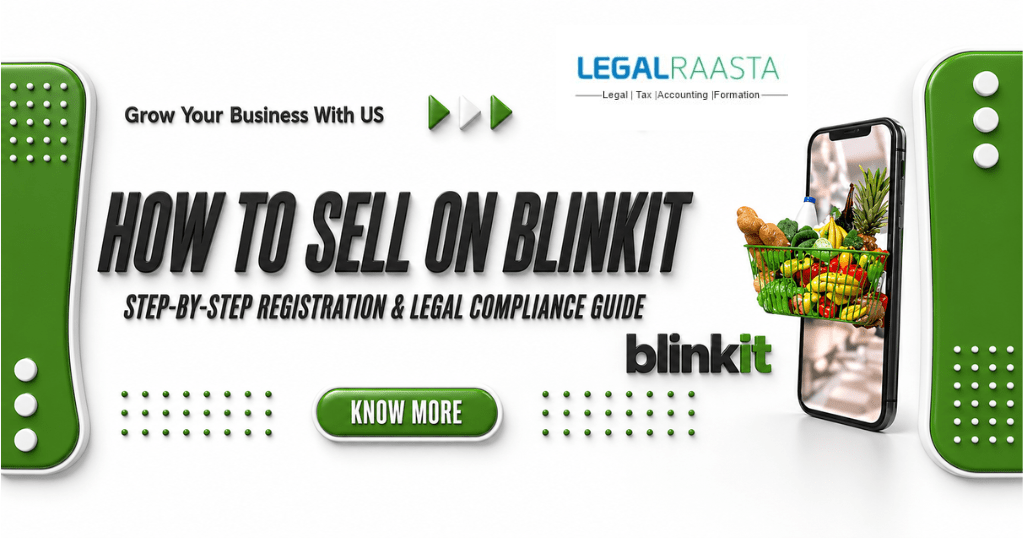
The landscape of retail in India has shifted from traditional storefronts to “Quick Commerce” (Q-Commerce) at a lightning-fast pace. As we move through 2026, Blinkit remains the dominant force in this sector, promising 10-minute deliveries to millions of households. To brands, local manufacturers, and D2C startups, how to sell on Blinkit is a strategic imperative to win the modern urban consumer.
Nevertheless, to enter this high-turmoil ecosystem, a strong legal base and profound knowledge of hyperlocal logistics. Do you want to work through the puzzles of FSSAI licensing or have to smooth out your GST registration because of Q-commerce? LegalRaasta can offer you all the end-to-end support to make your brand live on Blinkit easily.
Understanding the Blinkit Hyperlocal Ecosystem
It is essential to familiarise yourself with the Dark Store model before plunging into the world of Blinkit seller registration online. Unlike conventional online shopping platforms such as Amazon or Flipkart, where the order could be shipped by a central warehouse to any part of the country. Blinkit uses a system of local mini-warehouses, or dark stores, across the country.
- Hyperlocal Focus: Your products are stocked in stores within a 2-3 km radius of the target consumer.
- Inventory Ownership: Typically, Blinkit works on a B2B model where they purchase inventory from registered vendors or acts as a marketplace with dedicated storage.
- Velocity is King: The platform prioritises fast-moving consumer goods (FMCG), fresh produce, and daily essentials.
Who is Eligible for Blinkit Seller Registration?
Blinkit is highly selective about its vendor base to maintain quality and delivery speed. In 2026, the following entities can apply:
- Direct Manufacturers: Brands that produce their own goods.
- Authorised Distributors: Large-scale distributors representing established FMCG giants.
- D2C Brands: These are digitally native businesses that have garnered some momentum on either a social media platform or their websites.
- Local Specialised Retailers: In specific categories like organic produce or gourmet bakery items.
Mandatory Legal Requirements to Sell on Blinkit 2026
You cannot sell on Blinkit 2026 as a person without a registered business entity. The system insists on very high compliance rates to safeguard the interests of consumers.
Business Entity Registration
You have to be registered under the Private Limited Company, LLP, or One Person Company (OPC). Although a proprietorship can be used, the vendor onboarding team of Blinkit prefers an organisation to leverage an organisation in the short and long term.
GST Registration (The Non-Negotiable)
Is it possible to sell on Blinkit 2026 without GST? The short answer is no. As the platform is that which involves interstate or intrastate supply of goods carried out by a third-party aggregator under the CGST Act, a valid GSTIN is obligatory.
FSSAI License (For Food Products)
When you are in the food or beverage category, a simple registration is usually not sufficient. A State or Central FSSAI License is necessary, depending on the volume of your turnover, with the aim of enforcing standards of food safety.
Trademark Registration
While you can theoretically complete a Blinkit seller registration without a trademark, it is highly discouraged. A trademark protects your brand from “listing hijackers” and ensures that Blinkit recognises you as the sole owner of that brand’s intellectual property.
Legal Compliance for Quick Commerce Packaging
Before you can successfully sell on Blinkit 2026, your product packaging must undergo a “Digital-Ready” audit. Unlike traditional retail, Q-commerce packaging must be durable enough to withstand rapid bike transit while meeting all statutory disclosure norms.
- Legal Metrology Compliance: In 2026, every SKU must display the “Unit Sale Price” (USP) alongside the MRP to help consumers make instant value comparisons.
- Sustainability Mandates: According to the Plastic Waste Management (Amendment) Rules, Blinkit has started to focus on brands that employ recyclable or compostable primary packaging.
- Barcode Accuracy: Each product must contain a scannable EAN/UPC barcode; no longer must a product be entered manually in the dark stores, and any mismatched barcode will cause the consignment to be rejected immediately.
Advanced Inventory Management and Dark Store Logistics
Learning the logistical aspect of Blinkit seller registration can be made easier by grasping the Fill rate measurements through which the algorithm of the platform ranks your brand.
- The Mother Hub Model: The sellers are usually obliged to transport large quantities of stock to a Regional Distribution Centre (RDC). In this step, the automated system of Blinkit spreads the stock to the different dark stores in accordance with localised demand heat maps.
- Real-Time Stock Reconciliation: In 2026, the Blinkit seller registration online portal will have a live dashboard displaying the stock levels of all the dark stores allocated. There is a required minimum of 48 hours of “Buffer Stock” that sellers must have to avoid the deactivation of the listing.
- Returns and Expiries: Any item that is perishable and has less than 20% life of the shelf space of the item is automatically assigned to “Flash Sales” or returned to the supplier to ensure the consumers can be safe and also of high quality.
Documents Required to Sell on Blinkit in 2026
By preparing the following documents required to sell on Blinkit 2026 before, you will get through the onboarding process much faster.
Documentation Checklist for Vendors
|
Document Type |
Requirement Detail |
Purpose |
|
Identity Proof |
PAN Card & Aadhaar of Directors/Owners |
Verification of Promoters |
|
Business Proof |
Certificate of Incorporation / Partnership Deed |
Legal Existence |
|
Tax Proof |
GST Registration Certificate |
Tax Compliance |
|
Financial Proof |
Cancelled Cheque & Bank Statements |
Payment Settlements |
|
Category Proof |
FSSAI, Drug License, or BIS Certificate |
Product Safety |
|
Brand Proof |
Trademark Certificate / Authorisation Letter |
Brand Protection |
Step-by-Step Guide to the Blinkit Seller Onboarding Process
The road on the way to your first 10-minute delivery has a written legal and operational process.
Step 1: Initial Inquiry via the Blinkit Seller Registration Portal
The first step would be to go to the official blinkit seller registration portal or to submit a detailed pitch to their procurement department. Most frequently in 2026, it is done via a separate section on their site labelled Partner with Us.
Step 2: Product Cataloguing and Pricing
Your list of products will be reviewed by the category managers of Blinkit. They look for:
- Packaging quality.
- Market demand.
- Competitive pricing (Blinkit often expects margins that allow for its operational costs).
Step 3: Legal Agreement and Vendor Code Creation
After this approval, you will sign a Vendor Master Agreement. This legal paper provides details about the arrangement of commissions, payment periods, and refunds. After this, a distinctive Vendor Code is produced.
Step 4: Dark Store Allocation and Logistics
You will be advised to forward your stock to one of the ranking hubs, or definite dark stores, called a Mother Hub. In comparison with selling at home, you are required to deliver in large quantities to their designated locations.
Financials: Fees, Commissions, and Margins
Many sellers ask about Blinkit seller registration fees. While the registration itself is often free, the “cost” of selling is integrated into the margins.
Commission Structure
The commission usually paid by Blinkit is between 15% to 30%, depending on the category. Goods with short shelf life, such as milk or bread, are less likely to be given a high margin, but electronics or luxury snacks are more likely.
Logistics and Storage Fees
There are costs associated with holding your inventory in their dark stores. These are usually deducted from your bi-monthly or monthly payouts.
Estimated Margin Comparison (Category-Wise)
|
Category |
Typical Margin/Commission |
Payment Cycle |
|
FMCG / Staple Food |
10% – 15% |
7-14 Days |
|
Gourmet & Snacks |
20% – 30% |
15 Days |
|
Personal Care / Beauty |
25% – 35% |
15-30 Days |
|
Electronics/Home Needs |
15% – 25% |
15 Days |
Compliance and Product Labelling Rules
When you sell on Blinkit 2026, your product labelling must be 100% compliant with the Legal Metrology (Packaged Commodities) Rules. Failure to do so can lead to heavy penalties and delisting.
- MRP Awareness: The Maximum Retail Price must be clearly printed.
- Manufacturing/Expiry Dates: Crucial for the Q-commerce model, where inventory turns over rapidly.
- Customer Care Details: Every pack must have an address and phone number for consumer grievances.
- FSSAI Logo: For food products, the logo and license number must be visible on the primary packaging.
The Role of Brand Protection and Intellectual Property
The most frequent error made in Blinkit seller registration is a failure to protect your brand rights, which may result in your competitors selling similar-looking offerings within the same hyperlocal radius.
- Trademark Class 35: To secure your rights against other sellers on the platform, make sure that your trademark is registered under Class 35 (Retail and E-commerce).
- Brand Registry on Blinkit: After your Blinkit seller registration portal login, apply to the internal Brand Registry. This places in your hands the authority to report rogue dealers of your products in real time.
- IP Infringement Consequences: Blinkit has a One Strike Policy; once a vendor has been proven to be violating the rights of another brand in terms of trademark or copyright, then their vendor code is blacklisted permanently throughout the Zomato/Blinkit ecosystem.
Tax Compliance and Invoicing for Q-Commerce Vendors
There has now been a stricter reconciliation between GST returns and Income Tax filings of e-commerce vendors under the ITR Filing 2026 Changes in India.
- Section 194-O Compliance: Blinkit is subject to deduce 1% TDS on the gross value of sales. To claim credit in their final tax filing, sellers are obligated to make sure that this is captured in their Form 26AS.
- GSTR-8 Reconciliation: Since Blinkit is an Electronic Commerce Operator (ECO), they file GSTR-8 monthly. As a seller, your GSTR-1 must perfectly match the sales reported by Blinkit to avoid “scrutiny notices” from the GST department.
- Invoice Accuracy: Each delivery to a Blinkit dark store should be accompanied by a tax invoice and an E-way bill to the extent that the value of the consignment is more than Rs 50,000 (or the threshold applicable to the state).
Overcoming Challenges: Competition and Inventory
The Blinkit seller registration online is only the beginning. The true difficulty is to remain alive and profitable.
Inventory Stock-outs
The Blinkit algorithm punishes brands that continuously run out of stock. In case a customer notices a sign that reads Notify Me too many times, you will be ranked lower.
- Solution: Have a buffer inventory at the hub level to make sure that dark stores do not run out of stock.
High Competition
There are hundreds of brands competing for the same “shelf space” in the app in 2026.
- Solution: Invest in the internal advertising (sponsored listings) of Blinkit, and make sure that your internal packaging stands out in a digital thumbnail.
Why Professional Legal Compliance is the Secret to Success
Numerous sellers attempt to determine how to sell on Blinkit from home without permitting any paperwork, and their applications are denied, or their accounts are frozen.
- Avoid Penalties: Failure to fill in GST correctly or provide updates on FSSAI may result in penalties.
- Smooth Onboarding: With your Trademark and Company Incorporation welcome, you will be considered a low-risk partner to the legal team of Blinkit.
- Scalability: When you are operating with 5 dark stores, but now you are operating with 500 dark stores, your legal structure must keep up with the volume and the taxation.
Ready to dominate the Q-commerce market? LegalRaasta takes care of Company Registration, GST, and Trademarking, and you can focus on growing your sales on Blinkit.
Conclusion: The Future of Quick Commerce
To know how to sell on Blinkit 2026 is an investment in the future of the retail business. Since customers will change their shopping patterns from frequent grocery shopping to weekly shopping to on-demand shopping, brands that appear in the Blinkit app will capture the biggest market share. It is difficult to enter the market with high barriers that include compliance with legal aspects and disciplined supply chain management, yet the benefits are also of a high level.
When you have a legally sound business, and you have optimised your inventory to meet the hyperlocal needs, you can create a brand that is sustainable and has high growth opportunities in the centre of the Indian digital economy. Make the first move and find your way into a successful partnership by ensuring your GST, FSSAI, and Trademark registration today with LegalRaasta.
FAQs
-
How do I register on Blinkit as a seller?
To finalise Blinkit seller registration, you would have to submit your business incorporation certificate and GSTIN via the official vendor portal to ensure complete background and document checking.
-
Can I sell on Blinkit without GST?
No, you cannot sell on Blinkit without a GST number: due to the existing taxation regulations, all participants in e-commerce must have a registered GST number in order to collect the tax on goods and services at the destination.
-
Is FSSAI mandatory for Blinkit sellers?
As any brand that trades in consumables, an FSSAI License is an indispensable necessity of Blinkit seller registration to ensure that all food products comply with the national standards of food safety.
-
What are Blinkit seller fees for registration?
Although Blinkit seller registration will be technically free, it follows the Success Fee model, in which they will be charged a commission fee depending on the type of product you are selling and the amount of sales you make.
-
How can I sell my products through Blinkit?
To sell on Blinkit, you can use their Partner with Us application form, where you will then be required to sign a Vendor Master Agreement and comply with their dark store model by integrating your supply chain.
-
What is the listing price in Blinkit?
The listing price simply reflects the MRP that you provide during Blinkit seller registration, but the platform can recommend competitive pricing approaches to enhance the visibility of your product in search results.
-
How to start a sale on Blinkit?
As soon as you have completed Blinkit seller registration and your inventory has arrived at the level of the particular hub, your products will be automatically recognised as being available to customers in your individual geographic location.
-
What is the profit margin of Blinkit?
The profit you retain from your sale, when using Blinkit, will be determined by your capacity to optimise your supply chain expenses to the standard 15-30% commission rate that Blinkit charges.
-
What products sell best on Blinkit?
Very fast-moving products, that is, high on a daily turnover character (including dairy and snacks), and personal care, are the most effective following a Blinkit seller registration because the platform promises delivery within 10 minutes.
-
Do I need a trademark to sell on Blinkit?
Although it is not mandatory to have a trademark when registering as a Blinkit seller, having one is the only sure method of protecting your brand name and avoiding other vendors stealing your special product listings.
Related Posts
Our Clients




Featured In