How to Start a Lithium-Ion Battery Recycling Plant in India (2026): Complete Business & Compliance Guide
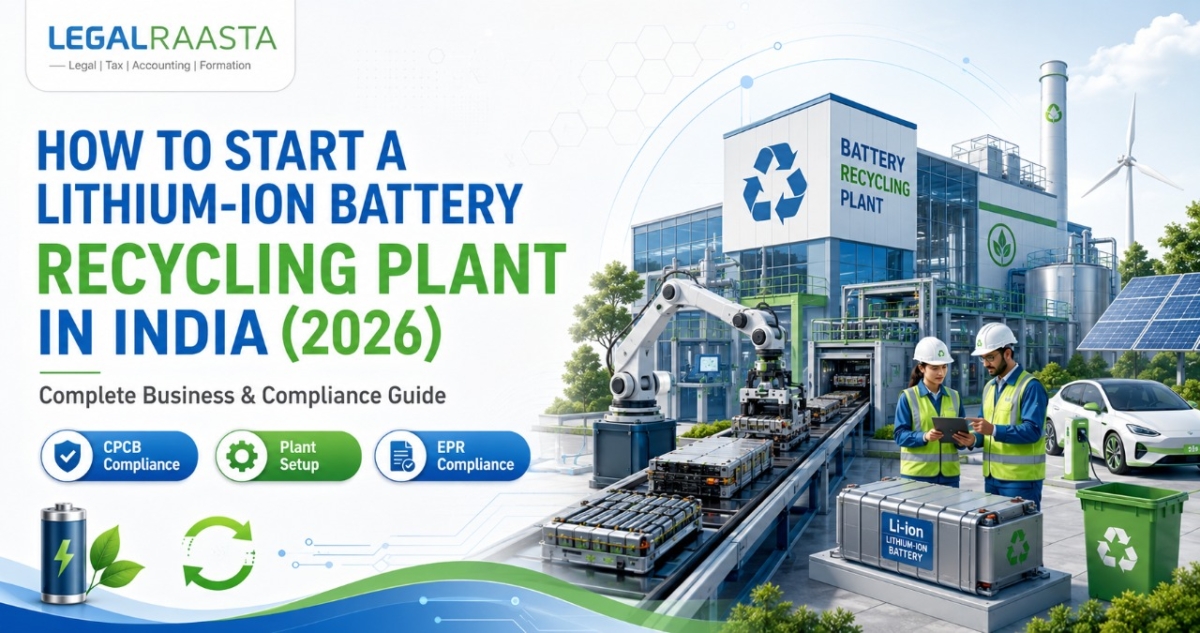
India had 1.5 million electric vehicles on the road in 2023. By 2030, that number is expected to cross 50 million. Every one of those EVs carries a lithium-ion battery that will eventually need to be disposed of. Right now, India has barely a handful of organised lithium-ion battery recycling plants to handle what is coming.
That gap is a business opportunity. Lithium, cobalt, nickel, and manganese recovered from used batteries are worth more per kilogram than most mined ore. Battery waste is classified as hazardous under Indian law, so anyone who handles it commercially must be licensed. Because the barrier to entry is regulatory, not just financial, businesses that get compliant early will dominate this space for years.
This guide covers everything you need to set up a lithium-ion battery recycling plant in India in 2026, from investment and machinery to all licenses and compliance requirements under the Battery Waste Management Rules, 2022. LegalRaasta helps battery recycling businesses obtain all required licenses, EPR authorizations, and regulatory clearances correctly, so you can start operations without compliance delays.
What Is a Lithium-Ion Battery Recycling Plant?
A lithium-ion battery recycling plant is a facility that collects, processes, and recovers valuable materials from used lithium-ion batteries. These batteries come from electric vehicles, mobile phones, laptops, power tools, and energy storage systems.
The plant breaks down old batteries through a combination of mechanical, hydrometallurgical, or pyrometallurgical processes to extract:
- Lithium: Used in new battery production
- Cobalt: High-value metal, sold to battery manufacturers globally
- Nickel: Used in stainless steel and battery cathodes
- Manganese: Battery and steel industry input
- Copper and aluminium: Recovered from current collectors
Because lithium-ion batteries contain toxic and flammable materials, the recycling process is tightly regulated under the Battery Waste Management Rules, 2022, and the Hazardous Waste Management Rules, 2016.
Why Invest in a Lithium-Ion Battery Recycling Business in India?
The business case is straightforward. India’s EV market is growing fast. Battery waste is growing with it. And domestic supply of critical minerals for battery manufacturing is almost zero.
|
Driver |
Current Status |
2030 Projection |
|
EVs on Indian roads |
1.5 million |
50 million+ |
|
Annual battery waste |
50,000 tonnes |
500,000+ tonnes |
|
Domestic cobalt supply |
Near zero |
Must be recycled |
|
Lithium import dependency |
100% |
Target 50% from recycling |
|
EPR registered recyclers |
Under 50 |
Growing fast |
Beyond the market opportunity, the government actively supports battery recycling through EPR mandates, CPCB compliance frameworks, and inclusion in the National Critical Minerals Mission. Because very few organised players exist today, early movers have pricing power over battery collection and material sales.
Investment, Land, and Machinery Requirements
Setting up a lithium-ion battery recycling plant requires capital for land, machinery, safety systems, and compliance infrastructure. Here is a realistic breakdown:
|
Component |
Small Plant (1 to 5 tonnes/day) |
Medium Plant (10 to 50 tonnes/day) |
|
Land (lease or purchase) |
2,000 to 5,000 sq ft |
10,000 to 30,000 sq ft |
|
Machinery and equipment |
Rs 50 lakh to Rs 1.5 crore |
Rs 3 crore to Rs 10 crore |
|
Safety and fire systems |
Rs 5 lakh to Rs 15 lakh |
Rs 20 lakh to Rs 50 lakh |
|
Working capital |
Rs 20 lakh to Rs 50 lakh |
Rs 1 crore to Rs 3 crore |
|
Compliance and licensing |
Rs 2 lakh to Rs 8 lakh |
Rs 5 lakh to Rs 20 lakh |
|
Total estimated investment |
Rs 80 lakh to Rs 2.5 crore |
Rs 5 crore to Rs 15 crore |
Key machinery for a lithium-ion battery recycling plant:
- Discharge and dismantling stations with ventilation
- Shredders and crushers (explosion-proof)
- Sorting and screening equipment
- Hydrometallurgical processing tanks
- Black mass processing units
- Wastewater treatment system
- Fire suppression and gas detection systems
Lithium-Ion Battery Recycling Process Explained
The recycling process at a lithium-ion battery recycling plant follows these stages in sequence:
Stage 1: Collection and Sorting
Used batteries arrive from EV manufacturers, dealers, collection centres, and EPR channels. Batteries are sorted by chemistry, size, and condition. Damaged or swollen batteries need special handling.
Stage 2: Discharge
All batteries are fully discharged before processing. This removes stored electrical energy and makes the next steps safer. Salt solution discharge baths or resistive discharge systems are used.
Stage 3: Dismantling and Shredding
Battery packs are manually or mechanically dismantled into cells. Cells are then shredded in a controlled, inert-atmosphere environment to prevent fire or gas release.
Stage 4: Black Mass Separation
Shredding produces black mass, a powder containing lithium, cobalt, nickel, and manganese compounds. Copper foil and aluminium foil are separated at this stage. Black mass is the core valuable output.
Stage 5: Hydrometallurgical Processing
Black mass is treated with acid leaching solutions to dissolve metals. Then, through solvent extraction, precipitation, and filtration, individual metals are recovered in purified form.
Stage 6: Material Sale or Reuse
Recovered metals are sold to battery manufacturers, chemical companies, or exporters. Residual waste is disposed of under hazardous waste management rules.
Licenses and Registrations Required for a Battery Recycling Plant
Every lithium-ion battery recycling plant in India needs multiple clearances before it can legally operate. Here is the complete list and which authority issues each.
|
License / Registration |
Issuing Authority |
Timeline |
|
Ministry of Corporate Affairs |
3 to 7 days |
|
|
Ministry of MSME |
1 day |
|
|
GST Council |
3 to 7 days |
|
|
Consent to Establish (CTE) |
State Pollution Control Board |
30 to 90 days |
|
Consent to Operate (CTO) |
State Pollution Control Board |
30 to 60 days after CTE |
|
Hazardous Waste Authorization |
State Pollution Control Board |
Along with CTE / CTO |
|
EPR Authorization |
CPCB |
30 to 60 days |
|
Factory License |
State Labour / Factory Inspector |
30 to 60 days |
|
Fire NOC |
Local Fire Department |
15 to 30 days |
|
Municipal Corporation |
15 to 30 days |
Company Registration
Register as a Private Limited Company or LLP through the MCA21 portal. A Private Limited Company is preferred because it allows future equity funding, creates limited liability, and is taken more seriously by banks and institutional buyers of recovered materials.
Pollution Control Board Consent to Establish and Operate
The CTE is required before construction begins. The CTO is required before operations start. Both require detailed project reports, site plans, waste management plans, and environmental impact assessments. The State Pollution Control Board conducts site inspections before issuing either consent.
EPR Authorization from CPCB
Under the Battery Waste Management Rules, 2022, a lithium-ion battery recycling plant must obtain EPR Authorization from the Central Pollution Control Board. This authorizes the plant as a registered recycler in the CPCB EPR system, allowing producers and importers to fulfill their EPR obligations through your facility.
Hazardous Waste Authorization
Lithium-ion batteries and their processing residues are listed as hazardous waste under Schedule I and II of the Hazardous Waste Management Rules. The SPCB issues Hazardous Waste Authorization as part of the CTE or CTO process. Without it, you cannot legally receive, store, or process battery waste.
Factory License and Fire NOC
Any facility employing 10 or more workers with power qualifies as a factory under the Factories Act, 1948. The Fire NOC from the local fire department is mandatory given the fire risk from lithium-ion battery processing. Fire suppression systems, emergency exits, and trained personnel are all inspected before the NOC is issued.
Battery Waste Management Rules, 2022 and CPCB Compliance
The Battery Waste Management Rules, 2022 are the primary regulations governing every lithium-ion battery recycling plant in India. Key compliance requirements include:
- Registration on the CPCB EPR portal as an authorized recycler
- Annual recycling target reporting to CPCB
- Maintenance of records for all batteries received, processed, and residues disposed of
- Submission of annual returns to CPCB covering recycling quantities and material recovery data
- Collection through only CPCB-recognized channels and EPR-registered producers
Non-compliance with the Battery Waste Management Rules can result in cancellation of EPR authorization, SPCB consent suspension, and criminal proceedings under the Environment Protection Act, 1986.
Documents Required to Start a Battery Recycling Plant
This section covers every document needed across the licensing process for a lithium-ion battery recycling plant.
Company and MSME Registration:
- PAN card and Aadhaar of all directors or partners
- Address proof of registered office
- MOA, AOA, and incorporation certificate
Pollution Control Board (CTE and CTO):
- Detailed Project Report including process flow, machinery list, and waste generation estimates
- Site plan and layout drawings
- Environmental impact assessment or Form I under EIA Notification
- Consent application with processing capacity details
EPR Authorization (CPCB):
- SPCB CTE or CTO certificate
- Company registration documents
- Details of collection network and tie-ups with producers or importers
- Technical details of recycling process and material recovery rates
Factory License:
- Building plan approval
- Machinery list with capacity
- Fire NOC certificate
Profit Margin, Revenue, and Business Opportunities
A lithium-ion battery recycling plant generates revenue from two primary sources: processing fees from producers under EPR obligations, and sale of recovered materials.
|
Revenue Stream |
Approx. Value |
|
Processing fee per tonne of battery waste |
Rs 15,000 to Rs 50,000 per tonne |
|
Cobalt recovered (per kg) |
Rs 3,000 to Rs 6,000 |
|
Lithium carbonate recovered (per kg) |
Rs 700 to Rs 1,500 |
|
Nickel recovered (per kg) |
Rs 1,200 to Rs 2,000 |
|
Copper foil recovered (per kg) |
Rs 500 to Rs 800 |
|
Aluminium recovered (per kg) |
Rs 120 to Rs 180 |
A small plant processing 2 to 3 tonnes per day can generate Rs 8 lakh to Rs 20 lakh in monthly revenue at current material prices. Net margins after operating costs typically run at 20% to 35% for well-run operations.
Common Challenges and Compliance Tips
Starting a lithium-ion battery recycling plant comes with challenges that can be managed with the right preparation.
Challenge 1: Getting SPCB consent in states with slow processing
Apply in states with established industrial zones and faster SPCB turnaround. Rajasthan, Gujarat, and Maharashtra are comparatively faster for green category or orange category industrial applications.
Challenge 2: Building a battery collection network
Start by approaching EV dealers, service centres, and mobile phone repair shops. Sign formal collection agreements before applying for EPR authorization, because CPCB requires evidence of collection capacity.
Challenge 3: Managing fire and safety risks
Invest in explosion-proof shredding equipment, thermal monitoring systems, and dedicated firefighting infrastructure from day one. The Fire NOC inspection is strict for battery recycling facilities.
Challenge 4: Black mass export regulations
Black mass is classified as hazardous waste for export purposes. Exporting it requires CPCB and MoEFCC clearances. Plan domestic processing capacity instead of relying on exports for revenue.
How LegalRaasta Can Help
Setting up a lithium-ion battery recycling plant involves more regulatory steps than almost any other manufacturing business in India. LegalRaasta manages the complete compliance stack so your plant gets operational faster.
- Private Limited Company or LLP incorporation through MCA
- Udyam MSME and GST registration
- Detailed Project Report preparation for SPCB applications
- CTE and CTO application and follow-up with State Pollution Control Board
- Hazardous Waste Authorization documentation
- EPR Authorization application and CPCB portal registration
- Factory License and Fire NOC applications
- Ongoing annual compliance filing under Battery Waste Management Rules, 2022
Conclusion
The lithium-ion battery recycling plant business in India sits at the intersection of two powerful trends. EV adoption is growing faster than any other vehicle segment. And India’s dependence on imported critical minerals is a national priority to reduce. Recycling plants that get licensed and operational in 2025 and 2026 will have a first-mover advantage in a market that is about to get very competitive.
The investment numbers are manageable for serious operators. The revenue from recovered materials and EPR processing fees makes the business financially sound. What slows most people down is the compliance stack, and that is exactly where the right support makes all the difference. Connect with LegalRaasta today and get every license, clearance, and registration for your lithium-ion battery recycling plant handled correctly from day one.
Frequently Asked Questions (FAQs)
1. What is a lithium-ion battery recycling plant and how does it work?
A lithium-ion battery recycling plant collects used batteries, dismantles and shreds them, and recovers valuable metals like cobalt, lithium, nickel, and copper through hydrometallurgical processing. In India, it operates under the Battery Waste Management Rules, 2022, and requires CPCB EPR authorization.
2. Is a lithium-ion battery recycling plant profitable in India?
Yes. A lithium-ion battery recycling plant earns from EPR processing fees of Rs 15,000 to Rs 50,000 per tonne and from selling recovered metals, including cobalt, at Rs 3,000 to Rs 6,000 per kg. Net profit margins for well-run plants range from 20% to 35%.
3. What licenses are required to start a battery recycling business in India?
To operate a lithium-ion battery recycling plant, you need company registration, Udyam MSME registration, GST registration, SPCB Consent to Establish and Operate, Hazardous Waste Authorization, CPCB EPR Authorization, Factory License, and Fire NOC from the local fire department.
4. What is EPR Authorization and why does a battery recycling plant need it?
EPR Authorization from CPCB registers your lithium-ion battery recycling plant as an official recycler under the Battery Waste Management Rules, 2022. Without it, battery producers and importers cannot legally channel their EPR obligations through your facility, cutting off a major revenue and supply source.
5. How much investment is needed to start a lithium-ion battery recycling plant in India?
A small lithium-ion battery recycling plant processing 1 to 5 tonnes per day requires Rs 80 lakh to Rs 2.5 crore in total investment. This covers machinery, land, safety systems, working capital, and compliance costs. Medium plants processing 10 to 50 tonnes need Rs 5 crore to Rs 15 crore.
6. What are the Battery Waste Management Rules, 2022 and how do they apply?
The Battery Waste Management Rules, 2022 govern every lithium-ion battery recycling plant in India. They require CPCB EPR registration, annual recycling target reporting, hazardous waste handling under SPCB authorization, and maintenance of collection and processing records submitted in annual returns to CPCB.
7. What materials are recovered from a lithium-ion battery recycling plant?
A lithium-ion battery recycling plant recovers cobalt worth Rs 3,000 to Rs 6,000 per kg, lithium carbonate at Rs 700 to Rs 1,500 per kg, nickel at Rs 1,200 to Rs 2,000 per kg, and copper foil and aluminium from current collectors, all sold to battery manufacturers and chemical companies.
8. Which states in India are best for setting up a battery recycling plant?
Gujarat, Maharashtra, and Rajasthan have comparatively faster SPCB processing for a lithium-ion battery recycling plant application. These states also have established industrial zones, better EV dealer networks for battery collection, and port access for importing battery feedstock if needed.
9. Can black mass from a lithium-ion battery recycling plant be exported from India?
Black mass produced by a lithium-ion battery recycling plant is classified as hazardous waste under Indian law. Exporting it requires CPCB and MoEFCC clearances, which are complex and slow. Most operators focus on domestic hydrometallurgical processing to convert black mass into individual recoverable metals before sale.
10. How can LegalRaasta help set up a lithium-ion battery recycling plant in India?
LegalRaasta handles every compliance requirement for a lithium-ion battery recycling plant, including company incorporation, SPCB CTE and CTO applications, Hazardous Waste Authorization, CPCB EPR Authorization, Factory License, Fire NOC, and annual Battery Waste Management Rules compliance filing, so your plant gets operational without regulatory delays.
Related Posts
Our Clients





Featured In