Difference Between Private Limited and Public Limited Company: Key Differences
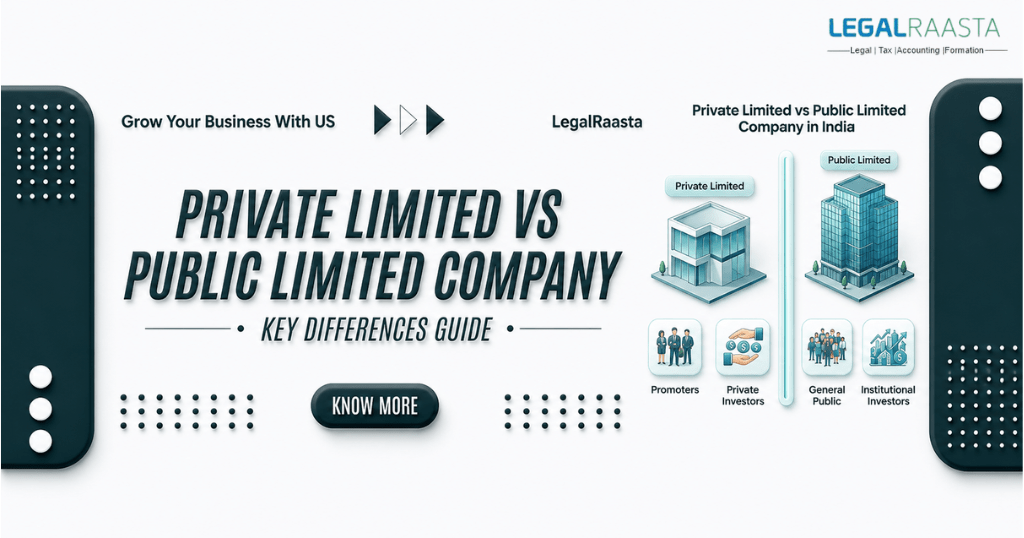
We are in the midst of a seismic change in the Indian corporate landscape that will go on into 2026. As the Ministry of Corporate Affairs (MCA) continues the digitisation of the V3 portal and simplifies the process of compliance with the Companies Act, 2013, entrepreneurs have a significant choice to make when starting their journey: Should they incorporate as a Private Limited Company or a Public Limited Company? The difference between Private Limited vs Public Limited Company structure is not merely a question of nomenclature; it determines the way that a business raises capital, how it is controlled, and the degree to which the public can take part in its development.
Although a private limited company provides its founders with a strictly closed-door setting in which they can maintain complete control over the company, a public company opens the doors to the stock market, which enables virtually unparalleled growth at the cost of extensive regulatory oversight. This is a legal, operational, and financial guide to the scintillating aspects of the relationships. Moreover, the processes of these two pillars of Indian industry in the year 2026. Starting a venture or going to IPO, LegalRaasta supports the smooth registration and compliance of your company both inside and outside.
What is a Private Limited Company? (The Boutique Powerhouse)
Section 2(68) of the Companies Act, 2013, is used to define a Private Limited Company. It is a company owned mainly by a small number of individuals, usually founders, family members, or a personal investor. Within the framework of the tech venture and SMEs, this is the most favoured type of vehicle. Since, in the context of the Startup India ecosystem of 2026 because it is restricted.
Key Characteristics:
- Membership Limits: A private company should only have a membership of at least 2 and an unlimited membership of up to 200 persons (excluding previous and current employees).
- Restricted Transfer: It is a requirement that the Articles of Association (AoA) should include statements that limit the ability of the members to transfer their shares. This helps to deter hostile takeovers and preserve the privacy of the character.
- Prohibition on Public Subscription: It is not allowed to invite the general public to subscribe to any of its securities.
- Naming Convention: It is required to include the letter Pvt. Ltd. at the end of its name, meaning that it is legally termed as Private Limited.
This structure is selected by founders because it provides a status of Separate Legal Personality and Limited Liability. It is without the added burden of complying with disclosure necessities to the general audience. While providing all the board actions. It is the perfect form of corporation that is close-held.
What is a Public Limited Company? (The Market Giant)
A Public Limited Company is simply any company except a privately held company. Which a company is defined under the provisions of the Companies Act, 2013, Section 2(71). It is meant to operate on large-scale operations where the capital requirement is way beyond the capabilities of some individuals.
Key Characteristics:
- Unlimited Membership: Although the facility needs at least 7 members to be incorporated, the number of shareholders is not restricted.
- Free Transferability: In contrast to its private equivalent, shares in a publicly listed company are free to transfer. This liquidity is one of the significant attractions to investors in 2026, when the use of retail trading apps becomes widespread.</span></span>
- Public Invitations: It may issue stock as a Prospectus to solicit the purchase of shares or debentures by the public.
- Naming Convention: It should be signed with the words Limited (Ltd.).
A publicly traded company is commonly regarded as an indicator of corporate maturity. It allows a business to go to the purse of the populace to expand, but at the cost of the Goldfish Bowl effect- your every financial action is seen by the globe.</span></span>
What is the Difference Between Private and a public company under the Companies Act, 2013?
The legal distinction between the two entities is based on certain provisions of the Act. To know the difference between a private and a public company under the Companies Act, 2013, it will take a look at the statutory requirements that have been amended from 2025 to 2026 fiscal year.</span></span>
The Governance Gap
In the provisions of Section 149(1), the minimum number of directors required by a private company is 2 directors, as opposed to 3 directors<span style=”font-weight: 400;”> in a public company. Moreover, any company with at least one board member listed as an Independent Director should include at least one-third of its board as such, a fact that most of the companies in the private category are not bound by.</span>
<h4 style=”text-align: justify;”>Capital Thresholds
“text-align: justify;”>=”font-weight: 400;”>Although these two requirements were previously eliminated by the Companies (Amendment) Act, practically, both the Companies (Amendment) Act and the minimum paid-up capital requirement demand more functional capital in practice to cover the expenses of secretarial audits needed to comply</span>
with the provisions of the Companies Act and public disclosures.</span>
Technical Comparison (Statutory Requirements 2026)
|
Parameter |
Private Limited Company |
Public Limited Company |
|
Relevant Section |
Section 2(68) |
Section 2(71) |
|
Min/Max Members |
2 / 200 |
7 / Unlimited |
|
Min/Max Directors |
2 / 15 (can increase with resolution) |
3 / 15 (can increase with resolution) |
|
Transfer of Shares |
Restricted by AoA |
Freely Transferable (Sec. 58) |
|
Quorum at AGM |
2 Members (Sec. 103) |
5 to 30 Members (Based on size) |
|
Prospectus |
Not allowed to issue |
Mandatory for public issue |
Public vs Private Company Difference: Operational & Compliance View
Depending on the status of the company, the daily existence of a company differs greatly. The most experienced public vs private company difference in 2026 is encountered in the Compliance Calendar.
Transparency and Disclosure</h4>
A public company is required to report its financ
ial performance quarterly if it is listed, or annually if it is not. It should also conduct its Annual General Meeting (AGM) by ensuring that the standards of secretarial excellence are observed. Privately listed companies are, however, also allowed some kind of exceptions that are offered under the MCA, like smaller board meetings among the “Small Companies”.</span></span>
5 Differences Between Private and Public Companies (Operational)</h4>
- Issue of Shares: An issue of shares is used by a private company by using a Private Placement or Rights
Issues; a reflective company can use an IPO.</span></span>
- Managerial Remuneration: The maximum amount of director remuneration that may be paid by a public company is 11% of net profits (under Section 197), but there is no limit on salaries that househo
lds (large or small) may pay their directors.</span></span>
- Audit Requirements: Companies that are publicly listed receive stricter Secretarial Audits as per Section 204.
- Acceptance of Deposits: Deposits may be accepted by public companies (with Section 76 exceptions); in the case of private companies, the maximum size of a deposit is limited to a member and director.</span></span>
- Index of Members:> This is required to be filled in public companies of 50 or more members; optional for private companies with 50 or more members.</span></span>
e=”text-align: justify;”>Capital Raising and Share Transferability
><span style=”font-weight: 400;”>The difference between private limited vs public limited company structures in the state sense becomes most obvious at the moment when the money talk sets in motion.</span>
<h4 style=”text-align: justify;”>The Private Route</h4>
Internal Accruals or Private Equity (VC/PE) is relied upon </span>
by privately-held companies. There are also a limited number of shares, and hence an investor cannot easily dispose of the shares by trading on an exchange. They must find a buyer whose exit is sanctioned by the board, and consequently, we are likely to have valuation-based exits, as compared to market-based exits.</span>
The Public Route
>Public companies are accelerated by the engine of the capital market. They achieve this through the allowance of a Prospectus, a matter of significant distinction between the documents of a private company and those of a public company, which provide the Invitation to Offer. In this document, there are audited financials, risk factors, and the purpose of the fundraiser. The post-listing shares are to be traded in the form of Demat (dematerialised), thus providing immediate liquidity.
Disadvantages: The Hidden Costs of Your Choice
Granted, there are advantages to both of them; they also have great weights to bear.
5 Disadvantages of a Private Company
-
-
-
- Capital Crunch:<span style=”font-weight: 400;”> You cannot request the people to give money. You are limited to 200 members.
-
- >Valuation Complexity: The absence of a stock market price means that the process of pricing shares to exit is l</li>
-
- engthy and costly.</span>
- <l
-
i style=”font-weight: 400;”>Limited Prestige:</b> The Fairness tag can be perceived as less weighty in an institutional sense when used on large international deals, in the form o</span>
-
- f a “Private” tag.</span> <li style=”font-weight: 40
0;”></li>
No Market Liquidity:<span style=”font-weight: 400;”> Shareholders have a tendency to be stuck until a marketplace bully, such as a merger or acquisition, occurs.</span></span>
- Strict Transferability: Founders are also able to bar a minority shareholder from transferring their shares to a competitor.
<b>Disadvantages of a Public Company
The major drawback is Loss of Control. You are accountable to thousands of retail shareholders once you become public. SEBI (LODR) regulations that are expensive to comply with, forced audits, and a threat of friendly takeovers make it an environment with a lot of pressure on founders who enjoy a sense of autonomy.</span></span>
Difference Between Private and Public Companies in Table Form
We have outlined the fundamental differences to help you picture the decision in 2026.
The Master Comparison Table
|
Feature |
Private Company |
Public Company |
|
Minimum Directors |
2 |
3 |
|
Maximum Members |
200 |
No Limit |
|
Suffix |
Pvt. Ltd. |
Ltd. |
|
Public Subscription |
Prohibited |
Allowed via Prospectus |
|
Statutory Meeting |
Optional |
Mandatory (for certain types) |
|
Share Warrants |
Cannot issue |
Can issue |
|
Loans to Directors |
More flexible |
Stringent under Section 185 |
|
Listing on SE |
Not possible |
Possible (BSE/NSE) </td> |
Specific Legal Clauses and 2026 Compliance
With the MCA, stricter rules in the 2026 regulatory world have taken action in the form of KYC of Directors and Active Tagging.</span></span>
<ul style=”text-align: justify;”>
-
- Section 67: It is illegal to provide any financial aid for the repurchase of shares by the company in which people will have a stake.</span></span></span>
- “font-weight: 400;”>Section 173:</b> There must be at least 4 board meetings annually, though an exception of fewer than 4 by private companies of type D (Dormant) or type S (Small) is available.</span></span>
- Digital Compliance: The entire difference between private and public company documents, such as the MGT-7 (Annual Return), and AOC-4 (Financial Statements), now must be submitted via high-level digital signatures with data validation in real time.</span></span>
<
/ul>
Adverse consequences of failure to comply with these sections include the disqualification of Directors under Section 164 and the
-
- striking off of the name of the company on the register.</span>
Conclusion: The Verdict for 2026</h3>
Making a choice on the difference between private limited vs public limited company status is a long-term strategic s
tep and determines how your company will run its course over decades. Start-up founders who want to be agile, private, and allow narrow control of their cap table cannot find a stronger competitor than the </span>Private Limited Company. But when you build a corporate heritage, the acquisition of firms in your own stock as a medium of exchange, and the beckoning of the nation to divide your revenue, the Public Limited Company will be realised as your final destination.</span></span>
But in 2026, there is a less bumpy transition happening than ever, as long as you set up the correct legal architecture at the onset of time. </span&gt;LegalRaasta provides professional advisory services on the legal aspects of the Companies Act and will help you navigate the many complexities of business structuring to make sure that the business</span>
structure remains fut</span>ure</span>-proof.</p>
FAQs
-
What’s the difference between a private company and a public company regarding members?</h3>
style=”text-align: justify;”>The main difference between a private limited vs public limited company is the limitation; in a private company, the number is restricted to 200 members, although in the case of a public company, the numb
<h3 style=”text-align: justify;”>er of shareholders is unlimited, in accordance with the Companies Act, 2013.</p>
- style=”text-align: justify;” start=”2″>
-
What is a private company’s role in a startup?
A private company is the best vehicle when starting it, since the following factors make it more desirable than a public company: as the founders retain ownership as the company stays private, but they receive limited liability and separate legal incorporation under the public vs private company difference.</p></p>
<ol style=”text-align: justify;” start=”3″>
-
What is a public company’s method of raising money?
“text-align: justify;”>Another significant difference between private and public company approaches to raising funds lies in the process of
a Prospectus being issued to the general public by a public company and not by a private one, a practice known as the private placement route.</p>
<ol style=”text-align: justify;” start=”4″>
-
What are five differences between the public and private sector corporate forms?</b>
The 5 differences between private and public company forms include: 1) Minimum members (2 vs 7), 2) Minimum directors (2 vs 3), 3) Share transfer restrictions, 4) Public invitation rights, and 5) Naming suffixes (Pvt. Ltd vs Ltd).</p>
<ol style=”text-align: justify;” start=”5″>
-
What are the 5 disadvantages of a private company’s growth?
The cons can be enumerated as a limit of 200 members, not being able to tap into the stock market, a limited liquidity of stock, difficulties in valuation, and the difference between private and public company prestige and that of a stock market when negotiating with international institutional lenders.</p>
<ol style=”text-align: justify;” start=”6″>
-
-
What is an example of a public company on the BSE?
</ul>
-
The example of Tata Motors is also an excellent illustration of the difference between private and public company stock market transparency and state transparency, as the company can provide its share prices in real-time and submit its quarterly reports publicly to millions of shareholders.</p>
<ol style=”text-align: justify;” start=”7″>
-
-
-
What is an example of a private company in India’s MSME sector?
-
-
An example of a local manufacturing company with 10 shareholders is a local privately owned company, thus the difference between a private and a public company with shareholding and without shareholding, since the owners run the company daily, free of interference with the operations of the company.</p>
<ol style=”text-align: justify;” start=”8″>
-
-
-
What is the difference between a company going public and private in 2026?
-
-
Going public is achieved through the vehicle of an IPO, to achieve the required market capitalisation, whereas going private is achieved through the vehicle of a Delisting, which is often necessary to avoid the difference between private and public company compliance costs and public scrutiny.</p>
<ol style=”text-align: justify;” start=”9″>
-
-
-
What is meant by private limited vs public limited company legal status?
-
-
This status imposes its regulatory burden on you; the difference between a private and a public company in table form reveals that the standards of rigorous auditing and disclosure imposed on a public company are much stricter.</p>
<ol>style=”text-align: justify;” start=”10″>
-
-
-
What are the disadvantages of a public company’s transparency?
-
-
The demerit of the “goldfish bowl” is that rivals can view your profit margins and risks on the variance difference between private and public company documents, such as the annual report, which should be made publicly available.</p>

Related Posts




Our Clients






Featured In