
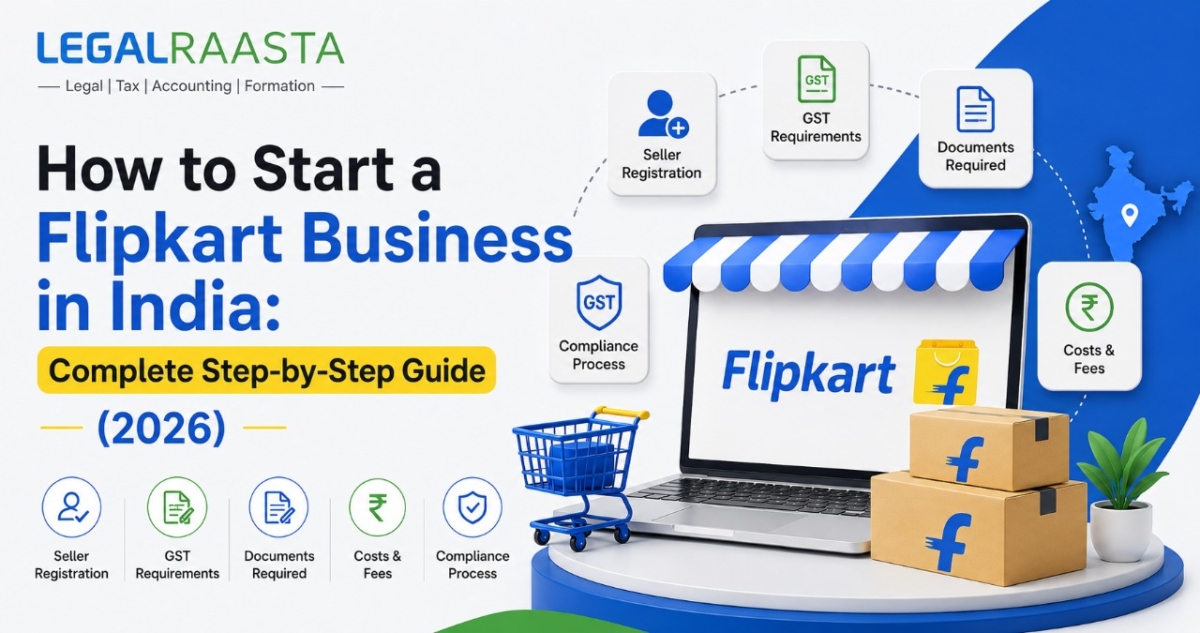
How to Start a Flipkart Business in India: Complete Step-by-Step Guide (2026)
A guy from Surat started selling bedsheets on Flipkart from his father’s textile shop in 2022. No website, no ads, no big investment. Within eight months, he was clearing Rs 3 lakh every month sitting in the same shop. Same stock, just a new channel.
Starting a Flipkart business in India in 2026 is one of the most practical things you can do if you have a product and want to reach crores of buyers without building your own store. Flipkart has over 15 lakh sellers, ships to 27,000-plus pin codes, and is still the first choice for fashion, home, and electronics buyers across tier-2 and tier-3 India. But setting it up wrong, skipping GST, choosing the wrong business structure, or ignoring brand protection can get your account suspended before you even find your feet.
LegalRaasta gets your Flipkart business legally ready from day one with company registration, GST, trademark, and complete compliance support under one roof.
Who Can Start a Flipkart Business in India?
Pretty much anyone with a product to sell. Here is what Flipkart asks for:
- Indian citizen above 18 years of age
- PAN card (personal or business)
- Active bank account in India
- GST registration number (compulsory for taxable products)
- Working email ID and phone number
Individuals and registered businesses can both sell on Flipkart. If you are just starting out with low volume, a sole proprietorship is fine. But if you are serious about growing, a Private Limited Company or LLP is the smarter foundation. Suppliers take you more seriously, GST stays cleaner, and you need it when you apply for Flipkart’s brand programs.
Documents Required to Start a Flipkart Business in India
|
Document |
Why You Need It |
|
PAN Card (personal or company) |
Identity and tax verification |
|
GST Registration Certificate |
Compulsory for taxable products |
|
Bank Account Details |
Flipkart pays settlements here |
|
Address Proof |
Business or home address |
|
Business Registration Certificate |
For companies, LLPs, partnerships |
|
Trademark Certificate (recommended) |
For Flipkart Brand Registry |
|
Cancelled Cheque or Bank Statement |
Confirms payment account |
Keep all of these ready before you begin. Missing one document during verification can delay your account by a week.
Do You Need GST to Sell on Flipkart India?
Yes, for almost everything. Flipkart makes GST registration compulsory for sellers who sell taxable goods. The only exception is sellers dealing in GST-exempt items like certain fresh produce, which is a very small category.
For e-commerce sellers, there is no minimum turnover limit. You cannot wait until you cross Rs 40 lakh. You need a GSTIN before your first listing goes live.
GST registration takes 3 to 7 working days on the government portal. Your GSTIN shows on every Flipkart invoice and is used to calculate tax on every order you get.
Which Business Structure Works Best for a Flipkart Business?
|
Structure |
Good For |
GST |
Trademark |
Investor Ready |
|
Beginners, small volume |
Yes |
Yes |
No |
|
|
2 to 3 founders |
Yes |
Yes |
Limited |
|
|
Growing sellers |
Yes |
Yes |
Partially |
|
|
Scaling, brand programs, funding |
Yes |
Yes |
Yes |
For anyone planning to grow, Private Limited Company is the right call. It gets you into Flipkart’s brand protection programs, makes wholesale suppliers take you seriously, and matters a lot if you ever want a business loan or want to sell your brand. LLP works if you want lower compliance but still want limited liability.
Step-by-Step Process to Start a Flipkart Business in India
This guide covers starting a Flipkart business from scratch, including business registration, GST setup, bank account opening, seller account creation, product listing, fulfilment setup, and brand protection.
Step 1: Register Your Business
Pick your structure and apply on the MCA21 portal. For a Private Limited Company, the SPICe+ form handles incorporation, PAN, TAN, and bank account in one single application. Takes 3 to 7 working days.
Step 2: Get GST Registration
Apply at gst.gov.in with your incorporation certificate, PAN, address proof, and bank details. GSTIN is issued within 3 to 7 working days after Aadhaar verification goes through.
Step 3: Open a Business Current Account
Flipkart pays your settlement amount into a current account. Your bank will ask for your incorporation papers, PAN, and GST certificate. Keep these ready before you walk in.
Step 4: Create Your Flipkart Seller Account
Go to seller.flipkart.com and register. You need PAN, GSTIN, bank details, and your address. Your store display name is set here, so think it through properly before you type it in.
Step 5: List Your Products
Write clear titles, honest bullet points, and upload sharp photos. Use the correct HSN code for your product category. Flipkart’s algorithm gives better placement to listings that are complete and accurate from day one.
Step 6: Choose Your Fulfilment Method
Flipkart gives you two options. Flipkart Advantage, where they store and ship from their own fulfilment centres, or self-shipping, where you pack and hand over to their logistics partner. This affects your delivery speed, seller rating, and fee structure.
Step 7: Apply for Trademark Registration
Apply for your brand trademark at ipindia.gov.in under the right product class. Even with a pending application, you can use your filing number to enrol in Flipkart Brand Registry and start protecting your listings from day one.
Flipkart Advantage vs Self-Shipping: Which One Should You Pick?
|
Factor |
Flipkart Advantage |
Self-Shipping |
|
Storage |
Flipkart fulfilment centre |
Your own space |
|
Delivery Speed |
Faster, assured delivery |
Depends on your courier |
|
Seller Rating Impact |
Better scores typically |
More variables |
|
Returns |
Flipkart handles |
You handle |
|
Cost |
FA fees apply |
Lower fees, more effort |
|
Best For |
Standard, high-volume products |
Custom or low-volume items |
Flipkart Advantage makes sense once your order volume is steady enough to justify the storage fees. When you are just starting out, self-shipping keeps costs down while you figure out what actually sells.
Flipkart Seller Fees in India
Before you price anything, know what Flipkart takes from each sale:
- Commission Fee: 3% to 25% depending on product category
- Collection Fee: Per-order charge for payment handling
- Shipping Fee: Based on product weight and delivery zone
- Fixed Fee: Per-item charge on lower-priced products
- GST on Fees: 18% GST on all Flipkart charges to sellers
Work out your margin after every single deduction before you finalise your price. New sellers who skip this math lose money on their first few hundred orders without understanding why.
Legal Compliance for Running a Flipkart Business in India
Going live is just the start. These are the ongoing obligations you need to stay on top of:
- GST Returns: File GSTR-1 and GSTR-3B monthly or quarterly as applicable
- TCS Credit: Flipkart cuts 1% TCS from your sales and pays it to the government. Claim this credit back when you file your GST returns
- Income Tax: Include all Flipkart income in your annual ITR. Most sellers file ITR-3 or ITR-4 depending on structure
- Trademark Renewal: Valid for 10 years. Renew the trademark before it lapses, or you lose access to brand programs
- Seller Performance: Flipkart tracks cancellation rate, return rate, and response time. Fall below their threshold, your listings get pulled, or your account gets suspended
Why Trademark Registration Matters for Your Flipkart Business
Without a trademark, anyone can sell under your brand name on Flipkart. A competitor can list cheap copies using your exact brand, and Flipkart cannot do much about it without legal proof from you.
With a registered trademark, you get:
- Entry into Flipkart Brand Registry
- Tools to report and remove fake or unauthorised listings
- Legal standing under the Trade Marks Act, 1999
- Stronger position when dealing with Flipkart’s seller support team
- Brand protection that covers all platforms with the same single registration
Government trademark fees start at Rs 4,500 per class for individuals and MSMEs. Full certificate takes 12 to 18 months but Brand Registry access starts from your application filing date itself.
Common Mistakes New Flipkart Sellers Make
- No GST before going live: Flipkart blocks listings immediately without a valid GSTIN
- Wrong HSN code: Causes GST mismatches and problems during tax audits
- Skipping trademark: Brand has zero legal protection from the moment you list
- Not calculating fees: Commission, shipping, and GST on fees can easily eat your margin
- Staying sole proprietor while growing: Creates problems with banks, brand deals, and investors later
- Ignoring seller metrics: Flipkart suspensions happen fast and reversing them takes time
How Much Money Do You Need to Start a Flipkart Business?
|
What You Are Spending On |
Rough Cost (Rs) |
|
Rs 5,000 to Rs 15,000 |
|
|
GST Registration |
Free |
|
Trademark Registration |
Rs 4,500 to Rs 9,000 per class |
|
Starting Inventory |
Rs 20,000 to Rs 2,00,000+ |
|
Product Photos |
Rs 3,000 to Rs 15,000 |
|
Packaging |
Rs 5,000 to Rs 20,000 |
|
First FA Shipment |
Rs 5,000 to Rs 30,000 |
|
Total to Get Started |
Rs 50,000 to Rs 3,00,000+ |
You can start a small Flipkart business with Rs 50,000 to Rs 1 lakh by picking one product, self-shipping, and keeping opening stock tight. Reaching Rs 5 to 10 lakh in monthly sales usually means putting early profits straight back into inventory.
How LegalRaasta Helps Flipkart Sellers
LegalRaasta handles the legal and compliance work so you can focus on selling:
- Private Limited Company or LLP registration through MCA
- GST registration and monthly return filing
- Trademark registration and Flipkart Brand Registry support
- MSME and Udyam registration for lower fees and easier credit
- Yearly MCA and ROC compliance filings
- Documentation help if your seller account gets suspended
Conclusion
Starting a Flipkart business in India in 2026 is one of the most realistic ways to build a real income without a big setup. You get access to crores of buyers, a delivery network that works deep into smaller cities, and tools that give new sellers the same shot as established brands.
But sellers who actually last are not just the ones with good products. They are the ones who registered properly, protected their brand early, stayed GST compliant, and ran their Flipkart store like a real business from the start.
Connect with LegalRaasta today and get your company, GST, and trademark done before your first product goes live on Flipkart.
Frequently Asked Questions
-
How do I start a Flipkart business in India?
Register your business, get GST, open a current account, then sign up at seller.flipkart.com. Your Flipkart business needs PAN, GSTIN, and bank details to go live.
-
Is GST mandatory for a Flipkart business?
Yes. Flipkart needs a valid GSTIN for most products. Without it, your Flipkart business listings get blocked before they even go live on the platform.
-
Which business structure is best for selling on Flipkart?
Private Limited Company suits a Flipkart business planning to scale or access brand programs. Sole proprietorship works only for very small, early-stage selling with low volume.
-
What documents are needed for Flipkart seller registration?
Your Flipkart business account needs PAN, GSTIN, bank details, address proof, and a business registration certificate if you are running as a company or LLP.
-
What is Flipkart Brand Registry and who can join?
Brand Registry protects your Flipkart business from fake sellers. You need a registered trademark or a valid pending application in the right product class to enrol.
-
What are the seller fees on Flipkart India?
A Flipkart business pays commission fees of 3 to 25%, collection fees, shipping charges, and 18% GST on all Flipkart charges. Calculate all of this before you set any price.
-
What is Flipkart Advantage and should I use it?
Flipkart Advantage means Flipkart stores and ships your stock. It improves delivery speed and seller ratings for your Flipkart business. Best for standard products with consistent order volume.
-
How much money do I need to start a Flipkart business?
A basic Flipkart business needs Rs 50,000 to Rs 1 lakh to start covering registration, stock, and packaging. Scaling to steady monthly revenue needs early profits reinvested into more inventory.
-
Is trademark registration needed for a Flipkart business?
Not compulsory to start but very important. Without one, your Flipkart business brand can be copied, and Flipkart has very limited ways to help without legal IP proof on your side.
-
How does LegalRaasta help with a Flipkart business?
LegalRaasta handles registration, GST, trademark, and Brand Registry support so your Flipkart business is legally protected and fully compliant from the very first day you go live.

Related Posts


Our Clients






Featured In