How to Protect Your AI Healthcare Product in India: Trademark, Copyright & Patent Guide
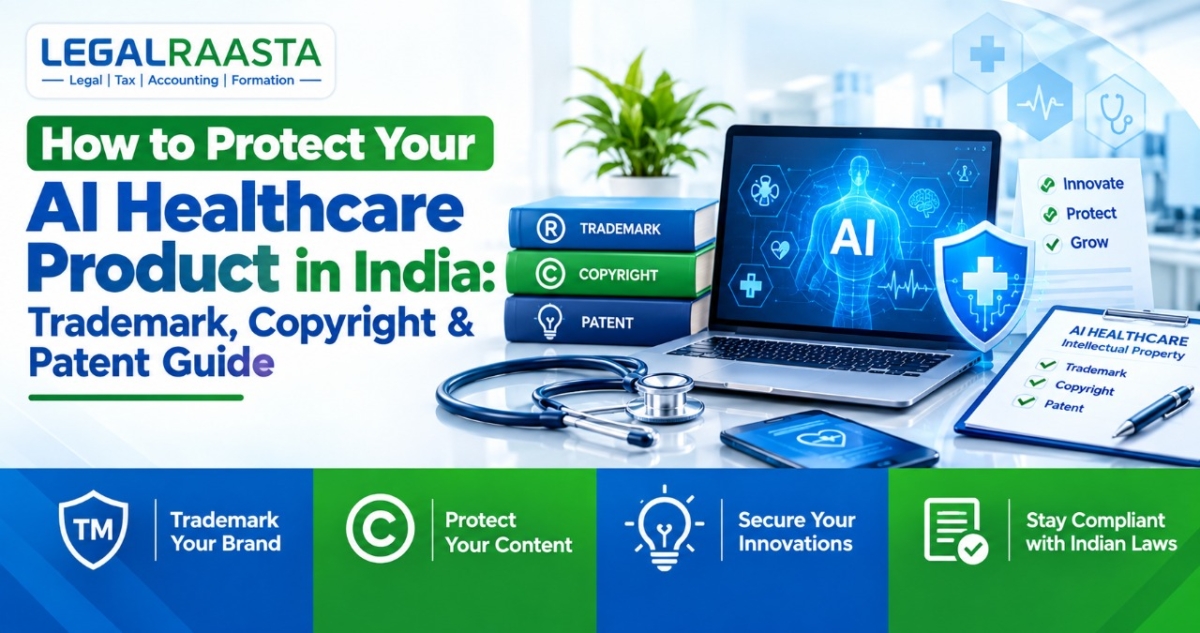
A Hyderabad health-tech team built an AI model that catches early signs of diabetic retinopathy from a phone camera photo. Genuinely useful, genuinely accurate. They filed one trademark for the brand name and figured that covered it. It didn’t. Eight months later, a competitor launched something suspiciously similar, and there was almost nothing on paper to stop them: no patent application, no documented trade secret controls, nothing beyond the logo they’d already registered. Protect your AI Healthcare Product, and you’re not looking at one filing; you’re looking at four or five moving pieces that rarely get handled together.
Patents, copyright, trademarks, trade secrets, plus CDSCO and data protection compliance sitting right alongside them. Miss one, and the gap usually shows up exactly when a competitor or an investor’s lawyer goes looking for it. This guide walks through what actually protects an AI healthcare product in India today, patent rules that changed meaningfully in 2025, copyright’s unsettled edges, and the regulatory layers that sit on top of all of it. LegalRaasta’s IP and compliance team handles this end-to-end, so get your protection strategy mapped before a competitor gets there first.
Protect Your AI Healthcare Product: Quick Overview
|
Protection Type |
Covers |
Governing Law |
|
Patent |
The technical method or system, if it clears Section 3(k) |
Patents Act, 1970 |
|
Copyright |
Source code, UI, documentation, training material |
Copyright Act, 1957 |
|
Trademark |
Brand name, logo, product identity |
Trade Marks Act, 1999 |
|
Trade Secret |
Algorithms, model weights, training datasets |
Contract and confidentiality law, no dedicated statute |
|
Regulatory Compliance |
Safety and data handling, not IP itself |
MDR 2017 (CDSCO), DPDP Act, 2023 |
What Is an AI Healthcare Product?
An AI healthcare product is any tool using machine learning or algorithmic logic to support a medical purpose, diagnostic imaging software, triage systems, predictive risk models, even a chatbot handling patient symptom checks. Some run standalone. Others sit bundled inside hardware, a wearable, a diagnostic device, a monitoring system. What counts as “the product” for IP purposes usually includes the algorithm, the training data, the interface, and the brand wrapped around all of it, and each of those pieces needs a different kind of protection.
What Types of Intellectual Property Can Protect an AI Healthcare Product?
No single IP filing covers everything here, and that’s exactly why founders under-protect these products so often.
|
IP Type |
Best Suited For |
Registration Needed? |
|
Patent |
The underlying technical method, if genuinely novel |
Yes, examined application |
|
Copyright |
Code, documentation, UI design |
No, automatic on creation, registration optional |
|
Trademark |
Product and company branding |
Yes, examined application |
|
A distinctive device or interface appearance |
Yes, if applicable |
|
|
Trade Secret |
Model architecture details, training data, weights |
No, protected through confidentiality instead |
Can an AI Healthcare Product Be Patented in India?
Sometimes, and the rules around this shifted meaningfully in 2025. Section 3(k) of the Patents Act, 1970 excludes “a mathematical or business method or a computer programme per se or algorithms” from patentability. That word “per se” carries the entire debate.
Courts and the Indian Patent Office have consistently held that an invention isn’t excluded just because it involves an algorithm; the exclusion only bites when the claim is directed at nothing more than the algorithm itself. The CRI Guidelines 2025, notified by the Controller General of Patents, Designs and Trade Marks on 29 July 2025, finally codified this into a structured test built around “technical effect” and “technical contribution,” replacing outdated 2017 guidance that never even defined those terms clearly. An AI diagnostic tool that measurably improves a technical process- faster detection, better accuracy on a defined clinical task- has a real shot. A patent application describing only what the model outputs, without explaining how it gets there, generally doesn’t.
The Guidelines also settled something founders kept asking about: whether an AI system itself can be named as inventor. It can’t. Indian law still requires a human inventor, so however autonomous your model’s outputs look on paper, a person behind the invention needs to be named on the application.
How to Patent an AI Healthcare Product in India
Filing well means anticipating exactly what an examiner will ask for under the new framework.
Step 1: Confirm You Have a Technical Contribution
Frame the invention around a concrete technical improvement, not just a better prediction or output.
Step 2: Document the Full Technical Stack
Disclose model architecture, training dataset characteristics, pre-processing steps, and validation results in the specification; vague disclosure fails on sufficiency grounds now.
Step 3: Draft Claims Carefully
Avoid claims that read as pure algorithm or business logic; tie every claim back to the technical effect.
Step 4: File With the Patent Office
Submit through the appropriate patent office with complete specifications and required forms.
Step 5: Respond to Examination
Expect Section 3(k) objections even on strong applications, and respond by pointing directly to the technical contribution, not the algorithm’s cleverness.
Copyright Protection for AI Healthcare Software and Content
Copyright covers your code, your UI, your documentation, automatically, the moment it’s created; no registration required. Where AI complicates things is authorship of anything the model itself generates. Section 2(d)(vi) of the Copyright Act, 1957 defines the author of a computer-generated work as “the person who causes the work to be created,” a test that still leaves genuine grey area around outputs with little human creative direction behind them. For an AI healthcare product, this mostly matters for generated reports, visualisations, or documentation; the underlying source code itself is on much firmer copyright footing regardless of how it was written.
Trademark Protection for AI Healthcare Products
Your product name, logo, and any distinctive branding around the AI tool need their own trademark registration, separate entirely from whatever patent or copyright protection covers the technology itself. Trademark law doesn’t care whether AI helped design your logo or name; it cares about distinctiveness and whether the mark clashes with something already registered. Skipping this step is common among health-tech founders focused entirely on the technology, and it’s an easy gap for a competitor to exploit.
Protecting AI Algorithms, Models and Training Data as Trade Secrets
India has no dedicated trade secrets statute, unlike the US or EU, so this protection runs entirely through contract and confidentiality law instead. That makes the paperwork around it non-negotiable, and it’s usually the cheapest, fastest layer of protection a startup can put in place, often within a week, well before a patent application or CDSCO clearance is anywhere close to ready.
- Employee and contractor NDAs covering anyone with access to model architecture or training data
- Access controls limiting who inside the company can view core algorithm details
- Confidentiality clauses in investor and partner agreements, since due diligence conversations are a common leak point
- Clear internal documentation of what’s classified as confidential, since courts look for evidence the company actually treated it as secret
AI Healthcare Product and Medical Device Compliance in India
None of the IP protections above substitute for regulatory clearance, and this is where AI healthcare products face rules ordinary software never touches. If your product makes a diagnostic or clinical decision, it likely falls under CDSCO’s Medical Device Rules, 2017, classified using the same Class A-D risk system every device uses, based on function rather than the mere presence of AI. A basic symptom-checker sits closer to Class A, while an AI tool reading scans to flag potential cancer typically lands in Class C or above, given the direct clinical stakes involved.
CDSCO issued a final Medical Device Software guidance on 21 July 2026, covering algorithm documentation, dataset validation, and change management for exactly this category of product. It expects training dataset provenance to be documented well enough that reviewers can judge whether the data actually represents the population the product will serve in practice. Selling an AI diagnostic tool without this clearance isn’t a grey area; it’s a straightforward compliance violation regardless of how strong your patent position looks.
Data Protection and Privacy Considerations for AI Healthcare Products
Healthcare data is about as sensitive as personal data gets, and the Digital Personal Data Protection Act, 2023 applies directly to any AI healthcare product processing patient information. The Act’s substantive obligations- consent, breach notification, and data principal rights- come into full force on 14 May 2027, but the groundwork- consent flows, data retention policies, breach response plans- takes real time to build properly, and building it under deadline pressure rarely produces something an auditor is happy with. An AI model trained or fine-tuned on patient data also needs a defensible legal basis for that processing, not just a checkbox buried in a terms of service page nobody reads, and that basis needs documenting well before the model ever reaches production.
Documents Required to Protect an AI Healthcare Product
|
Document |
Needed For |
|
Technical specification with architecture details |
|
|
Source code and version history |
Copyright evidence, if disputed |
|
Brand name, logo, and usage samples |
Trademark application |
|
NDA templates and access logs |
Trade secret protection |
|
CDSCO classification and test reports |
Medical device compliance |
|
Data protection impact assessment |
DPDP Act compliance |
Cost of Protecting an AI Healthcare Product in India
Budgets vary widely, but a realistic range helps founders plan rather than guess.
|
Protection Type |
Typical Cost Range |
|
Patent filing and prosecution |
Rs 40,000 to Rs 2,00,000+ depending on complexity |
|
Trademark registration |
Rs 4,500 to Rs 9,000 per class |
|
Copyright registration (optional) |
Rs 500 to Rs 2,000 per work |
|
Rs 5,000 to Rs 2,50,000 depending on device class |
|
|
Legal setup for trade secrets |
Varies, mostly legal drafting time |
Common IP Mistakes AI Healthcare Startups Should Avoid
Most gaps trace back to founders treating one filing as if it covers everything.
- Assuming a trademark protects the underlying AI technology too
- Filing a patent application that describes only outputs, not the technical method behind them
- Skipping NDAs with early contractors who touched core model architecture
- Treating CDSCO clearance as optional because “it’s just software”
- Building on patient data without a documented legal basis under the DPDP Act
AI Healthcare IP Protection Strategy: What Should You Protect First?
Sequencing matters more than founders think, since some protections take months and others take days.
- Trade secret controls first; NDAs and access limits cost almost nothing and protect immediately
- Trademark early, before public launch, since a delayed filing risks losing the name to someone else
- Patent application before public disclosure; publishing details before filing can destroy novelty
- CDSCO classification alongside development, not after the product is market-ready
- DPDP compliance groundwork in parallel, since consent flows take time to build properly
Benefits of Protecting Your AI Healthcare Product
A properly protected product is easier to fund, harder to copy, and safer to scale. Investors specifically ask about IP position during due diligence, and a founder with nothing to show beyond “we have a great model” faces harder questions than one with a filed patent application and a registered trademark already in place. Hospitals and enterprise buyers ask similar questions too, since procurement teams increasingly want proof that a vendor’s technology and data handling are both properly locked down before signing anything.
Get Professional Help to Protect Your AI Healthcare Product
Coordinating patent, trademark, CDSCO, and DPDP compliance across separate advisors usually means gaps fall through the cracks between them. LegalRaasta’s team handles the full picture together: patent strategy under the CRI Guidelines 2025, trademark filing, CDSCO classification, and DPDP Act readiness, so nothing gets protected in isolation while everything else waits.
Conclusion
Protect your AI Healthcare Product properly, and you’re covering patent, copyright, trademark, trade secrets, and two separate regulatory regimes, not filing one form and calling it done. The 2025 CRI Guidelines make patents genuinely achievable for AI healthcare inventions with real technical substance behind them, but every other layer still needs its own attention. Talk to LegalRaasta before your next funding round or product launch, so your protection strategy isn’t the thing investors find missing.
If your legal and compliance groundwork is solid but almost nobody outside your existing network has actually heard of your product, that gap is worth closing too. CloudGeta (cloudgeta.com) builds the websites, runs the SEO, and handles the digital marketing that gets a genuinely good health-tech product in front of the hospitals and patients who’d actually use it.
Frequently Asked Questions About AI Healthcare IP Protection in India
1. Can you patent an AI healthcare product in India?
Yes, if it clears Section 3(k). The 2025 CRI Guidelines make this genuinely achievable now for anyone trying to Protect Your AI Healthcare Product, provided the application shows real technical contribution.
2. Does copyright automatically protect AI healthcare software?
Yes, source code is protected the moment it’s written; no registration needed. Founders looking to Protect Your AI Healthcare Product should still register copyright for stronger evidence in disputes.
3. Is a trademark enough to protect an AI healthcare product?
Not even close. A trademark only covers your brand name and logo. Anyone serious about AI Healthcare Product protection in India needs patent and trade secret coverage too.
4. What is the biggest patent mistake AI healthcare startups make?
Describing only what the model predicts, not how it gets there. That single gap sinks more applications trying to Protect Your AI Healthcare Product than any Section 3(k) technicality does.
5. Does an AI healthcare product need CDSCO approval?
Almost certainly, if it supports a diagnosis or clinical decision. Regulatory clearance runs entirely separate from IP protection, so Protect Your AI Healthcare Product plans need both tracks moving together.
6. How does the DPDP Act affect AI healthcare products?
It governs how patient data gets collected, used, and protected. Full enforcement lands in May 2027, but founders planning to Protect Your AI Healthcare Product shouldn’t wait until then to prepare.
7. Can training data be protected as a trade secret in India?
Yes, through contracts rather than a dedicated law. India has no standalone trade secrets statute, so protecting an AI Healthcare Product‘s data relies entirely on NDAs and access controls.
8. Should a startup file a patent before or after launching an AI healthcare product?
Before, always. Public disclosure before filing can destroy novelty entirely. Anyone hoping to Protect Your AI Healthcare Product through patents needs to file first, launch second.
9. What happens if a competitor copies an AI healthcare product’s algorithm?
Recourse depends entirely on what’s actually protected. Without a patent or solid trade secret controls, options to Protect Your AI Healthcare Product after the fact narrow considerably.
10. Can LegalRaasta help protect an AI healthcare product across all these areas?
Yes, patents, trademarks, CDSCO classification, and DPDP compliance together. Coordinating all of it is exactly how founders genuinely Protect Your AI Healthcare Product, not through scattered, one-off filings.

Related Posts
 CDSCO
CDSCO
AI-Driven Medical Device Registration in India: CDSCO Process, Fees & Requirements
Read More → CDSCO
CDSCO
CDSCO Registration for Disposable Medical Devices in India: Eligibility, Process, Documents, Fees & Compliance
Read More →
Our Clients




Featured In