
ROC Registration in India: Process, Documents, Eligibility & Key Requirements
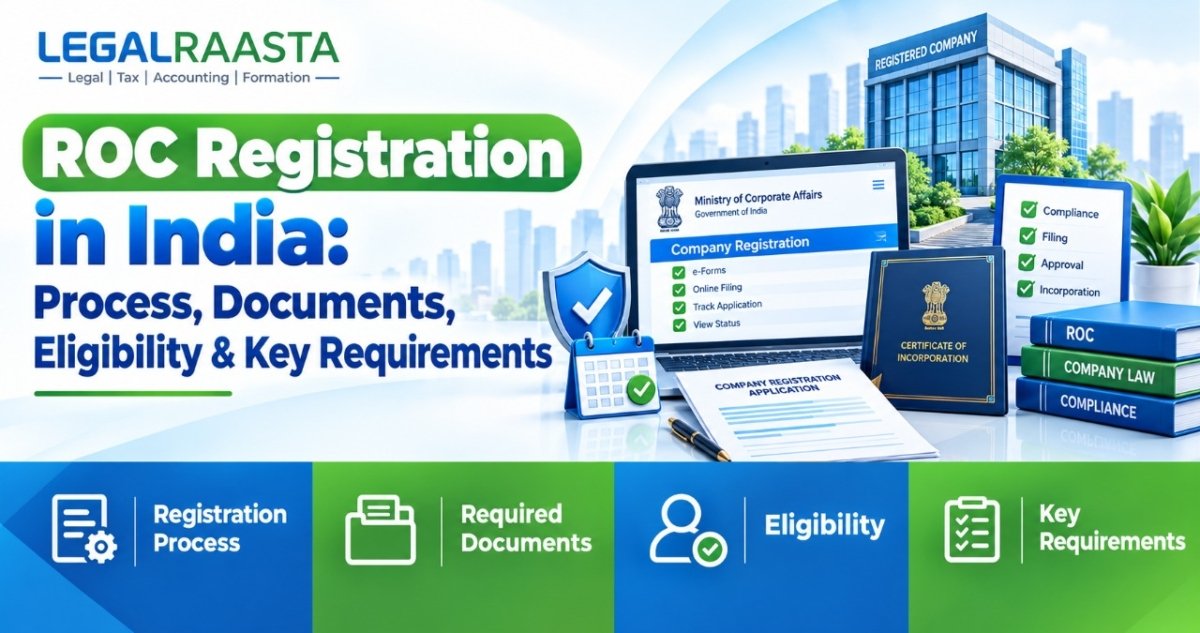
A Chennai founder found out the hard way. His company had a Certificate of Incorporation, a working office, and paying customers. What it didn’t have was a single AOC-4 filed in three years. The bank loan he needed got rejected on the spot, ROC records showed a company that looked abandoned on paper, even though it was very much alive and trading. ROC Registration isn’t just the one-time paperwork that gets your company its incorporation certificate. It’s an ongoing relationship with the Registrar of Companies that keeps your business legally alive on record, year after year.
Miss that second half, and the first half stops mattering much, no matter how well the actual business is doing. This guide walks through both sides of it, getting ROC registered and staying registered properly. LegalRaasta’s compliance team handles this daily for companies of every size, so bring your specific situation to them before a lender or investor finds the gap first.
ROC Registration in India: Quick Answer
|
Detail |
Information |
|
Authority |
Registrar of Companies, under the Ministry of Corporate Affairs |
|
Governing law |
Companies Act, 2013 |
|
Portal |
|
|
Incorporation form |
SPICe+ |
|
Government fee |
Nil, for authorised capital up to Rs 15 lakh |
|
Mandatory for |
Every registered company, regardless of size |
What Is ROC Registration in India?
ROC Registration is the process of getting a company officially recorded with the Registrar of Companies, the government office responsible for incorporating companies and tracking their compliance for life. It starts with incorporation and doesn’t end there. Every annual filing, every director change, every document you submit afterward still runs through the same ROC record.
There’s no separate “off-boarding” from this relationship either, short of formally winding up the company or getting it struck off. As long as your company legally exists, it stays on the ROC’s books, and that record is exactly what a bank, an investor, or a government tender committee checks before trusting your business with money or a contract.
What Is the Role of the Registrar of Companies (ROC)?
The ROC issues your Certificate of Incorporation, maintains your company’s master data, and reviews every filing you submit afterward. Think of it as the government’s permanent file on your company. Miss a filing, and that gap shows up publicly on the MCA portal for anyone, a bank, an investor, a competitor, to see.
Is ROC Registration Mandatory for Companies in India?
Yes, without exception. Every private limited company, public company, OPC, and Section 8 company must complete ROC Registration before it can legally operate, sign contracts, or open a business bank account. There’s no size threshold that exempts a company from this, a two-person startup follows the same rule as a large enterprise.
Eligibility for ROC Registration in India
Any group of promoters meeting the Companies Act’s basic requirements can apply, minimum two directors and two shareholders for a private company, one for an OPC, at least one resident director on the board, and a registered office address in India. Foreign nationals can be directors too, provided the residency condition is met by at least one board member.
Types of Companies That Require ROC Compliance
Every company type follows ROC rules, though the specific forms and thresholds shift slightly by structure.
|
Company Type |
ROC Compliance Applies? |
Notes |
|
Yes |
Full annual filing set required |
|
|
Yes |
Additional disclosure requirements |
|
|
Yes |
Simplified MGT-7A instead of MGT-7 |
|
|
Yes |
Same filings, plus charitable-purpose restrictions |
|
|
Separately regulated |
Files Form 8 and Form 11, not standard ROC company forms |
Documents Required for ROC Registration in India
Getting these ready before you start saves a filing from bouncing back on a technicality.
|
Document |
Purpose |
|
Identity and address proof of directors |
Confirms director identity |
|
PAN card of all directors |
Mandatory for Indian directors |
|
Registered office proof |
Utility bill or rent agreement |
|
Required to sign forms electronically |
|
|
Defines company objects and internal rules |
|
|
NOC from property owner |
If office is rented or shared |
ROC Registration Process in India: Step-by-Step
Filing runs entirely online through MCA21 V3, and following the sequence properly avoids most rejection headaches.
Step 1: Reserve Your Company Name
File SPICe+ Part A to check availability and reserve your proposed name with the ROC.
Step 2: Obtain Digital Signature Certificates
Get DSCs issued for every proposed director before moving further.
Step 3: Prepare Incorporation Documents
Draft the MOA, AOA, and director declarations required for SPICe+ Part B.
Step 4: File SPICe+ Part B
Submit the complete incorporation application with TAN, PAN, and EPFO/ESIC registration bundled in.
Step 5: Receive the Certificate of Incorporation
Once the ROC approves, you get your Certificate of Incorporation along with your Corporate Identification Number.
Important ROC Forms and Filings
A handful of forms cover almost everything a company files with the ROC across its lifetime.
|
Form |
Purpose |
Frequency |
|
SPICe+ |
Company incorporation |
One-time |
|
AOC-4 |
Filing financial statements |
Annual |
|
MGT-7/MGT-7A |
Filing annual return |
Annual |
|
Director KYC verification |
Once every 3 years |
|
|
DIR-12 |
Director appointment or resignation |
As triggered |
ROC Registration Fees and Government Charges
Costs stay modest for most small companies, since the fee structure favours lower authorised capital.
|
Item |
Fee |
|
Incorporation, capital up to Rs 15 lakh |
Nil |
|
Name reservation (standalone) |
Rs 1,000 |
|
DIR-3 KYC (on time) |
Nil |
|
Late filing penalties |
Rs 100 per day, uncapped |
ROC Annual Compliance Requirements
Registration doesn’t end at incorporation, and this is the part companies underestimate most often.
Every company needs to hold its Annual General Meeting, get its accounts audited, and file AOC-4 and MGT-7 within the prescribed windows every single year, regardless of whether the business turned a profit, broke even, or sat dormant. Directors also need DIR-3 KYC current, now required once every three years instead of annually, a change that trips up compliance calendars still running on the old schedule. A Companies Compliance Facilitation Scheme introduced in 2026 has eased penalties during the ongoing shift to MCA21 V3, but that relief won’t run forever, and relying on it instead of filing properly is a risky bet. Treating annual compliance as a once-a-year scramble, rather than something tracked month to month, is exactly how small errors turn into bigger, costlier ones.
ROC Filing Due Dates and Penalties
Missing these dates costs real money, and the penalty structure doesn’t taper off gently.
|
Filing |
Due Date |
Penalty for Delay |
|
AOC-4 |
30 days from AGM |
Rs 100/day, uncapped |
|
MGT-7/MGT-7A |
60 days from AGM |
Rs 100/day, uncapped |
|
DIR-3 KYC |
Once every 3 years, by 30 June |
Rs 5,000 flat, plus DIN deactivation |
Repeated defaults over three consecutive years can trigger director disqualification under Section 164 of the Companies Act, blocking that person from directorship anywhere else too.
Common Mistakes to Avoid During ROC Filing
Most penalties trace back to a handful of avoidable slip-ups, not genuinely complicated disputes.
- Assuming DIR-3 KYC is still an annual requirement after the shift to a three-year cycle
- Filing AOC-4 before the AGM actually happens, when the sequence needs to run the other way
- Ignoring a DSC mismatch until a form gets rejected outright
- Ignoring the ROC compliance calendar until a bank or investor asks for clean records
- Letting a dormant company skip filings entirely, assuming inactivity means exemption
ROC Registration vs Company Registration: What’s the Difference?
These two get used interchangeably, but there’s a genuine, useful distinction worth knowing. Company Registration usually refers to the one-time act of incorporating, getting your Certificate of Incorporation and closing that chapter. ROC Registration is the broader, ongoing relationship, incorporation plus every filing, renewal, and compliance obligation that follows for as long as the company exists. A company can complete Company Registration in a week. Staying properly ROC-registered, in good standing, is a permanent job that doesn’t end until the company itself does.
Founders who treat these as the same thing tend to relax right after incorporation, exactly when the real work of staying compliant is only just starting.
How LegalRaasta Can Help With ROC Registration & Compliance
Getting ROC Registration in India is the easy part. Staying compliant year after year, across DSC renewals, DIR-3 KYC cycles, and annual filings, is where most founders lose track. LegalRaasta’s team handles company registration from SPICe+ filing through to ongoing annual compliance, tracking every deadline so a missed AOC-4 doesn’t cost you a loan approval or a clean due diligence report later.
Conclusion
ROC Registration in India is the foundation your entire company legally stands on, and it doesn’t stop mattering once the incorporation certificate arrives. Annual filings, director KYC, and staying ahead of penalty-heavy deadlines are just as much a part of this as the original registration was. Talk to LegalRaasta before your next filing deadline sneaks up on you.
If your compliance paperwork is finally in order but your company’s website still looks like an afterthought, that’s worth fixing too. CloudGeta (cloudgeta.com) builds websites and handles the SEO and digital marketing that gets a properly registered business actually found online.
Frequently Asked Questions About ROC Registration in India
1. Is ROC registration mandatory for a private limited company?
Yes, no exceptions. Every private limited company needs ROC Registration in India before it can legally sign contracts or open a bank account, regardless of size or turnover.
2. What documents are required for ROC registration?
Director ID and address proof, PAN, EPFO, registered office proof, and a Digital Signature Certificate top the list. ROC Registration in India also needs MOA and AOA drafted before filing.
3. How long does ROC registration take?
Usually 7 to 10 working days for a clean SPICe+ filing. Delays in ROC Registration in India almost always trace back to document mismatches, not the portal itself being slow.
4. What happens if a company fails to comply with ROC requirements?
Penalties start accumulating immediately, Rs 100 a day for late AOC-4 or MGT-7. Repeated failures under ROC Registration obligations can lead to director disqualification eventually.
5. What is the difference between ROC registration and ROC filing?
Registration is the one-time incorporation event. Filing is the recurring annual submission of forms like AOC-4. ROC Registration in India covers both, filing is just one ongoing piece of it.
6. Is ROC registration the same for LLPs as it is for companies?
Not quite. LLPs file Form 8 and Form 11 instead of the standard company forms. ROC Registration in India for an LLP still runs through the ROC, just under separate LLP-specific rules.
7. Can ROC registration be done online?
Yes, entirely, through the MCA21 V3 portal using SPICe+. Nobody needs to visit a ROC office physically to complete ROC Registration in India today, the whole process runs digitally.
8. What is the fee for ROC registration in India?
Nil, for companies with authorised capital up to Rs 15 lakh. Beyond that threshold, ROC Registration fees scale up based on the capital slab declared at incorporation.
9. Does a Section 8 company need ROC registration too?
Yes, the same as any other company. ROC Registration in India for a Section 8 company follows identical annual filing rules, alongside its separate charitable-purpose restrictions under the license.
10. Can ROC registration be cancelled or revoked?
Yes, through a strike-off process if a company stops filing for years. Restoring ROC Registration in India after that point is possible but involves a separate, more complicated NCLT process.

Related Posts
 Company Registration
How to Improve Company Compliance in India: A Complete Guide for Businesses
Read More →
 Company Registration
Company Name Reservation in India (2026): MCA Process, Rules, Fees & Approval
Read More →
Our Clients








Featured In