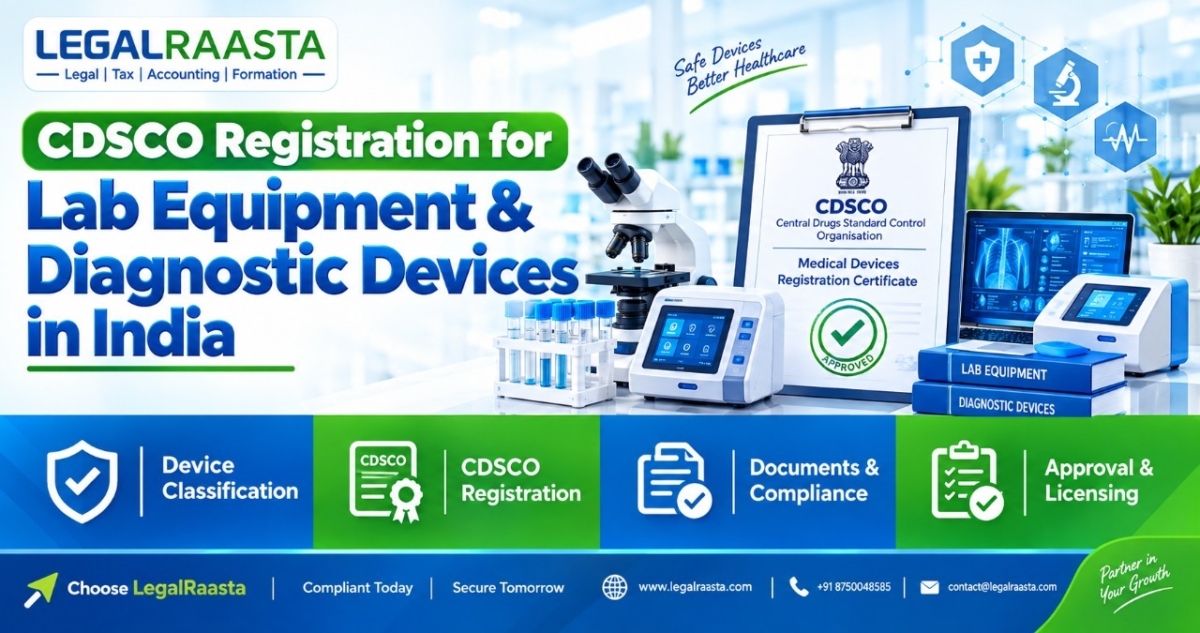
CDSCO Registration for Lab Equipment & Diagnostic Devices in India
A Pune diagnostics lab imported a new analyzer last year, assuming it fell outside CDSCO’s reach, since it was “just an instrument,” not a test kit. Customs held the shipment for three weeks. The instrument, it turned out, had been brought under the same regulatory net as the diagnostic kits it ran, years after an older rule once said otherwise. Nobody on the import team had checked whether that older guidance still applied. CDSCO Registration for Lab Equipment & Diagnostic Devices covers more ground than most importers and manufacturers expect, and the rules around instruments specifically shifted since the early days of the Medical Devices Rules, 2017.
What used to sit outside CDSCO’s scope often doesn’t anymore. Getting this wrong costs weeks at port, sometimes months, and occasionally a shipment that has to be re-exported entirely. This guide walks through classification, the actual registration process, and a genuinely new 2026 development most competitor content hasn’t caught up with yet. LegalRaasta’s regulatory team handles exactly this kind of filing, so get your device classified correctly before you ship or manufacture another unit.
CDSCO Registration for Lab Equipment & Diagnostic Devices: Quick Answer
|
Question |
Answer |
|
Governing law |
Medical Devices Rules, 2017, under the Central Drugs Standard Control Organisation |
|
Classification rule for IVDs |
Rule 4, based on First Schedule Part II criteria |
|
Are lab instruments and analyzers covered? |
Yes, phased in since the early MDR 2017 rollout |
|
New 2026 development |
Online IVD Risk-Classification Module, effective 2 February 2026 |
|
Portal |
|
|
New IVD forms |
MD-28 (application), MD-29 (permission) |
What Is CDSCO Registration for Lab Equipment & Diagnostic Devices?
It’s the mandatory clearance from the Bureau’s drug regulator that permits manufacturing, import, or sale of laboratory instruments and in-vitro diagnostic devices in India. That covers diagnostic kits, reagents, analyzers, and the instruments that run them, all under the same Medical Devices Rules, 2017 framework, though the specific classification and licensing path differs by device type and risk level.
Which Lab Equipment and Diagnostic Devices Require CDSCO Compliance?
Almost anything used for diagnosis, from a simple rapid test strip to a full molecular sequencing platform, falls under this net today.
- Diagnostic reagent kits and test strips
- Blood and specimen collection tubes
- Diagnostic analyzers and instruments
- Software driving or interpreting diagnostic results
- Point-of-care testing devices
- Laboratory testing equipment used specifically for in-vitro diagnosis
CDSCO Classification of Medical Devices and IVDs
Classification decides your entire regulatory path, and IVDs follow their own specific rule within the broader framework.
Rule 4 of the Medical Devices Rules, 2017 sets out four risk classes for IVDs, A through D, based on intended use and criteria under Part II of the First Schedule. The Central Licensing Authority classifies every IVD centrally, regardless of which authority eventually issues the manufacturing licence. A specimen collection tube, for instance, sits in Class A under this framework, while a molecular diagnostic kit for a serious infectious disease typically lands in Class C or D given the clinical stakes involved.
CDSCO tightened this further with an October 2025 directive to State Licensing Authorities, making clear that no IVD licence can be issued for a device that hasn’t first cleared central classification. That closed a gap where some SLAs had, in practice, licensed products without confirming classification through the CLA first. Since then, classification genuinely has to come before licensing, not alongside it or as an afterthought during examination.
CDSCO Registration vs CDSCO License: What Is the Difference?
These terms get used loosely, and the distinction matters more than people assume. Registration, in the lighter sense CDSCO uses for certain lower-risk categories, involves less scrutiny and no mandatory factory inspection. A full manufacturing licence, required for higher-risk IVDs and most lab equipment falling under Class C or D, involves detailed technical review and often a site inspection before approval.
Who Can Apply for CDSCO Registration/Approval?
Indian manufacturers apply directly through the SUGAM portal. Foreign manufacturers without an Indian legal presence must appoint an Authorised Indian Representative to file on their behalf, since CDSCO doesn’t accept applications from entities without a legal footprint in India. Laboratories themselves, seeking to conduct IVD performance evaluation on behalf of a manufacturer, apply separately for their own registration too.
CDSCO Registration Process for Lab Equipment & Diagnostic Devices
The process runs through a handful of stages, and the exact route depends on whether your product already has a published classification.
Step 1: Confirm the Device Classification
Check the product against CDSCO’s published IVD classification list before doing anything else.
Step 2: Use the Risk-Classification Module If Unlisted
For a device with no existing classification, submit intended use, technology, and device principle details through CDSCO’s Risk-Classification Module.
Step 3: Arrange Performance Evaluation
Get the device tested at a CDSCO-recognised laboratory for IVD performance evaluation.
Step 4: File the Application
Submit through SUGAM, using the appropriate form based on classification and manufacturing route.
Step 5: Respond to Review Queries
Address any technical or documentation queries CDSCO raises during examination.
Step 6: Receive the Licence or Permission
Once approved, you receive your licence number or, for a genuinely new IVD, Form MD-29 permission.
Documents Required for CDSCO Registration
|
Document |
Purpose |
|
Device Master File |
Technical details of the product |
|
Performance evaluation report |
From a CDSCO-recognised testing laboratory |
|
Intended use and classification justification |
Confirms Rule 4 classification claimed |
|
Constitution/incorporation documents |
Confirms applicant’s legal identity |
|
Authorised Indian Representative agreement |
Required for foreign manufacturers |
|
Labelling and packaging artwork |
Confirms compliant labelling |
CDSCO Fees for Lab Equipment & Diagnostic Devices
Fees scale with classification and manufacturing route, following the same structure as other medical devices under MDR 2017.
|
Category |
Government Fee |
|
Manufacturing, Class A/B |
Rs 5,000 site fee, plus Rs 500 per product |
|
Manufacturing, Class C/D |
Rs 50,000 site fee, plus Rs 1,000 per product |
|
Import, any class |
Approximately Rs 83,300 to Rs 2,49,900, plus USD 1,000 per product |
Always confirm the exact current figure on the SUGAM portal, since CDSCO revises fee schedules periodically.
How Long Does CDSCO Registration Take?
Class A and B lab equipment and IVDs typically clear in 3 to 6 months from a complete application. Class C and D products, and any genuinely new IVD without an existing classification, often take 9 to 15 months, since classification queries and performance evaluation reviews both add real time to the process.
CDSCO Requirements for Imported Lab & Diagnostic Devices
Import applications route through the Central Licensing Authority regardless of the device’s risk class. A foreign manufacturer’s Authorised Indian Representative files the application, holds the resulting licence, and carries ongoing responsibility for post-market surveillance and adverse event reporting once the product enters the Indian market.
CDSCO Requirements for Indian Manufacturers
Domestic manufacturers of Class A and B lab equipment or IVDs deal with State Licensing Authorities, usually without a mandatory factory inspection for Class A. Class C and D manufacturing shifts to the Central Licensing Authority and typically involves a plant inspection before the licence is granted, the same as it would for any higher-risk medical device.
Lab Equipment vs IVD Devices: Key Regulatory Differences
Older guidance once suggested lab instruments and analyzers sat outside CDSCO’s scope entirely; only the diagnostic kits themselves needed registration. That’s no longer accurate. Instruments, analyzers, and software used for in-vitro diagnosis are now regulated under the Medical Devices Rules, 2017 too, phased in gradually since the rules first came into force. A manufacturer relying on an old FAQ or an outdated blog post claiming instruments are exempt is working off information that stopped being true years ago.
|
Point |
Standalone Lab Equipment |
IVD Kits/Reagents |
|
Covered under MDR 2017? |
Yes, when used for diagnostic purposes |
Yes |
|
Classification authority |
Central Licensing Authority |
Central Licensing Authority |
|
Typical class |
Varies by function and risk |
A through D based on Rule 4 criteria |
Common Mistakes to Avoid in CDSCO Registration
Most delays trace back to a short list of avoidable errors, not genuinely complex disputes.
- Assuming diagnostic instruments and analyzers fall outside CDSCO’s scope, based on outdated guidance
- Filing before classification is confirmed, when CDSCO’s own October 2025 directive requires classification ahead of licensing
- Using a test report from a lab not recognised for IVD performance evaluation specifically
- Treating a new, unlisted IVD the same as an already-classified product
- Skipping the Authorised Indian Representative requirement for foreign-manufactured devices
Post-Registration Compliance for Lab & Diagnostic Devices
The licence isn’t the finish line. Manufacturers and importers need to track adverse events, maintain batch and performance records, and renew licences before the five-year validity lapses. Any change to the device, a reagent formulation update, or a software revision to an analyzer needs assessment of whether it requires a fresh regulatory review before it ships.
Benefits of CDSCO Compliance for Lab Equipment & Diagnostic Devices
Proper registration opens doors that an unregistered product simply can’t access: hospital procurement, government tenders, and export markets that check for valid Indian regulatory status before considering a supplier at all. It also protects against the far costlier alternative, a shipment held at port or a product pulled from a lab mid-contract.
Why Choose LegalRaasta for CDSCO Registration?
Getting classification wrong at the outset, especially for a genuinely new IVD without an existing predicate, means redoing months of paperwork later. LegalRaasta’s team confirms the correct classification against CDSCO’s current framework, coordinates performance evaluation testing, and manages the full SUGAM filing so a query over an outdated assumption doesn’t stall your product for another quarter.
Conclusion
CDSCO Registration for Lab Equipment & Diagnostic Devices isn’t static, and the instruments-versus-kits distinction that used to matter doesn’t work the same way it did when MDR 2017 first rolled out. Classification now has to come before licensing, a dedicated Risk-Classification Module exists for genuinely new IVDs since February 2026, and relying on old guidance is exactly how a shipment ends up stuck at customs. Talk to LegalRaasta before your next filing, so your product’s classification holds up under current scrutiny, not last decade’s.
If your regulatory paperwork is solid but your diagnostics business still has no real digital presence to reach hospitals and labs searching for suppliers, that gap is worth closing too. CloudGeta (cloudgeta.com) builds websites and handles the SEO and digital marketing that gets a properly registered device actually found by the buyers looking for it.
Frequently Asked Questions
1. Is CDSCO Registration Mandatory for Lab Equipment?
Yes, when the equipment is used for in-vitro diagnosis. CDSCO Registration for Lab Equipment & Diagnostic Devices now covers analyzers and instruments too, not just the diagnostic kits they run.
2. Which Diagnostic Devices Require CDSCO Approval?
Reagent kits, specimen tubes, analyzers, and diagnostic software all need approval. Almost every category under CDSCO Registration applies once a device serves an in-vitro diagnostic purpose.
3. How Are IVDs Classified Under CDSCO?
Rule 4 of the Medical Devices Rules, 2017 sets four risk classes, A through D. CDSCO Registration for Lab Equipment & Diagnostic Devices relies entirely on this classification to decide the licensing route.
4. What Documents Are Required for CDSCO Registration?
A Device Master File, performance evaluation report, and classification justification form the core set. CDSCO Registration for imported devices also needs an Authorised Indian Representative agreement.
5. What Is the Cost and Timeline for CDSCO Registration?
Fees range from roughly Rs 5,000 for Class A/B manufacturing to over Rs 2 lakh for higher-risk imports. CDSCO Registration for Lab Equipment & Diagnostic Devices typically takes 3 to 15 months depending on class.
6. What is the difference between CDSCO Registration and a CDSCO License?
Registration involves lighter scrutiny for certain categories, while a full licence often needs a facility inspection. CDSCO Registration and licensing aren’t interchangeable terms; the risk class decides which applies.
7. Do imported diagnostic devices need CDSCO Registration too?
Yes, regardless of risk class. CDSCO Registration for Lab Equipment & Diagnostic Devices requires foreign manufacturers to file through an Authorised Indian Representative for every import application.
8. Does an IVD testing laboratory need separate CDSCO registration?
Yes, through Form MD-39 for application and MD-40 for registration. CDSCO Registration for testing labs runs entirely separate from the manufacturer or importer’s own device registration.
9. What happens if a new IVD has no existing classification?
It goes through CDSCO’s Risk-Classification Module first, then Form MD-28 for application. CDSCO Registration for Lab Equipment & Diagnostic Devices treats genuinely new IVDs differently from already-listed categories.
10. Can a lab equipment manufacturer in India apply for CDSCO Registration directly?
Yes, Indian manufacturers file directly through SUGAM without needing an intermediary. CDSCO Registration only requires an Authorised Indian Representative for foreign manufacturers without an Indian legal presence.

Related Posts
 CDSCO
How to Protect Your AI Healthcare Product in India: Trademark, Copyright & Patent Guide
Read More → CDSCO
AI-Driven Medical Device Registration in India: CDSCO Process, Fees & Requirements
Read More →
Our Clients



Featured In