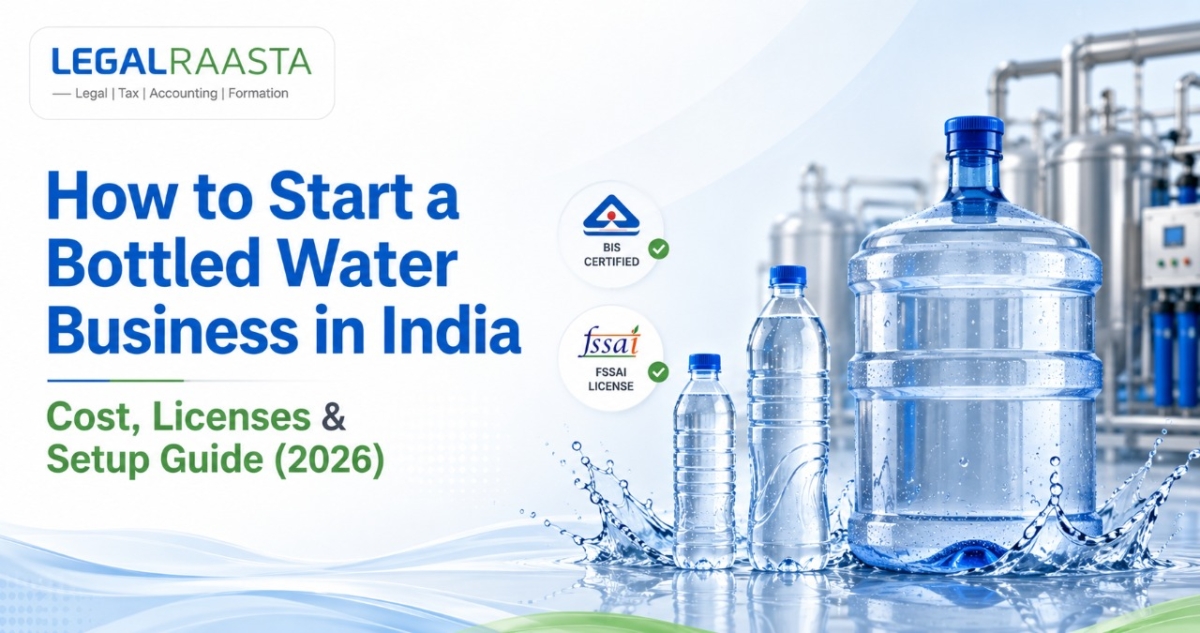
How to Start a Bottled Water Business in India: Cost, Licenses & Setup Guide (2026)
A friend once drove from Pune to Ahmedabad and counted 14 different packaged water brands at highway dhabas along the way. None of them were Bisleri. All of them were selling just fine.
The packaged drinking water market in India sits at roughly Rs 30,000 crore today and keeps growing, driven by corporate offices, highway retail, hotels, and hospitals. Starting a bottled water business in India in 2026 is genuinely achievable, but the compliance requirement list is non-negotiable. Before your first bottle leaves the plant, you need BIS certification, an FSSAI licence, a Pollution Control Board NOC, GST registration, and, depending on your water source, a CGWA groundwater extraction approval.
LegalRaasta has helped over 30 water plant owners complete this exact licensing process without the delays that kill early momentum. Connect today to know exactly what your state and scale require.
Packaged Drinking Water vs Natural Mineral Water: Know the Difference First
Before anything else, decide what you are producing. These two categories look similar on a shelf but carry completely different compliance paths.
Packaged Drinking Water is processed from any raw water source through RO, UV, and ozone treatment. It must conform to IS 14543:2016. This is the standard that applies to nearly every small and medium water plant in India.
Natural Mineral Water comes from a notified natural underground source and cannot be chemically processed. The applicable standard is IS 13428, which requires geological surveys, source verification, and significantly higher infrastructure investment.
If you are setting up your first plant, IS 14543 is where you begin. This distinction directly affects your BIS application, your FSSAI product category, and your entire manufacturing process.
Is the Bottled Water Business Profitable in India? (2026 Reality Check)
Yes, but the outcome depends on capacity, distribution, and quality control.
Why demand is consistent: Cities keep expanding and piped water quality in many urban areas remains unreliable. Hotels, restaurants, corporate parks, airports, and hospitals treat packaged water as a non-negotiable input. The 20-litre jar segment generates reliable recurring institutional revenue for smaller plants.
Realistic margins by scale:
- 500 to 1,000 LPH plant: 15 to 25% margin once distribution is stable
- 2,000 to 5,000 LPH plant: 20 to 35% with better unit economics
- 5,000+ LPH with private label or branded contracts: 25 to 40%
A 500 ml bottle costs Rs 2.50 to Rs 4 to produce and retails at Rs 10 to Rs 20. A 20-litre jar costs Rs 25 to Rs 35 to produce and sells at Rs 60 to Rs 80. Private label arrangements with hotel chains give you volume without marketing spend, making it a smart starting channel.
Investment Required to Start a Bottled Water Plant
|
Expense Category |
Estimated Cost (Rs.) |
Notes |
|
Rs 5,000 to Rs 20,000 |
Depends on entity type |
|
|
Rs 40,000 to Rs 1,00,000+ |
Including inspection fee |
|
|
Rs 2,000 to Rs 10,000 |
State vs central licence |
|
|
Plant and Machinery |
Rs 5 lakh to Rs 50 lakh+ |
Scale-dependent |
|
RO and Water Treatment |
Rs 2 lakh to Rs 15 lakh |
Capacity-based |
|
Packaging Equipment |
Rs 3 lakh to Rs 20 lakh |
Semi or fully automatic |
|
Factory Rent and Setup |
Rs 50,000 to Rs 5 lakh |
Location-dependent |
|
Staff and Labour |
Rs 20,000 to Rs 2 lakh per month |
Headcount-based |
|
Branding and Marketing |
Rs 50,000 to Rs 5 lakh |
First year primarily |
|
Total Estimated Investment |
Rs 10 lakh to Rs 1 crore+ |
Scale-dependent |
Most first-time operators land between Rs 25 lakh and Rs 60 lakh for a viable mid-range setup.
Licences Required for a Bottled Water Business in India
This is where most first-timers lose months. Multiple licences come from different government authorities, and filing them in the wrong order creates avoidable delays.
BIS Certification (IS 14543) — Mandatory, No Exceptions
A valid BIS licence under IS 14543 is compulsory under the Bureau of Indian Standards Act, 2016. You cannot legally sell packaged water without it.
How to apply: Through the BIS portal at manakonline.in. A BIS inspector conducts a factory inspection. Water is tested for TDS, pH (must be between 6.5 and 8.5), turbidity, hardness, chloride, nitrate, and microbiological parameters; E. coli and coliform must be completely absent. Your process must align with IS 10500:2012.
Timeline: 3 to 6 months from application to certificate. BIS conducts unannounced surveillance visits after licensing.
Common rejection reasons: Incomplete plant setup at inspection time, parameter failures in microbiological testing, non-compliant labelling, or missing process records.
FSSAI Licence — Mandatory
FSSAI classifies packaged water as a Schedule 1 food product. Applications go through foscos.fssai.gov.in.
- Annual turnover between Rs 12 lakh and Rs 20 crore: State Licence
- Above Rs 20 crore or pan-India operations: Central Licence
A Food Safety Management System aligned with HACCP or ISO 22000 strengthens both your FSSAI application and BIS documentation. Timeline: 30 to 60 days.
Business Registration
Required before most other applications proceed.
- Sole Proprietorship: Fastest, personal liability
- LLP: Two or more founders, moderate compliance
- Private Limited Company: Best for scaling or raising capital
FSSAI’s Central Licence specifically requires a formally registered entity.
GST Registration
Packaged water falls under HSN Code 2201:
- Containers of 20 litres or less: 12% GST
- Containers above 20 litres: 18% GST
Always verify against the latest GST Council notification before filing. Timeline: 3 to 7 working days.
Pollution Control Board NOC (CTE and CTO)
Governed by the Water (Prevention and Control of Pollution) Act, 1974.
- CTE (Consent to Establish): Before construction begins
- CTO (Consent to Operate): Before commercial production
Applied through your State Pollution Control Board. Timeline: 1 to 3 months per stage.
CGWA Groundwater NOC (If Applicable)
Required if your source is a borewell or tubewell. Apply at cgwa.nic.in. Valid for 5 yeaRs Not required if sourcing from municipal supply. CGWA has significantly tightened approvals in over-exploited zones, so verify your location before committing to a borewell-based setup.
Factory Licence, Trade Licence, and Fire NOC
Factory Licence is required if you employ 10 or more workers using power, or 20 or more without power. Trade Licence comes from your local municipal corporation in 15 to 30 days. Fire Safety NOC comes from the State Fire Department.
All Approvals at a Glance
|
Licence |
Issuing Authority |
Mandatory? |
Timeline |
|
BIS Certification (IS 14543) |
Bureau of Indian Standards |
Yes |
3 to 6 months |
|
FSSAI Licence |
FSSAI |
Yes |
30 to 60 days |
|
MCA |
Yes |
3 to 7 days |
|
|
GSTN |
Yes |
3 to 7 days |
|
|
PCB NOC (CTE + CTO) |
State Pollution Control Board |
Yes |
1 to 3 months |
|
CGWA NOC |
Central Ground Water Authority |
If borewell |
2 to 4 months |
|
Factory Licence |
State Labour Department |
If applicable |
30 to 60 days |
|
Municipal Corporation |
Yes |
15 to 30 days |
|
|
Fire Safety NOC |
State Fire Department |
Yes |
15 to 30 days |
What Happens If You Operate Without These Licences?
- Without BIS Certification: Your product is illegal to sell. BIS can seize stock and initiate prosecution under the BIS Act, 2016.
- Without FSSAI Licence: FSSAI can shut your plant, seize inventory, and impose penalties up to Rs 5 lakh under the Food Safety and Standards Act, 2006.
- Without PCB NOC: The State Pollution Control Board can seal your plant mid-operation and impose daily penalties.
- Without CGWA NOC: Borewell-based extraction without approval attracts heavy penalties and forced shutdown under CGWB regulations.
The most common reason operators face these consequences is not wilful non-compliance. It is filing applications in the wrong sequence or with incomplete documentation.
DIY vs Expert-Assisted Licensing: What Changes
|
Factor |
Self-Filing |
LegalRaasta Assistance |
|
Application Sequencing |
High risk of wrong order |
Correct sequence from day one |
|
Documentation Accuracy |
Common errors and resubmissions |
Verified before submission |
|
BIS Inspection Readiness |
Often flagged as incomplete |
Prepared and audit-ready |
|
PCB NOC Follow-Up |
Delayed without local knowledge |
Proactive follow-up included |
|
Total Time to Licence |
Often 10 to 14 months |
Typically 5 to 8 months |
|
Risk of Rejection |
High for first-timers |
Significantly reduced |
Step-by-Step Process to Start a Bottled Water Business in India
- Market Research: Identify target segment, retail, institutional, or 20-litre bulk. Check local competition.
- Business Plan: Map investment, revenue model, and break-even. Required for MSME loans and Udyam registration.
- Register Your Entity: Get your legal structure, PAN, and bank account in place before any other application.
- Plant Location Setup: Prioritise a reliable water source, road access, and industrial zone placement for easier PCB compliance.
- Water Treatment Installation: RO, UV, and ozonation together bring source water to IS 14543 and IS 10500:2012 compliance.
- Apply for BIS and FSSAI Simultaneously: BIS takes longer, so file that first. FSSAI goes through the FoSCoS portal.
- Obtain Remaining Approvals: PCB CTE and CTO, CGWA NOC if applicable, Factory Licence, Trade Licence, Fire NOC.
- Purchase Machinery: Bottle blowing machine, filling machine, capping unit, labelling machine, shrink wrap equipment.
- Hire and Train Staff: Minimum: plant operator, quality control tester, lab technician.
- Pre-Launch Testing and BIS Audit: Full quality testing across microbiological, chemical, and physical parameters before commercial dispatch.
Machinery Required
|
Machine |
Purpose |
Approx. Cost (Rs.) |
|
RO System (1,000 to 5,000 LPH) |
Primary purification |
Rs 2 lakh to Rs 8 lakh |
|
UV and Ozonation Unit |
Secondary disinfection |
Rs 50,000 to Rs 2 lakh |
|
Bottle Blowing Machine |
PET bottle forming |
Rs 3 lakh to Rs 15 lakh |
|
Bottle Filling Machine |
Auto-fill |
Rs 2 lakh to Rs 10 lakh |
|
Capping Machine |
Sealing |
Rs 50,000 to Rs 3 lakh |
|
Labelling Machine |
Label application |
Rs 1 lakh to Rs 5 lakh |
|
Shrink Wrap Machine |
Final packaging |
Rs 75,000 to Rs 3 lakh |
Common Challenges and How to Handle Them
- BIS inspection delays: File early and ensure your plant is fully operational before requesting an inspection date. Incomplete setups get rejected and restart the timeline.
- Groundwater restrictions: Check your location’s CGWA status before committing to a borewell. Municipal sourcing avoids this risk entirely.
- Packaging cost pressure: Buying PET preforms in bulk and running your own blowing machine reduces per-unit cost once volumes justify it.
- Distribution logistics: Start with institutional clients placing bulk orders before investing in retail distribution. Hotels and hospitals are your most reliable early revenue.
- Brand competition: Private label arrangements remove the marketing burden and give you volume on long-term contracts without competing with established brands on advertising.
Tips for Running a Successful Bottled Water Business
- Never compromise on filtration quality. BIS audits are unannounced and a failed audit means production halt and potential licence suspension.
- Build a private label offering for institutional clients early. Recurring volume without ongoing brand investment is the best business model at small scale.
- Register under Udyam from the start. MSME classification opens access to priority lending, subsidy schemes, and credit guarantee programmes.
- Track GST filings every month. With two rates applying under HSN 2201, misclassifying container sizes creates audit issues that are entirely avoidable.
How LegalRaasta Helps
LegalRaasta handles your end-to-end compliance: BIS documentation, FSSAI application, PCB NOC follow-up, CGWA coordination, GST registration, and business entity setup. You focus on the plant. They handle the paperwork.
Call: 8750048585
Conclusion
The bottled water business in India is one of the more structured manufacturing opportunities available in 2026. Demand is consistent. The regulatory path is defined. The licensing process, while lengthy, is navigable when sequenced correctly.
The most common reason first-time operators delay launch is not funding. It is one application filed in the wrong order, or a document set sent back incomplete. Starting without the right licences does not save time. It costs more when BIS rejects your application or the PCB flags your plant mid-operation.
Connect with LegalRaasta today and get your bottled water plant legally ready before the first bottle rolls off the line.
FAQs
What is the total cost to start a bottled water business in India?
A small setup starts around Rs 10 lakh. A practical first plant typically runs between Rs 25 lakh and Rs 60 lakh. Fully automated larger plants go above Rs 1 crore depending on capacity, location, and automation level.
Is BIS Certification compulsory for packaged drinking water?
Yes, without exception. Every packaged drinking water product sold in India must carry a valid BIS licence under IS 14543:2016. The Standard Mark and licence number must appear on every bottle. Operating without it is a legal violation under the BIS Act, 2016.
How is IS 14543 different from IS 13428?
IS 14543 applies to drinking water processed through RO, UV, or ozone from any raw source. IS 13428 applies strictly to natural mineral water from a protected underground source. Testing parameters differ, and the two standards cannot be used interchangeably.
Does a water plant need a Pollution Control Board NOC?
Yes. You need a Consent to Establish before construction and a Consent to Operate before production begins. Both come from your State Pollution Control Board and take 1 to 3 months per stage.
What is the GST rate on packaged water under HSN 2201?
12% on containers of 20 litres or less. 18% on containers above 20 litres. Always verify against the latest GST Council notification before filing, as rates have changed in previous sessions.
How long does full licensing take for a water bottling plant?
BIS takes 3 to 6 months. FSSAI takes 30 to 60 days. PCB NOC takes 1 to 3 months per stage. Running applications simultaneously, the full process typically takes 5 to 8 months.
Can I start a bottled water business as a sole proprietor?
Yes. Sole proprietorship works for smaller plants. A Private Limited Company or LLP is worth considering if you plan to scale, raise external funding, or enter institutional supply contracts with larger clients.

Related Posts
 FSSAI License
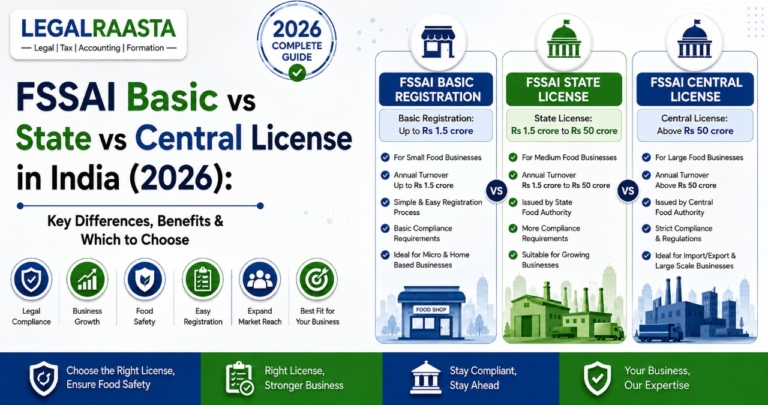
FSSAI Basic vs State vs Central License in India (2026): Key Differences, Benefits & Which to Choose
Read More →
 FSSAI License
FSSAI License for Home-Based Food Business 2026: Documents Checklist & Guide
Read More →

Our Clients




Featured In