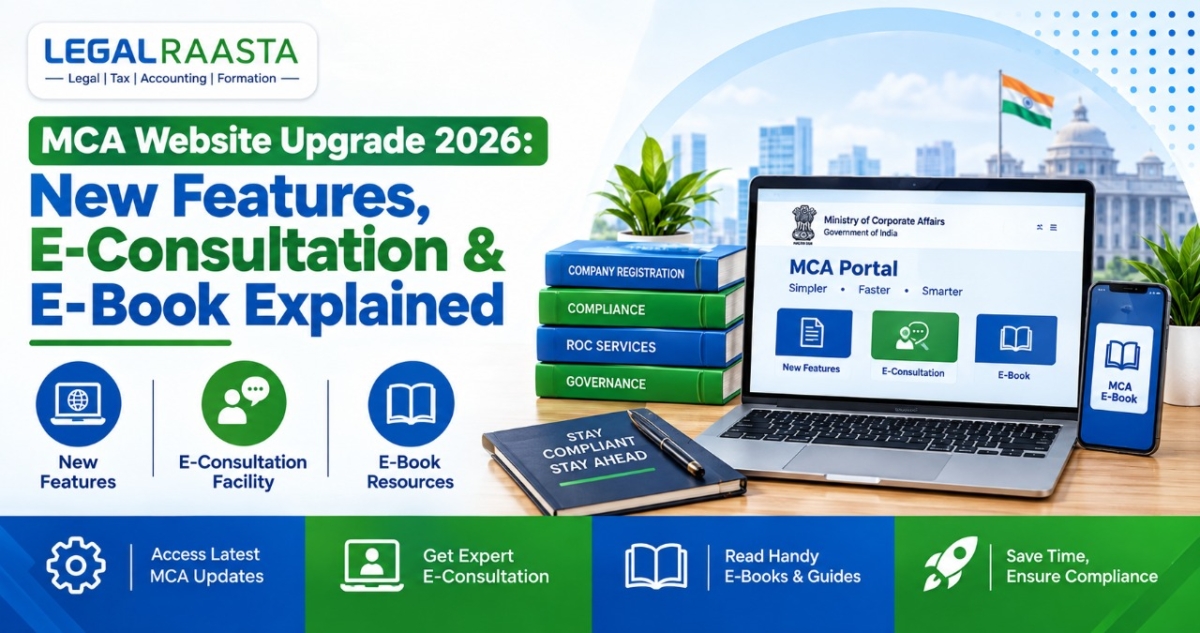
MCA Website Upgrade 2026: New Features, E-Consultation & E-Book Explained
A company secretary in Chennai spent forty minutes hunting for a circular last month. It existed. It was just buried three clicks deeper than she expected, on a portal that looks nothing like it did five years ago. Stories like hers are common enough among professionals who filed on the old system for years; DSC errors and navigation confusion are still the two complaints that come up most in compliance forums even now. That’s the honest state of the MCA Website Upgrade today. The Ministry of Corporate Affairs didn’t overhaul its digital platform overnight in 2026; the rebuild started back in 2021 and only finished migrating every single form by mid-2025.
What’s actually new this year is narrower but still worth knowing: fresh ROC jurisdiction changes, a facilitation scheme easing the V3 transition, and a portal that professionals still routinely mishandle. This piece walks through what the MCA Website Upgrade actually changed, what’s genuinely new in 2026, and where most businesses trip up using it. LegalRaasta’s ROC compliance team files on MCA V3 daily, so reach out if your own filings need a safe pair of hands on this portal.
MCA Website Upgrade 2026: Quick Snapshot
|
Detail |
Status |
|
V3 revamped website, e-Book, e-Consultation launched |
May 2021 |
|
Full migration of all 38 e-forms to V3 |
Completed 14 July 2025 |
|
V2 portal |
Read-only, historical access only |
|
New ROC/RD jurisdiction realignment |
Effective 16 February 2026 |
|
Companies Compliance Facilitation Scheme, 2026 |
General Circular No. 01/2026 |
|
Portal |
What Is the MCA Website Upgrade 2026?
Here’s the part most articles online get wrong, so let’s get it straight first.
The Ministry of Corporate Affairs launched the first phase of MCA21 Version 3.0 back in May 2021, a revamped website plus two new public modules, e-Book and e-Consultation. The remaining forms migrated in phases over the next four years, and the last batch of 38 e-forms went live on V3 on 14 July 2025. By 2026, the “upgrade” isn’t a rollout anymore; it’s simply how the portal works. V2 sits in read-only mode now, kept around purely so users can pull up old filings.
MCA21 V3 runs on a microservices architecture, built for tighter integration with the Income Tax department, EPFO, GST Network, and ESIC, so data doesn’t need to be re-entered across four separate government systems. Any company, director, LLP, or professional filing forms with the ROC uses this same platform today; there’s no separate “old” or “new” user category left.
MCA21 V2 vs V3: What Actually Changed for Users
Professionals who filed on V2 for years still notice the difference every time they log in, so a side-by-side comparison helps set expectations.
|
Aspect |
V2 (Legacy) |
V3 (Current) |
|
Status |
Read-only, historical access only |
Live, mandatory for all filings |
|
Login |
Separate credentials per role |
Single account, business or professional |
|
DSC handling |
Standalone utility, separate download |
Integrated directly into user profile |
|
Data entry |
Repeated across forms |
Pre-filled from master data |
|
Acts & Rules access |
Static PDF downloads |
Searchable e-Book with version history |
|
Public consultation |
No dedicated module |
e-Consultation for draft rules |
The jump from V2 to V3 wasn’t cosmetic. Filing workflows, document upload formats, and even payment gateways changed enough that professionals who skipped a proper walkthrough often lose time on forms they’ve filed a hundred times before.
Key Features of the MCA Website in 2026
Five things stand out on the current portal, and knowing where each one lives saves real time during a filing crunch.
Improved Service Navigation
The homepage groups services by user type, company, professional, or LLP, rather than burying everything under one generic menu. Frequently used links, like checking company master data or tracking an SRN, now sit within two clicks from the homepage instead of six.
MCA Forms and Online Filing
All 38 e-forms, SPICe+, AOC-4, MGT-7, DIR-3 KYC, and the rest, now file exclusively through V3, with pre-filled data pulled from your existing company or LLP master record.
Company & LLP Master Data
Anyone can search a company’s CIN, LLPIN, registered address, and filing history for free, without logging in.
MCA Notifications and Circulars
Every General Circular, including the newer Companies Compliance Facilitation Scheme, 2026 (Circular No. 01/2026), gets published here first, before it shows up on any third-party site.
DSC and User Account Services
Digital Signature Certificate registration and association now happens directly inside your V3 account, instead of through a separate standalone utility.
MCA V3 Support and Grievance Redressal
Even a well-designed portal breaks down occasionally, and knowing where to escalate a problem matters just as much as knowing how to file.
MCA maintains a dedicated helpdesk for V3-related technical issues, reachable through the portal’s support ticketing system rather than a generic email address. Response times vary, and professionals managing multiple filings a month often find that self-resolving common issues, DSC errors, SRN status confusion, and jurisdiction mismatches saves more time than waiting on a government ticket queue. That’s usually where working with someone who files on the platform regularly starts paying for itself.
MCA E-Book: Features and How to Access It
The e-Book module quietly does something useful that a lot of professionals still don’t know exists.
What Is MCA E-Book?
It’s a searchable digital library of the Companies Act, LLP Act, and every amendment or rule notified under them, hosted directly on the MCA website.
What Information Can You Find?
Full text of Acts, Rules, amendment history, and a version-tracking feature that shows exactly what changed and when, section by section. A compliance officer checking whether a specific clause in the Companies Act changed after a recent amendment can pull that history without digging through a separate gazette notification.
How to Access MCA E-Books
Head to the “Acts & Rules” section on the MCA homepage. No login needed, no registered account required either.
MCA E-Consultation: Process and Key Features
Before a draft rule or amendment becomes law, this module is where the public actually gets a say.
What Is MCA E-Consultation?
An online platform where MCA posts proposed amendments and draft legislation for public comment before finalising them.
Who Can Participate?
Anyone, registered users and the general public alike- though professionals and industry bodies tend to use it most actively, given how directly draft company law changes affect their client work.
How to Submit Comments Online?
Open the relevant draft under the e-Consultation tab, fill in the structured comment form, and submit before the stated deadline. Late submissions typically don’t get considered, so tracking which drafts are open matters more than most professionals realise.
Supporting Documents and Verification
Comments can include supporting attachments, and MCA may verify the submitter’s identity for substantive policy feedback, not just casual remarks. Industry bodies submitting on behalf of multiple members sometimes need to show that authority explicitly.
MCA V3 Registration and DSC Association
Getting your account and digital signature set up correctly the first time avoids the single most common V3 support ticket.
MCA V3 User Registration
New users register directly through the V3 sign-up flow, choosing between a business user account or a professional account depending on their role.
Business User Account
Meant for company representatives filing on behalf of their own entity, linked directly to the company’s CIN.
V2 to V3 User Migration
Existing V2 credentials don’t carry over automatically. Users need to complete a one-time registration on V3 even if they’ve filed on MCA for years.
DSC Association
Register your Digital Signature Certificate under your V3 profile before attempting any form submission; a mismatch between your DSC name and MCA record is the most common rejection reason on this portal.
Documents and Prerequisites Before You File on MCA V3
Half the rejected filings on this portal never had a technical problem at all; they were missing something basic before submission even started.
|
Prerequisite |
Why It Matters |
|
Valid Class 3 Digital Signature Certificate |
Required to sign and submit any e-form on V3 |
|
DIN for every director |
Filing blocks entirely if any linked DIN is deactivated |
|
Updated email and mobile on MCA record |
OTP verification fails silently otherwise |
|
Company or LLP master data accuracy |
Pre-filled fields pull directly from this; errors carry forward |
|
PAN card details matching MCA records |
Mismatches trigger manual verification delays |
Getting these right before you open a form saves more time than any portal feature ever will.
Recent 2026 Changes to the MCA Website
Two developments this year matter more than the original 2021 launch does for anyone filing right now.
The MCA portal went offline for a full day on 15 February 2026 to implement new Regional Director and ROC jurisdictions, splitting ROC Delhi into two separate offices, ROC Delhi I and ROC Delhi II, based on district and PIN code, while carving out a standalone ROC Haryana for companies previously mapped under Delhi. Businesses registered in these regions needed to check which office now holds their records, since master data migrated automatically but professionals still had to update their own internal references. Separately, the Companies Compliance Facilitation Scheme, 2026, issued through General Circular No. 01/2026, gives companies extra breathing room to file annual returns and financial statements correctly under V3 without the usual late penalties, a genuine concession while the platform transition settles fully. Neither change got the attention the 2021 launch did, but both affect real filings happening this year.
How to Use the MCA Portal for Compliance in 2026
Routine compliance work happens the same way across company types, once you know where to look.
Check Company or LLP, Master Data
Use the free public search on the MCA homepage to pull filing history, directors, and registered office details for any entity.
Find and File MCA Forms
Navigate to the relevant category, incorporation, annual filing, or charge management, and file directly through your V3 dashboard.
Check Filing Status
Track your Service Request Number (SRN) status under “View Filing Status” to confirm whether MCA has approved, queried, or rejected a submission. Checking this proactively, rather than waiting for an email that sometimes lands in spam, catches queries early enough to fix before a deadline passes.
Access Public Documents
Certified copies of filed documents, MOA, AOA, and annual returns are available for a small fee through the public document access service.
Benefits of the MCA Website Upgrade for Businesses
None of this matters if it doesn’t actually save a company time or money, so here’s where the upgrade genuinely pays off.
- Easier access to MCA services: one login now covers incorporation, annual filing, and charge management instead of separate portals
- Better compliance information: circulars and notifications reach users the same day MCA publishes them
- Digital access to Acts and Rules: the e-Book module removes the need to track amendments through scattered PDFs
- Improved online filing experience: pre-filled forms and integrated DSC handling cut down on repeated data entry
- Faster cross-agency verification: integration with Income Tax, GST and EPFO systems means less duplicate paperwork when applying for loans or tenders that check compliance status
That said, a smoother portal doesn’t make ROC compliance effortless on its own. Missed deadlines, DIN mismatches, and rejected DSC associations still happen constantly on V3, usually because nobody on the team is watching the portal full-time.
Common Filing Mistakes on the New MCA Portal
Most V3 rejections trace back to a handful of avoidable errors, not genuine technical faults with the platform itself. A surprising number of these show up on companies that have filed with MCA for a decade without issue, simply because the checks that used to be manual are now automated and unforgiving.
- Attempting to file using old V2 login credentials that were never migrated to V3
- DSC name mismatches between the certificate and MCA’s own company or director records
- Missing the DIR-3 KYC deadline, now on a three-year cycle instead of every September
- Assuming a form is unavailable on V3 when it’s simply filed under a different menu category
- Ignoring the Companies Compliance Facilitation Scheme, 2026 window before it lapses
- Not updating internal records after the February 2026 ROC jurisdiction changes, leading to filings sent under the wrong Registrar
If any of this sounds familiar, that’s usually the point where a business realises DIY filing on a platform this complex costs more in rework than it saves.
Conclusion: Why the MCA Website Upgrade Still Matters in 2026
The MCA Website Upgrade finished its rollout years ago, but 2026 is still shaping how it works, with new ROC jurisdictions, a facilitation scheme easing the transition, and a user base still catching up on where things moved. Knowing the platform well enough to file without rejections isn’t guesswork anymore; it’s a skill that takes actual practice on V3’s quirks, the kind that comes from filing on it every week rather than once a year. Talk to LegalRaasta if you’d rather have someone who files on this portal every day handle your next company registration or ROC submission.
If this whole conversation about outdated platforms getting a digital facelift has you looking at your own company’s website, that’s exactly the kind of work CloudGeta (cloudgeta.com) handles too: website development, SEO, and digital marketing for businesses that don’t want to look stuck in 2015.
Frequently Asked Questions About MCA Website Upgrade 2026
1. What is the MCA Website Upgrade in 2026?
It refers to the fully completed MCA21 V3 rollout, which finished migrating all 38 e-forms by mid-2025. The MCA Website Upgrade now includes 2026-specific changes like new ROC jurisdictions.
2. What is MCA21 V3?
MCA21 V3 is the current version of MCA’s digital filing platform, replacing V2 entirely. The MCA Website Upgrade brought this system online in phases starting in 2021.
3. What is MCA E-Book?
It’s a searchable digital library of Acts, Rules and amendments hosted on the MCA site. The MCA Website Upgrade introduced this module back in 2021 alongside e-Consultation.
4. What is MCA E-Consultation?
It’s the platform where MCA posts draft rules for public comment before finalising them. This module has been part of the MCA Website Upgrade since its very first phase.
5. How do I register on MCA V3?
Sign up directly through the V3 portal, choosing a business or professional account type. The MCA Website Upgrade requires fresh registration even for long-time V2 users.
6. How do I associate DSC with MCA V3?
Register your Digital Signature Certificate under your V3 profile before filing any form. Errors here are the top rejection reason professionals report post MCA Website Upgrade.
7. Where can I find MCA forms and notifications?
Forms sit under category-specific menus on the homepage, while notifications appear under the circulars section. The MCA Website Upgrade consolidated both into one navigation structure.
8. Is the old MCA V2 portal still accessible after the Website Upgrade?
Yes, but only in read-only mode for historical records. The MCA Website Upgrade requires all active filings to go through V3 exclusively now, with no exceptions.
9. Does the MCA Website Upgrade affect annual ROC filing deadlines?
Not the deadlines themselves, but the Companies Compliance Facilitation Scheme, 2026 does ease penalties during the transition. The MCA Website Upgrade changed the filing process, not the statutory dates.
10. Who should use MCA’s e-Consultation module after the Website Upgrade?
Professionals, industry bodies, and any business wanting a say on draft rules before they’re finalised. The MCA Website Upgrade opened this module to registered and public users alike.

Related Posts





Our Clients





Featured In