
FSSAI Basic vs State vs Central License in India (2026): Key Differences, Benefits & Which to Choose
Every food business in India needs one of three FSSAI approvals, and picking the wrong one wastes money or invites a penalty later. FSSAI Basic vs State vs Central License is the exact confusion that trips up new food entrepreneurs, from home bakers to national restaurant chains. The rules changed sharply in 2026 too, so what applied to your business last year might not apply anymore.
Most owners don’t even realise their category changed until an inspector points it out. That’s expensive to fix after the fact. This guide breaks down all three categories, the fresh 2026 turnover limits, fees, and the application process on FoSCoS. Talk to LegalRaasta’s food licensing team if you’d rather have someone confirm your category correctly the first time.
What Is FSSAI Registration and License?
FSSAI Registration or License is the government approval that lets you legally manufacture, store, sell, transport, or import food in India. It comes from the Food Safety and Standards Authority of India, under the Food Safety and Standards Act, 2006, and every food business operator needs one of the three tiers before starting operations.
Recent FSSAI Updates in 2026 You Should Know
Three changes reshaped this space this year, and skipping any of them means you’re working off outdated information.
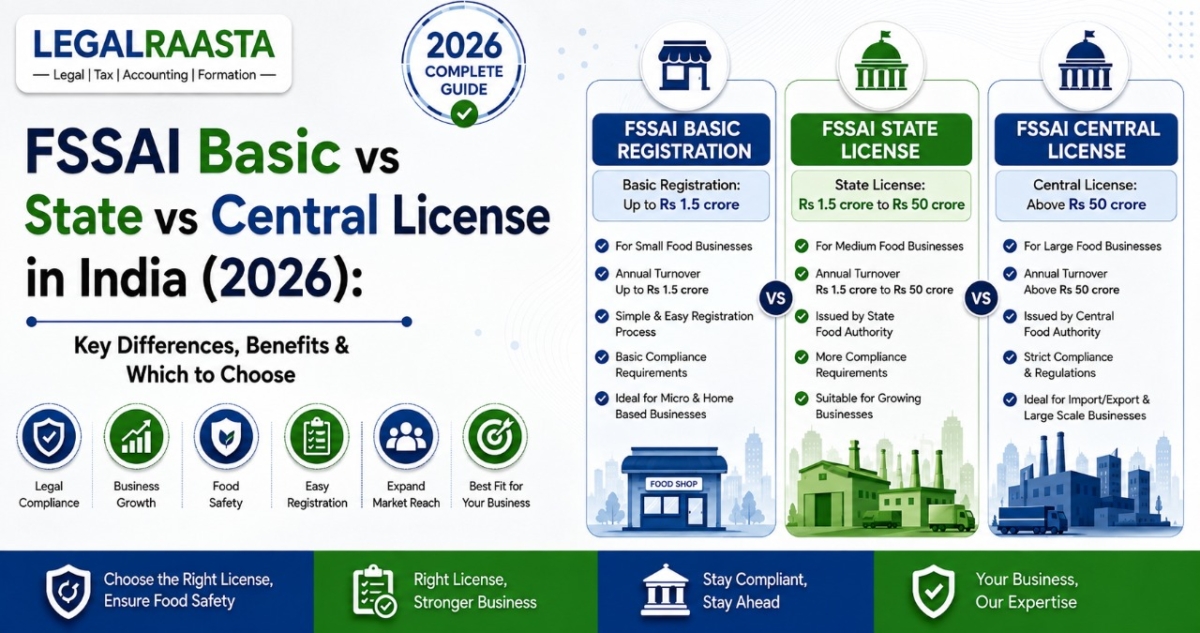
- Turnover thresholds jumped. Basic Registration went from Rs 12 lakh to Rs 1.5 crore. Central License moved from above Rs 20 crore to above Rs 50 crore.
- Licenses stopped expiring. Once granted on or after 1 April 2026, a licence or registration stays valid until it’s suspended, cancelled, or surrendered by the holder.
- Street vendors got deemed registration. Anyone already registered under the Street Vendors Act, 2014 is now automatically treated as FSSAI-registered; no separate application, no duplicate fee.
Inspections also moved away from a fixed calendar. FSSAI now schedules them based on commodity risk and your compliance history, so a clean track record genuinely means fewer visits from an officer.
FSSAI Registration vs State vs Central License: Key Differences
The three tiers exist purely to match compliance load with business size. A tiny tea stall doesn’t need the same paperwork as a food export company, and that’s exactly what this structure is built around.
|
Factor |
Basic Registration |
State License |
Central License |
|
Turnover (effective 1 April 2026) |
Up to Rs 1.5 crore |
Rs 1.5 crore to Rs 50 crore |
Above Rs 50 crore |
|
Issuing authority |
District officer |
State licensing authority |
FSSAI, central level |
|
Validity |
Perpetual, once granted |
Perpetual, once granted |
Perpetual, once granted |
|
Typical businesses |
Petty vendors, home kitchens, small stalls |
Restaurants, mid-size manufacturers |
Importers, exporters, five-star hotels |
FSSAI Basic Registration in India
Basic Registration is the entry point for the smallest food businesses, and after the 2026 revision, it covers a lot more of them than before.
Who Needs FSSAI Basic Registration?
Street vendors, small tea stalls, home-based tiffin services, petty retailers, and any food business with modest annual turnover fall here.
Eligibility and Turnover Limit
Annual turnover up to Rs 1.5 crore, revised upward from the earlier Rs 12 lakh limit through FSSAI’s March 2026 amendment.
Documents Required
- Passport-size photograph
- Identity and address proof of the applicant
- Declaration of the kind of business being carried out
- Self-declaration regarding food safety compliance
Benefits
Lowest government fee, roughly Rs 100 a year, minimal documentation, and now perpetual validity once the certificate is issued.
FSSAI State License in India
Once your business grows past petty vendor scale, a State License takes over, and it covers a much wider band of businesses than most people expect.
Who Needs an FSSAI State License?
Restaurants, mid-sized manufacturers, caterers, and food processing units operating within a single state generally sit here.
Eligibility and Turnover Limit
Annual turnover between Rs 1.5 crore and Rs 50 crore, under the revised 2026 thresholds. Some categories, like five-star hotel caterers or milling units, need a State License regardless of actual turnover.
Documents Required
- Form B application, duly signed
- Layout plan of the processing or storage unit
- List of directors or partners with address proof
- Water test report from a recognised lab
- Food safety management plan
Benefits
Legal recognition to operate across a state, builds customer trust, and now no more repeated renewal cycles once granted.
FSSAI Central License in India
Central License sits at the top, and it’s reserved for the largest or most sensitive food operations in the country.
Who Needs an FSSAI Central License?
Importers, exporters, e-commerce food businesses, operators inside central government premises, and multi-state restaurant chains need this, regardless of turnover in some cases.
Eligibility and Turnover Limit
Annual turnover above Rs 50 crore, raised from the earlier Rs 20 crore threshold under the 2026 amendment.
Documents Required
- Form B application
- Import Export Code, if applicable
- NOC from the concerned government department, for premises inside central establishments
- Certificate of incorporation for companies
- Food safety management plan and layout of the unit
Benefits
Recognition to operate nationwide and internationally, mandatory for import-export trade, and required for large-scale food brand credibility.
What Happens If You Operate With the Wrong FSSAI Category?
Operating without any FSSAI approval at all can attract a penalty of up to Rs 5 lakh, and repeated violations can mean the food business gets shut down on the spot. But the more common mistake isn’t skipping the licence entirely; it’s staying in the wrong tier.
A restaurant that scaled past Rs 1.5 crore but never upgraded from Basic Registration is technically non-compliant, even though it holds a valid FSSAI certificate. Inspectors check turnover during risk-based visits now, so this gap doesn’t stay hidden for long. Fixing it after the fact usually costs more time than getting it right at the start.
FSSAI Basic vs State vs Central License: Comparison Table
|
Point |
Basic Registration |
State License |
Central License |
|
Turnover cap |
Up to Rs 1.5 crore |
Rs 1.5 crore–Rs 50 crore |
Above Rs 50 crore |
|
Application form |
A |
B |
B |
|
Government fee |
Rs 100/year |
Rs 2,000–5,000/year |
Rs 7,500/year |
|
Inspection |
Rarely, risk-based |
Risk-based |
Risk-based, more frequent |
|
Portal |
FoSCoS |
FoSCoS |
FoSCoS |
FSSAI License Fees in India 2026
Fees stay modest across all three tiers compared to most other business licences in India.
|
Category |
Annual Fee |
|
Basic Registration |
Rs 100 |
|
State License |
Rs 2,000 to Rs 5,000, depending on turnover slab |
|
Central License |
Rs 7,500 |
You can now prepay this fee for multiple years at once, since FSSAI has removed the fixed renewal cycle entirely.
How to Apply for FSSAI Registration or License Online
Filing happens entirely online, and the process stays mostly the same across all three categories, just with different documents attached.
Step 1: Check Your FSSAI Eligibility
Confirm your annual turnover and the nature of your food business against the 2026 thresholds before choosing a category.
Step 2: Select the Appropriate License
Pick Basic, State, or Central based on turnover and business type; some categories need Central or State regardless of revenue.
Step 3: Prepare the Required Documents
Gather identity proof, address proof, layout plans, and food safety declarations relevant to your chosen tier.
Step 4: Submit the Application on FoSCoS
File through the Food Safety Compliance System portal, foscos.fssai.gov.in, since offline applications aren’t accepted anymore.
Step 5: Application Verification and Approval
FSSAI or the state authority reviews your application, may conduct a risk-based inspection, and issues the certificate upon approval.
FSSAI License Validity and Renewal Rules in 2026
This is the single biggest change this year. Licenses and registrations issued on or after 1 April 2026 carry perpetual validity, meaning they stay valid indefinitely unless suspended, cancelled, or surrendered. The old system of renewing every one to five years is gone.
That said, perpetual doesn’t mean zero obligation. Annual fees must still be paid on time; missing a payment triggers automatic suspension without a reminder. Inspections now follow a risk-based schedule instead of a fixed calendar, so compliant businesses actually see fewer visits.
If your existing licence was already in process on 1 April 2026, whether stuck at document scrutiny, a query, or a pending inspection, the certificate you eventually get still carries perpetual validity. You don’t need to file anything fresh to claim it. And if your turnover shifts you between categories, FoSCoS handles that migration automatically, with no modification fee and no change to your existing licence number.
Which FSSAI License Should You Choose?
The following section will help you choose the best and most suitable registration or license according to the needs and scale of your business.
Basic Registration for Small Food Businesses
Pick this if your turnover stays under Rs 1.5 crore and you run a single small outlet, cart, or home kitchen.
State License for Growing Food Businesses
Choose this once turnover crosses Rs 1.5 crore, or if you run a restaurant or mid-scale manufacturing unit within one state.
Central License for Large or Specific Food Businesses
Go with this if turnover exceeds Rs 50 crore, or your business involves import, export, or operations across multiple states.
Common Mistakes to Avoid While Applying for FSSAI License
- Assuming last year’s turnover limit still applies after the 2026 revision
- Applying for Basic Registration when your business category mandates a State or Central License regardless of turnover
- Skipping the water test report or layout plan for State License applications
- Forgetting that annual fee payment is still compulsory even with perpetual validity
- Not updating FoSCoS records when business details or address change
- Treating cloud kitchens as exempt from FSSAI just because there’s no dine-in seating
- Ignoring category upgrades when a business expands into a second state or adds an import line
- Delaying the FoSCoS modification request after a change in ownership or partnership structure
Get Professional Assistance for FSSAI Registration with LegalRaasta
Choosing the wrong tier or missing a document restarts your entire FoSCoS application. LegalRaasta’s team confirms your correct category under the revised 2026 thresholds, prepares your documents, and files your application end-to-end so you’re compliant without the guesswork.
Conclusion: Which FSSAI License Is Right for Your Business?
There’s no universal answer in the FSSAI Basic vs State vs Central License debate, only the tier that matches your actual turnover and business type. A home baker doesn’t need what a food export company needs, and the 2026 reforms make that distinction sharper than ever. Get your category, documents, and application right the first time with LegalRaasta’s food licensing experts.
Frequently Asked Questions (FAQs)
1. Which FSSAI turnover updated limit decides Basic Registration in 2026?
Basic Registration now covers turnover up to Rs 1.5 crore, under the revised food business licensing thresholds effective from April 2026.
2. What changed under food safety compliance in 2026?
FSSAI validity updated rules now give every FSSAI Basic vs State vs Central License holder lifetime validity, as long as annual fees are paid on time.
3. Does a cloud kitchen need FSSAI Basic vs State vs Central License differently than a restaurant?
Yes. A small cloud kitchen FSSAI registration usually needs only Basic Registration, while larger cloud kitchen chains cross into State License territory.
4. What licence does a restaurant FSSAI license fall under normally?
Most single restaurants need a State License. Comparing FSSAI Basic vs State vs Central License, only large multi-state restaurant chains move to Central.
5. What is the core difference in the three tiers of FSSAI Basic vs State vs Central License?
The difference in the three tiers comes down to turnover threshold and business scale: Basic for small, State for mid-size, and Central for large operators.
6. How does the FoSCoS registration process work for all three types?
You apply online, and depending on your FSSAI Basic vs State vs Central License category, upload different documents and pay a different annual fee.
7. Can a business apply for FSSAI Basic vs State vs Central License online only?
Yes, every application goes through the FoSCoS portal; no offline submission is accepted for state license eligibility or any other category.
8. What is central license eligibility based on now?
Central License eligibility now starts above Rs 50 crore turnover. In the FSSAI Basic vs State vs Central License structure, this is the highest tier.
9. Is FSSAI Basic vs State vs Central License mandatory for petty food businesses?
Petty food business owners with very low turnover can sometimes skip full registration, but most now fall under Basic Registration anyway.
10. What happens if a food business ignores FSSAI license renewal obligations post-2026?
Nothing to renew now, but under FSSAI Basic vs State vs Central License rules, missing the annual fee still triggers automatic suspension.

Related Posts
 FSSAI License
How to Start a Bottled Water Business in India: Cost, Licenses & Setup Guide (2026)
Read More → FSSAI License
FSSAI License for Home-Based Food Business 2026: Documents Checklist & Guide
Read More →
Our Clients






Featured In