
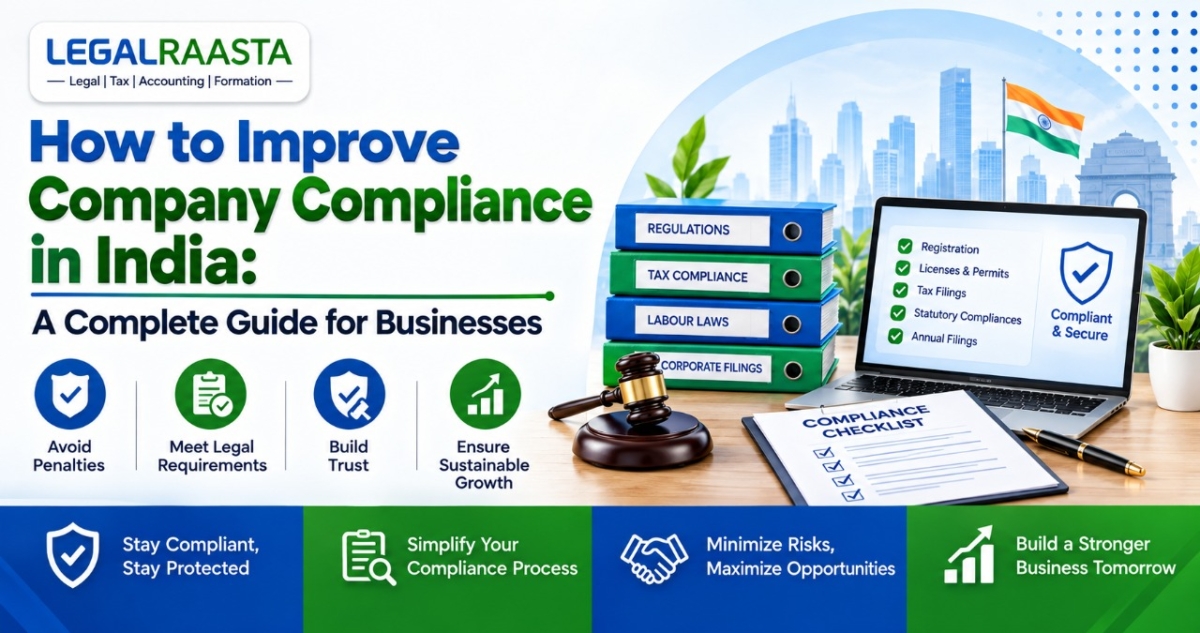
How to Improve Company Compliance in India: A Complete Guide for Businesses
A Pune manufacturing company missed one AOC-4 filing by eleven days. Nobody noticed for months, until a bank loan application got stuck because the company’s MCA master data showed a compliance default. Eleven days. That’s all it took. Company compliance in India isn’t one big task; it’s dozens of small, recurring ones spread across MCA, tax, GST, and labour law, and most businesses only discover the gaps when something else- funding, a tender, an audit- forces them to check.
Improve company compliance before that happens, and the whole thing becomes routine instead of a fire drill. This guide breaks down every major compliance area a business in India deals with, and the practical habits that actually keep a company clean on paper. LegalRaasta’s compliance team handles this full-time for businesses across sectors, so bring your gaps to them before a lender or regulator finds them first.
Company Compliance in India: Quick Overview
|
Compliance Area |
Key Requirement |
Typical Frequency |
|
MCA & ROC |
AOC-4, MGT-7/7A, DIR-3 KYC |
Annual / Triennial |
|
Income Tax |
ITR filing, advance tax |
Annual / Quarterly |
|
GST |
GSTR-1, GSTR-3B, GSTR-9 |
Monthly / Annual |
|
Deduction, deposit, quarterly return |
Monthly / Quarterly |
|
|
Labour |
PF, ESI, professional tax |
Monthly |
|
Statutory Audit |
Mandatory for all companies |
Annual |
What Is Company Compliance?
Company compliance means meeting every legal, financial, and regulatory obligation a registered business owes under Indian law. It isn’t optional, and it isn’t limited to one government department either. A single private limited company juggles the Ministry of Corporate Affairs (MCA), the Income Tax Department, GST authorities, and labour law bodies, often all in the same month.
Key Areas of Company Compliance in India
Seven broad categories cover almost everything a typical Indian business needs to track, though the exact mix depends on your structure and sector.
|
Area |
What It Covers |
Governing Authority |
|
MCA & ROC Compliance |
Annual returns, financial filings, director KYC |
|
|
Income Tax Compliance |
ITR filing, advance tax, assessments |
Income Tax Department, under the Income Tax Act, 2025 (effective 1 April 2026, replacing the 1961 Act) |
|
GST Compliance |
Monthly and annual returns, e-invoicing |
GST Network, CBIC |
|
TDS Compliance |
Deduction, deposit, quarterly statements |
Income Tax Department |
|
Labour & Employment |
PF, ESI, professional tax, shop registration |
EPFO, ESIC, state labour departments |
|
Annual Financial & Audit |
Statutory audit, board reports |
Institute of Chartered Accountants of India |
|
Industry-Specific Regulatory |
Sector licences (FSSAI, BIS, RBI, SEBI) |
Respective sectoral regulators |
Worth flagging here: FY 2025-26 returns, the ones due later this year, still fall under the old 1961 Act. Anything earned from 1 April 2026 onward falls under the new 2025 Act instead, so both laws are technically live right now, depending on which year you’re filing for.
Common Company Compliance Requirements and Due Dates
Missing a date is the single most common way businesses slip out of compliance, so here’s the calendar that matters most.
|
Filing |
Due Date |
|
AOC-4 (Financial Statements) |
30 days from AGM |
|
MGT-7 / MGT-7A (Annual Return) |
60 days from AGM |
|
DIR-3 KYC |
Once every 3 financial years, by 30 June |
|
ITR (non-audit cases) |
31 July |
|
ITR (audit cases) |
31 October |
|
GSTR-3B |
20th of the following month |
|
GSTR-9 (Annual Return) |
31 December |
|
TDS Deposit |
7th of the following month |
|
PF / ESI Payment |
15th of the following month |
How to Improve Company Compliance in India
Fixing compliance gaps for good comes down to habits, not heroics, and most of these cost nothing but discipline.
- Create a compliance calendar: map every due date across MCA, tax, GST and labour into one shared calendar, not scattered across five people’s memories.
- Maintain accurate corporate records: keep registers, minutes and resolutions updated as things happen, not reconstructed later under pressure.
- Track statutory due dates: set reminders well before the actual deadline, since document collection always takes longer than expected
- Ensure timely ROC and MCA filings: a delayed AOC-4 or MGT-7 shows up on public record and stays there.
- Review tax and GST compliance regularly: monthly, not just at year-end, so errors get caught while they’re still cheap to fix.
- Conduct periodic compliance audits: an internal check twice a year catches what daily busyness misses.
- Keep licences and registrations updated: renewal dates for sector-specific approvals slip through the cracks constantly.
- Assign clear compliance responsibilities: one person, or one small team, genuinely owning this beats “everyone’s responsible,” which usually means nobody is.
How Technology Can Simplify Company Compliance
Spreadsheets work until they don’t, usually right when three deadlines land in the same week. Compliance management software and GST-integrated accounting tools now handle date tracking, automatic reminders, and document storage in one place, which matters more as a business adds entities, states, or licences. Improve company compliance meaningfully, and most businesses eventually need software doing the remembering, not a person.
Common Company Compliance Mistakes to Avoid
The same handful of errors show up across sectors, regardless of company size.
- Treating compliance as a once-a-year task instead of a running calendar
- Assuming a CA or company secretary is tracking everything without confirming it directly
- Ignoring small penalties until they compound into a real problem
- Missing DIR-3 KYC because its due date no longer falls every September
- Letting sector-specific licences lapse quietly while MCA and tax filings get all the attention
Consequences of Non-Compliance
Penalties escalate fast, and some consequences go well beyond a monetary fine.
|
Violation |
Consequence |
|
Late AOC-4 / MGT-7 filing |
Rs 100 per day, uncapped |
|
Missed DIR-3 KYC |
DIN deactivation |
|
GST return delay |
Late fee plus 18% annual interest |
|
Repeated ROC default |
Director disqualification under Section 164 |
|
TDS non-deduction |
Disallowance of expense, interest, penalty |
Company Compliance Checklist for Indian Businesses
This structured compliance checklist outlines core corporate requirements for Indian businesses, covering annual financial filings, tax mandates, and licensing updates.
- Annual Return (MGT-7/7A) and Financial Statements (AOC-4) filed on time
- DIR-3 KYC current for every director
- ITR and advance tax instalments filed and paid
- GST returns filed monthly, GSTR-9 filed annually
- TDS deducted, deposited and reported correctly
- PF, ESI and professional tax payments current
- Statutory audit completed and board reports signed
- Sector-specific licences renewed before expiry
When Should a Business Seek Professional Compliance Support?
The moment compliance starts eating founder time that should go into the actual business, that’s the signal. Multi-state operations, a recent fundraise, an upcoming statutory audit, or simply too many entities to track manually are all good reasons to stop managing this in-house and bring in dedicated support.
How LegalRaasta Can Help With Company Compliance
Chasing due dates across MCA, GST, and labour departments isn’t a good use of a founder’s week, and it’s exactly where things quietly fall apart.
- Compliance Calendar Setup: one consolidated tracker covering every MCA, tax, GST, and labour deadline.
- ROC and Annual Filing Support: AOC-4, MGT-7/7A and DIR-3 KYC handled end to end.
- GST and TDS Return Filing: monthly and quarterly filings managed without last-minute scrambles.
- Compliance Health Check: a full audit of where your business currently stands against every applicable requirement.
- Sector Licence Renewal Tracking: FSSAI, BIS, RBI, SEBI, or any other approval your business holds.
Conclusion: Building a Strong Compliance Framework
Company compliance in India rewards businesses that treat it as infrastructure, not paperwork bolted on at year-end. The companies that struggle aren’t usually breaking rules on purpose; they’re just tracking too much across too many departments without a real system behind it. Build the calendar, assign the ownership, and check your standing before a bank or investor does it for you. Get in touch with LegalRaasta to set up a compliance framework that holds up under real scrutiny, not just on the days nobody’s checking.
Frequently Asked Questions
1. What is the biggest risk of poor Company Compliance in India?
Director disqualification under Section 164 is the harshest outcome, triggered by repeated ROC defaults. Company compliance failures rarely stay small once penalties start compounding.
2. How often should a business review its compliance status?
Monthly reviews work best for company compliance in India, rather than a single annual check. GST and TDS deadlines alone recur far too often to leave unchecked for months.
3. Does Company Compliance differ for a Pvt Ltd company versus an LLP?
Yes. Improve company compliance efforts look different across structures; LLPs file Form 11 and Form 8, while private companies handle AOC-4, MGT-7, and DIR-3 KYC instead.
4. What tools help improve company compliance in India?
Compliance management software and GST-integrated accounting platforms help the most. Company compliance gets noticeably easier once reminders and document storage stop depending on memory alone.
5. Can a small startup handle Company Compliance without professional help?
Early on, yes, with discipline. Improve company compliance habits matters here too, but complexity grows fast once fundraising, multiple states, or sector licences enter the picture.
6. What happens if GST returns are filed late repeatedly?
Late fees plus 18% annual interest apply each time. Persistent delays affecting company compliance in India can also trigger GST registration cancellation in serious cases.
7. Is DIR-3 KYC still an annual requirement for Company Compliance?
No, it shifted to a three-year cycle from 2026 onward. Company compliance calendars built on the old September deadline need updating to reflect this change.
8. How does a compliance audit support company compliance in India?
A periodic internal review flags gaps before regulators do. Company compliance audits typically cover ROC filings, tax deadlines, GST returns, and licence renewal status together.
9. Does industry-specific compliance add to standard Company Compliance obligations?
Yes, on top of MCA and tax filings. Improve company compliance outcomes by tracking sector licences like FSSAI or BIS separately, since general trackers often miss them.
10. When should a business outsource Company Compliance in India?
Once internal bandwidth can’t keep pace with deadlines across departments. Company compliance support becomes worthwhile the moment founders are tracking dates instead of running the business.

Related Posts
 Company Registration
ROC Registration in India: Process, Documents, Eligibility & Key Requirements
Read More →
 Company Registration
Company Name Reservation in India (2026): MCA Process, Rules, Fees & Approval
Read More →
Our Clients








Featured In